Tuesday, January 28, 2014

Furnishing the Restored Maryland Senate Chamber of 1783


From light into darkness?


by Edward C. Papenfuse, State Archivist, retired


The story of how Congress came to reside in  Annapolis in 1783-1784 is well known and well documented in http://mdstatehouse.net.  Some recent commentary has attempted to suggest that what they found in the way of accommodations in the State House and how they might have arranged themselves to accept General Washington’s resignation as Commander in Chief was rather spartan, without individual desks for the Congressmen and no lighting from a chandelier during one of the coldest, darkest winters on record.[14] Architectural historians and restoration architects of this ilk would do well to better verse themselves in the history of the communities in which the structures they are attempting to restore and interpret were built.  Annapolis is no exception.

In the summer of 1776, Maryland launched a new model of bicameral legislature that proved so inspiring as to have the upper house become the model for the United States Senate as envisioned by the Constitutional Convention of 1787.[1]


From its first meeting in the Armory behind the old State House, both adjacent to the one under construction by Charles Wallace in February of 1777, the Maryland Senate took equal, perhaps even a superior stand, to the House of Delegates resident in the large assembly hall, “the old one”, seen in Charles Willson Peale’s 1788 drawing.[2]
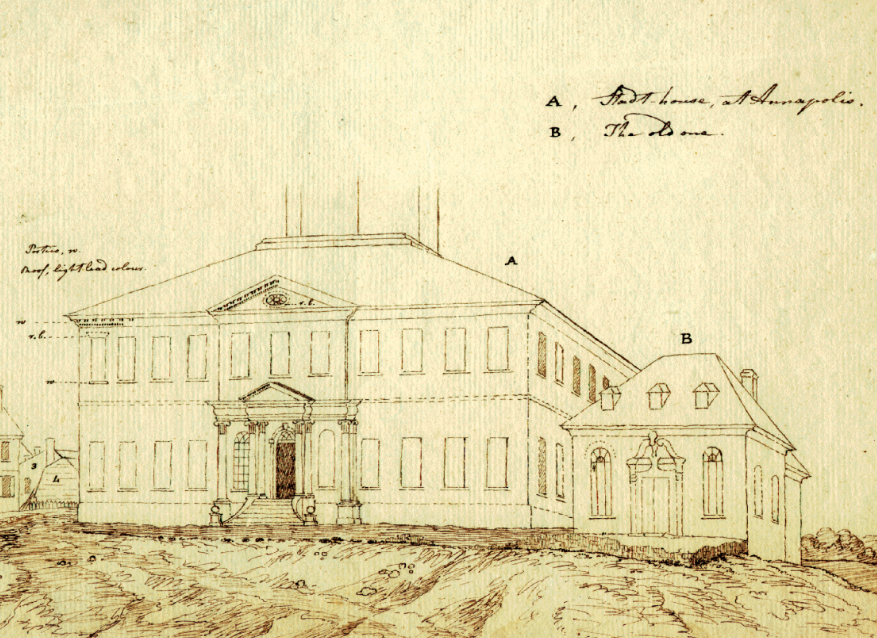
[3]

From its first session in 1777 when under the requirements of the 1776 Constitution at least 8 members needed to be present to conduct business, the Senate functioned according to its journals of proceedings with often as many as 11 members in attendance at any one session.[4]


The Senate met during the shortest days of the year and at one point, in its first year of existence, held its sessions after sunset.[5]  In the old Council chamber, which doubled as the Armory, they met with sufficient lighting from a twelve candle chandelier.[6]


Fortunately the Old State House (referred to by 1777 as the Assembly or the “Old One”) not only had sconces on the walls but at least one, and probably three chandeliers to provide sufficient lighting for the dark days of deliberation.[7]


The Maryland Senate prided itself from its first days of organization on proper procedure and protocol  with its fifteen members  ultimately drawn from the wealthiest citizens indirectly by the ballot of electors, but able to replace itself when duly elected members resigned or declined to serve.


How the Senate organized itself and provided working accommodations for its members beginning in 1777 is not known for certain, apart from following standard parliamentary procedure and having a doorkeeper, a secretary, and  a messenger.  Given the strict sense of order and the formality of public discourse, it is probable that considerable care was given to seating arrangements with every member of the Senate provided with a writing table/desk and chair suitable to his station.[8]


From the first day that the Senate convened, all fifteen members were expected to make their appearance at one time or another.  This was no longer the club of councilors selected by the proprietor to do his bidding as the upper house, but an elected (albeit indirectly elected) body of supposedly wise individuals intended to act as a break on the exuberance of the lower house.   As the Constitution of 1776 intended (to quote  Carl Everstine) “Members of the Senate were to be “men of the most wisdom, experience and virtue.”  [9]


Unfortunately we do not know for certain what those furnishings were like, but we can make a very good guess based upon what may be the only surviving example of that period of the Senate’s history.
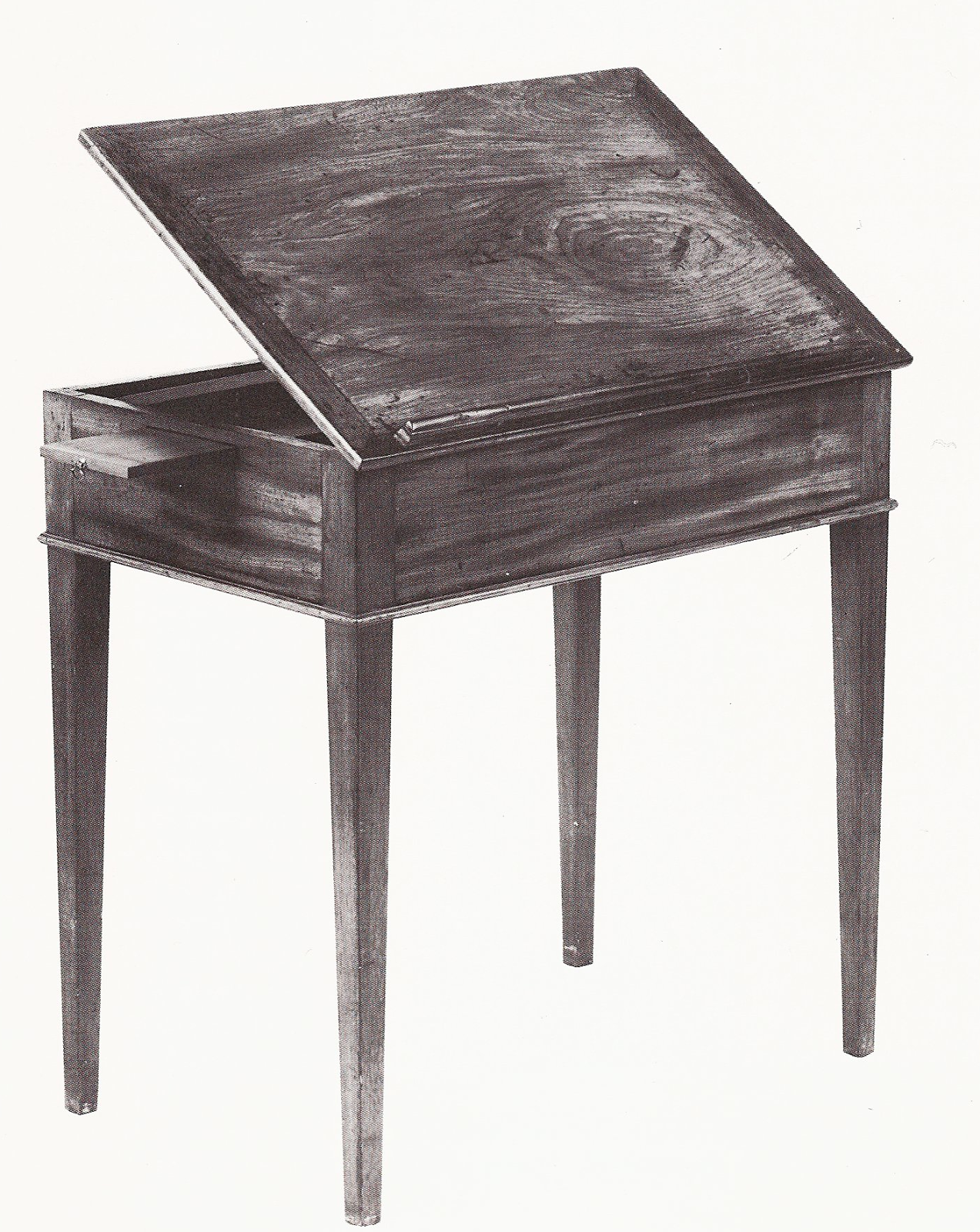


William Voss Elder and Lou Bartlett first identified this desk in 1983 as ca. 1780 by John Shaw or John Shaw and Archibald Chisholm. It would have been the perfect size for a Senator accompanied by a chair that would have been the same or similar to those with which William Paca apparently lent for the use of Congress for additional seating at Washington’s resignation ceremonies on December 23, 1783.[10]  William Paca was a member of that first Maryland Senate in 1777 from the Western Shore.  It is difficult to contemplate that he and his wealthy brethren would sit on or at anything less than a chippendale chair before a finely made, but simple desk with candle slide.


In all likelihood the presiding officer (the Senate President who was chosen from among his peers) did not have a desk but sat on a raised platform just as the Speaker of Parliament was seated.  Before him would have been a double clerks desk, possibly like the one made by Shaw and Chisholm for the Loan Office  or currently owned by the Masons.  Both Richard Ridgely, the first Clerk, and James Maynard, the first messenger would have sat at such a desk, the one taking down the minutes, the other ready to take whatever the secretary or the President (in that case the future Intendant of the Revenue, Daniel of St. Thomas Jenifer)  handed him for delivery to the House of Delegates and the officers of government. [11] 


When the Senate first met in the old Armory in February 1777, one of the first orders of business was to elect the Governor and his council (five members) to whom the furnishings of the old Council would have been allocated.  It is possible that they first convened at the Governor’s Mansion on what is now the Naval Academy grounds and where, by 1783, governor Paca was also holding forth with what the Maryland Journal described as the “Nursery of the Long Robe”.


Annapolis is a nursery of the long robe.  Its lawyers would do honor to any bar in Europe. The Governor [William Paca], who is of this profession, has instituted a society composed of students of the law, who meet at his house at stated periods to discuss law questions and questions in political economy.  He proposes the subject, sits as President and give judgment in conjunction with his council, the Chancellor and the Judges of the General Court.  When the debates are finished the company sup with the the Governor. [12]


By 1779 the Governor and Council had its own room over the Senate Chamber in the new State House, but the table called for in 1728 apparently was no longer extant in the State House, and more likely, remained at Government House to accommodate the “nursery” for discussion and dinner.


In 1779, when the Senate at last was able to move into its new quarters in the nearly finished State House (Stadthouse), it is likely that they took their writing table/desks and chairs with them.  The documentation for how any furnishings were acquired for both the House and the Senate in 1777 is obscured by summary journal entries, but the significant payments to John Shaw in 1777 leave no doubt in those who know the history of that cabinetmaker and cabinet making in Annapolis that he would have had a hand in crafting the furnishings for the Senate and the House.[13]


The story of how Congress came to Annapolis is well known and well documented in http://mdstatehouse.net.  Some recent commentary has attempted to suggest that what they found in the way of accommodations in the State House and how they might have arranged themselves to accept General Washington’s resignation as Commander in Chief was rather spartan, without individual desks for the Congressmen and no lighting from a chandelier during one of the coldest, darkest winters on record.[14]


For protocol for the ceremony and the furnishings on that day it is better not to have  recourse to a ceremony welcoming the representative of a King who needed to be treated with a higher level of respect and attention than a retiring General who was at all times, as he himself acknowledged, subservient to the Civil Authority.  It would be far more sensible to pay closer attention to the Journal of the Congress for December 1783,  and the ceremonial session it held on the eve of their move to Annapolis in May of 1782, in which the members of Congress sat at their “small” tables to celebrate the birth of the Dauphin, all of which is well documented in http://mdstatehouse.net:  


13 May 1782 - Public Audience for the announcement of the birth of the dauphin by a minister of France:
On May 2nd Congress had set Monday, May 13, for an audience to the minister of France for the purpose of reading a letter from the King to Congress announcing the birth of a dauphin, and on May 7 had adopted the ceremony for the occasion.
9 May - Letter from the Secretary of Congress to the Superintendent of Finance: "Sir, It is the desire of Congress that the table before the president and the tables before the Members be covered with green cloth on the day of the public Audience..."
12 May - Seating arrangement of the guests drawn up by Secretary Livingston:
"The Order in which the Guests shall sit at the entertainment given tomorrow by Congress shall be as follows...The president of Congress on a Chair in the center. The Minister of France on his right hand on a Chair; the Members of Congress in equal divisions on each side of him. The president and executive Council of Pennsylvania on the right of Congress, on the left, the Principals of three great executive Departments, (except the Secretary for foreign Affairs, who as Master of the Ceremonies shall sit opposite to the President of Congress). The Secretary of the United States in Congress assembled. The Secretary to the Legislation, shall sit on the left hand of the Secretary for foreign Affairs, and the Counsel of his left. The eldest General Officer on the right of the Secretary for foreign Affairs. The Genl. Officers Treasurer, Comptroller, and the Auditor General, and foreigners of distinction on his right and left without designation of Rank. The remainder of the Company seating themselves without and particular attention to rank. Governor Morris Esq. will do the honors at the Table at one end, Major Jackson at the other, Lewis Morris Esq. at the side of the table which is opposite and the farthest from the President." -- Papers of the Continental Congress, no. 79, vol. II, f. 197.
13 May - The Secretary of Congress, Report. Report contains descriptions of the arrangement of the room and details the protocol of the formal ceremony.
  • House arrangement: "The house was arranged in the following order--The President in a chair on a platform raised two steps from the floor with a large table before him. The members of Congress in chair son the floor to his right and left with small tables before them. The tables were all covered with green cloth...[Referring to the number of delegates present] The whole in a semi-circle...Next to the Members of Congress on the left of the chair stood the principals of the three executive departments namely the Superintendant of finance the Sec'ry at War and the Sec'ry for foreign affairs. The Secretary of the United States in Congress assembled stood on the right of the president on the first step of the platform. At his right on the floor stood the interpreter behind the chairs of the Members. The president and council of the State of Pennsylvania stood within the bar on the right as they entered and facing the president. The rest of the audience stood without the bar.
  • Protocol: "The Minister was conducted into the Congress Hall by the two members who had received him at the foot of the steps of the outward door. As he entered the bar the president and the house rose, the president being covered. The Minister as he advanced to his chair bowed to the president who took off his hat and returned the bow. The Minister being uncovered. The Minister then bowed to the members, on each side of the chair, who were standing uncovered but did not return the bow. The Minister then sat down and put on his Hat. A chair was prepared for him on the floor directly opposite the president and before it a table covered with green cloth. On each side of his chair was placed for the members and the Minister all took their seats at the same time..."[15]


It is my considered opinion based on the probable seating arrangement (with desks/writing tables provided by the Senate (in their possession since 1777-there were 15 Senators) that made for the “prettyest room”  in America) that the desks and chairs remained in the room with the observers above in the balcony and lining each side of the room.[16] The seated congressmen probably were arranged geographically with the states allotted one desk, seats as needed grouped around, lining each side of a central aisle in a room that was said by Charles Willson Peale to be about 45 foot square.  Following the congressional protocol of  voting by state and signing such important documents as the Articles of Confederation in geographical sequence, New Hampshire would have the lead desk to the left of the President, ending with Pennsylvania at their desk on the President’s right.  The desks may have been angled towards the central aisle, but there would have been only two rows with a center aisle.  Such an arrangement coincides with New Jersey Congressman Samuel Dick’s account of his own seating assignment the following summer, although he meant southwest corner and not northwest:


-I have not wrote any thing these two Minutes--my station at this Northwest Window of the Congress Room is not favourable to such a strict adherence to this Important Subject as it Merits. Any Digression you will do me the Justice I am perswaded with your usual Candor to attribute to the great variety of alluring Objects which prevent. That Young Lady with the Crimson [...] and that with the Green, [...] another blast and [...] the colour of her Garters walk this Windy Day on purpose to distract my attention.[17]


As the protocol created by the protocol committee required, Washington would have sat in a chair directly in front of the clerk’s desk flanked by two aides, with the President on the dias (seated) and the Secretary standing at his side.


The two best accounts of the actual ceremony are well known and available off of http:/mdstatehouse.net.  Congressman Tilton’s is the fullest and James McHenry’s (himself a member of the protocol committee and a former Aide to whom Washington gave the manuscript copy of his address now owned by the Maryland State Archives) the most moving.  From them it is clear that Washington arrived at noon and went directly to his chair following the protocol to the letter.  After giving his remarks, handing in his commission, and listening to the rather stilted response from President Mifflin, he retired to the Committee Room until all visitors were cleared, returned to the room, and left for an afternoon meal at South River before heading back to Mount Vernon.


Notes:

1.  See http://www.foundingfathers.info/federalistpapers/fed63.htm, Federalist No. 63: If reason condemns the suspicion, the same sentence is pronounced by experience. The constitution of Maryland furnishes the most apposite example. The Senate of that State is elected, as the federal Senate will be, indirectly by the people, and for a term less by one year only than the federal Senate. It is distinguished, also, by the remarkable prerogative of filling up its own vacancies within the term of its appointment, and, at the same time, is not under the control of any such rotation as is provided for the federal Senate. There are some other lesser distinctions, which would expose the former to colorable objections, that do not lie against the latter. If the federal Senate, therefore, really contained the danger which has been so loudly proclaimed, some symptoms at least of a like danger ought by this time to have been betrayed by the Senate of Maryland, but no such symptoms have appeared. On the contrary, the jealousies at first entertained by men of the same description with those who view with terror the correspondent part of the federal Constitution, have been gradually extinguished by the progress of the experiment; and the Maryland constitution is daily deriving, from the salutary operation of this part of it, a reputation in which it will probably not be rivalled by that of any State in the Union.

2. Thomas Johnson was elected the first Governor of Maryland prior to the completion of the third state house. The General Assembly was still meeting in the second, or "old" state house at the time of Johnson's election. Confirmation of this is evident in the reference to the use of the "conference room" for counting the votes. The official declaration of the first Governor of Maryland took place in the second State House. The first inauguration of the Governor of Maryland took place on the grounds of the State House Hill near the location of the South Portico of the current State House. It  has long been argued that both of the Peale illustrations do not show the "Old Armory" as some have claimed, but rather the second State House with the armory barely visible behind.. Analysis of the first inauguration of Governor Thomas Johnson provides support for this assessment.  See: http://statehouse.msa.maryland.gov/description.cfm?item=7&serno=1,  When the order was given to John Shaw to tear down the Armory in 1796, it is clear that it was formerly the old council chamber that had been given for the use of Anne Arundel County and Annapolis, leaving the Old State House as the Anne Arundel County Courthouse. See: http://statehouse.msa.maryland.gov/description.cfm?item=32&serno=1,
 

4. See the proceedings for 1777.  The comings and goings of the Senators is apparent from the proceedings.  They generally, but not always maintained a working majority as required but the total number rose and fell during the course of the session.  For example see: http://aomol.msa.maryland.gov/megafile/msa/speccol/sc4800/sc4872/003185/html/m3185-0078.html

5. During the war members of the Senate were also members of the Council of Safety and both could not be in session at the same time so the Senate convened between 3 and 5 p.m. at a time when the sun set at 5 p.m. (see: http://aomol.msa.maryland.gov/megafile/msa/speccol/sc4800/sc4872/003185/html/m3185-0016.html).

6. see http://aomol.msa.maryland.gov/megafile/msa/speccol/sc2900/sc2908/000001/000025/html/am25--504.html, cited by Morris Radoff, Buildings of the State of Maryland at Annapolis, 1954, p. 51.  Dr. Radoff confuses the second statehouse with the old Armory.  The Armory was added to the back of the second statehouse and served as the upper house chamber when the Council  to the governor served as the upper house.

7. http://msa.maryland.gov/megafile/msa/speccol/sc5200/sc5287/000006/000000/000021/restricted/mhm_14_v3_rebecca_key.pdf. Note that Dr. Papenfuse has found Rebecca Key’s memories to be accurate in most
details including her story of the ‘re­discovered’ charter of Annapolis which confirmed the palimpsest which
he discovered  and documented.  The old state house was not initially torn down when the Assembly moved
to its new quarters in 1779 and was used as the Arundel County courthouse until the new one was built on
Church Circle.  She is also the eyewitness who relates her father’s incorporation of the two chandeliers into
the ‘Assembly’ or Old State House when they were confiscated from Governor Eden’s storage at the
Governor’s residence on the Naval Academy grounds. 


8.  see the proceedings of the Senate available on http://aomol.net 

9. Carl N. Everstine, The General Assembly of Maryland 1776­1850, 1982, p. 15.

10. William Voss Elder III and Lou Bartlett,  John Shaw Cabinetmaker of Annapolis, Baltimore: Baltimore
Museum of Art, 1983, pp. 66­67, Robert Wilson, “Wye Island,” Lippincott’s Magazine for Popular Literature
and Science,  vol. 19, April 1877, p. 470, and William Voss Elder, III, Maryland Queen Anne and
Chippendale Furniture of the Eighteenth Century, Baltimore: Baltimore Museum of Art, 1968.


11.  http://aomol.msa.maryland.gov/megafile/msa/speccol/sc4800/sc4872/003185/html/m3185­0015.html.

12. see http://msa.maryland.gov/megafile/msa/stagsere/se1/se14/000014/html/ecp10_278.html.  The quote is
from the Maryland Journal and Baltimore Advertiser for Tuesday, September 30, 1783.


13.   8 November [1777] ­ John Shaw paid 254 pounds 11 shillings and 3 pence. One of many such entries.
(GOVERNOR AND COUNCIL (Proceedings) 1777­1779. MSA S 1071­23. Archives of Maryland Volume 16, Page
412.) http://statehouse.msa.maryland.gov/description.cfm?item=7&serno=1


14.  see: FURNISHING THE RESTORED SENATE CHAMBER, [2014] for details.  The report is available on line at mdstatehouse.net, a research web site that I designed and contributed to over my years as Archivist.  As to the weather, it was so cold, dark, and dreary that the supply of windsor chairs ordered for the use of Congress got held up by the ice in the Bay.


15  http://statehouse.msa.maryland.gov/description.cfm?item=2&serno=69.

16. http://msa.maryland.gov/megafile/msa/speccol/sc5200/sc5287/000001/000000/000009/unrestricted/congress_letters_williamson_to_blout_1783.pdf.

17  http://statehouse.msa.maryland.gov/description.cfm?item=12&serno=68.

Tuesday, December 24, 2013

Reflections on the year past and the years to come


Greetings from 206 Oakdale Road:

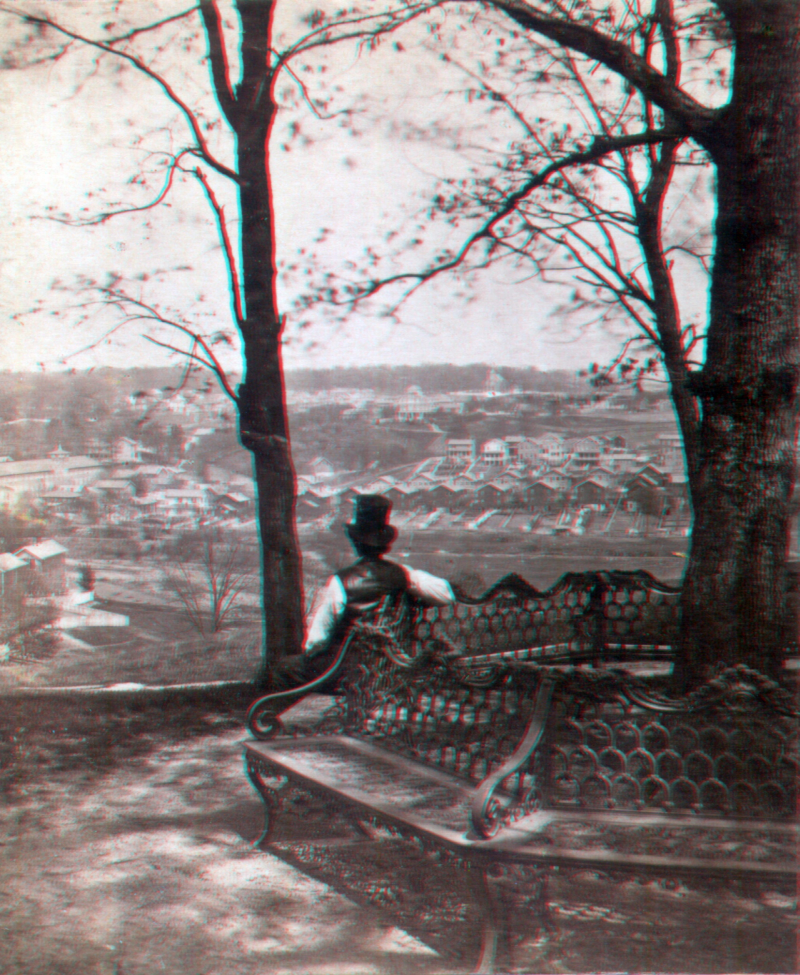
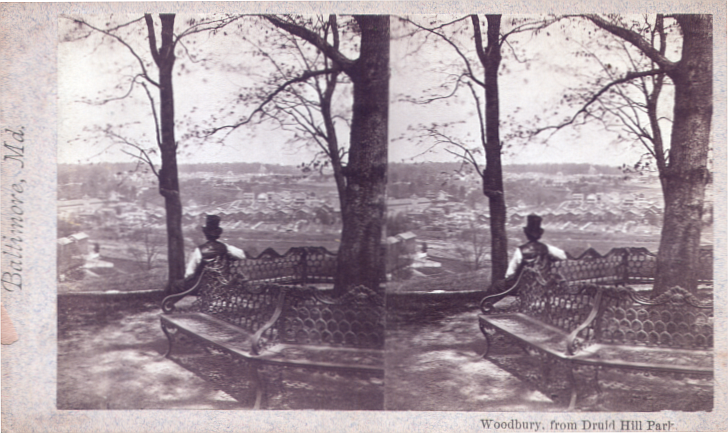
Of all the ‘stuff’ that has accumulated in my study over the past 40 years as an archivist, one of my favorites is this image taken from half of a stereo view of the lost Baltimore neighborhood of Woodberry.  If it seems blurred at first glance it is because I have converted it to a 3D image. It is best viewed with red and cyan (blue) glasses.


Retirement for me began on November 1, like this image without glasses, somewhat out of focus, but filled with reflection.  What the new year will bring is uncertain after 40 years of trying to preserve and make sense out of the surviving public records.  Lately with the glasses on, I have begun to concentrate on how to give dimension to the lost worlds that those records can reveal if I look close enough.  First a book on Baltimore in 1814 and then on to individual lost neighborhoods.  Up to this point my professional life has been devoted to helping others see through the dark glass of the past to better understand ourselves and why we have become what we are.  From here on out, it will be my goal to try to answer, in my own voice, what I think I see from the those records I have devoted my life to preserving and making accessible.  Time will only tell if the results will remain blurred or come sharply into view.


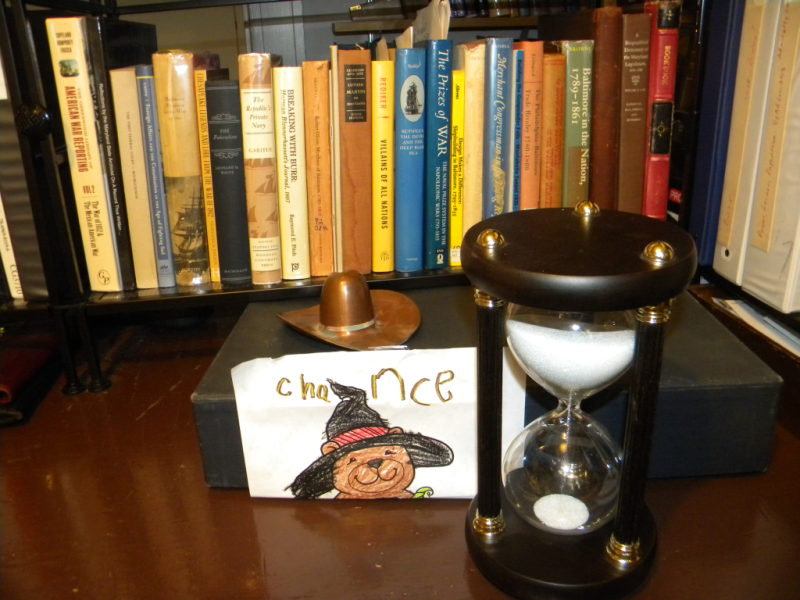
Yesterday our five year old grandson came into the study and saw the hour glass I used to have on my desk in Annapolis.  He turned it to start the sand running. “Pap Pap, when the sand runs out it is time to play with me.”  He then spent the time making a display of my grandfather’s cigar ashtray (a copper cowboy hat with a broad brim), periodically saying to me “look how fast the sand is running out.”  When it did, we went off to play.


The sand has run out on one aspect of my life in which you all played an important part. For all of you who have contributed to making the last 40 years a most enjoyable and challenging journey, I thank you for your support and friendship, and look forward to the next turn of the hour glass during which I hope we will continue to share our reflections on the past, but also take time to play.  I know I will. Sallie, Chauncey, Everett and Clara will see to that.


Happy Holidays!
Ed


Saturday, December 7, 2013

Baltimore's First Responders: The Mechanical Company founded in 1763


In the language of the past “mechanical” meant those small businessmen including storekeepers, shoemakers, tailors, copper smiths and ironmongers who united as the Mechanical Company of Baltimore in 1763 to promote the welfare of their community especially in the fighting of fires and raising militia units to fight the British.  Today that tradition is celebrated by those  who trace their immediate origins to a small group in the 1960s, “the mechanical remnant” who, when facing extinction, "decided to re-invigorate the group on a … limited basis that would insure its perpetuation--that being its only purpose.  They believed that the wisdom of their predecessors in doing this …. would hold if anything would. …”

In that spirit I was invited to reflect on 250 years of the history of the "Ancient and Honorable Mechanical Company" of Baltimore. 


On September 24, 1814, Hezekiah Niles, member of the Mechanical Company of Baltimore since 1800 and a future president (1832) informed the readers of his “Weekly Register”  that he was far too busy the previous two  weeks to meet his usual publication deadline.


Source: http://mdhistory.net/niles_register/nilesweeklyregis07balt.pdf


The defeat of the British at Baltimore in 1814 was a stunning victory for the assembled Citizen Soldiers of the City, of which the members of the Merchant Company were well-represented.  Niles would go on to record the general history of the times, while his newspaper colleague would publish the most famous song ever to come off the Baltimore presses, or any press for that matter, the song that became the “Star Spangled Banner.”  Composed by Francis Scott Key while observing the bombardment of Ft. McHenry as a British detainee, it was delivered to the printer by a friend and set to type, so some would argue, by an apprentice who remained behind to guard the office while everyone else was at the ramparts celebrating the successful repulse of the British.


General Samuel Smith who was in charge of the successful defense of Baltimore in 1814 would, twenty years  later, as Mayor of the City, praise the readiness of the Mechanical Company to be first responders to the defense of Baltimore:


“Indeed, it is [a] matter of notoriety that your Company has, from the first day of the Revolutionary War to the end of the War of 1815 with England, furnished volunteers in every great combat both on land and sea, and notwithstanding many of your members were of the “Society of Friends” there were always men enough to help the cause of liberty.  No matter where, under the most discouraging disadvantages, the boys of the Mechanical were to be found first in the foremost line.”


The ancient and honorable mechanical company of Baltimore, from its creation in 1763 until its evolution into an annual remembrance of the contributions of the company to city government and fire prevention was a civic organization devoted to the protection of the businesses and homes of its members.   It began when the population of the town was a mere 2500 and ended its active involvement in fire protection in 1859 when the population had mushroomed to over 200,000, among whom were 3,000 slaves and over 25,000 free blacks.  In that year the city took over responsibility for fire protection.   From that point forward the Mechanical Company devolved itself of its assets including its fire engines and cash in hand, and carried on the memory of its accomplishments at annual banquets that have continued to the present day. In dispersing its remaining treasury it was fitting that in 1874 the Company donated $1,230 to the Boys Home.   Many of the Boys of the Mechanical that Mayor Smith referred to in 1814 had been apprentices at the businesses of the members and were no doubt drawn from those who had similar backgrounds to the residents of the Boys Home in 1874.


The Mechanical Company was the first civic organization in Baltimore and would count the first six mayors of the city among its members.  It’s primary purpose and one that it adhered to until the City Fire Department took over its services was to provide fire protection.  At times this posed a dilemma as the records of the Company reveal.  When there was a fire involving buildings of members and non members, the rules required that they attend to the member’s property first, a rule that apparently was honored more in the breach than in fact.


From the days of the Revolution until 1829, the firehouse was just around the corner from the Battle Monument  on East Fayette Street and Calvert, under what is today the southwest corner of the Mitchell Court House.  It probably was  no accident that the principal consumers of paper, the printers and publishers of Baltimore’s newspapers, books, broadsides and pamphlets, had their printing establishments nearby as can be seen on the map that depicts their locations in 1814, although it was also no accident that the firehouse was close by the courthouse, ready to protect it in case of fire.


The map is a "screen shot" of an interactive google map file of the Poppleton map of Baltimore (1822;1855) showing the location of newspapers, printers and print shops in 1814.


To provide the best fire protection the Company needed not only plenty of leather buckets and a good water supply, but also a fire engine.  They were the first to have one which they apparently bought of a Dutch ship captain in 1769, although there is no official port record of the ship, referred to as the ‘Dido’ in the first comprehensive history of the Company.  However they came by it, the “Little Dutchman” as it came to be known was so famous by the 1830s that it may have been used to advertise fire insurance in the local newspapers as can be seen in contemporary ads.  The best image of the hand pumped fire engine was used by an insurance company endorsed by the Mechanical Company, but a competitor also used its image in a medal created especially to promote its brand of insurance.  That a volunteer fire department was also represented on the board of directors of a major fire insurance company poses some interesting questions about conflict of interest and "protection money" in more contemporary terms.  As to whether or not the fire engine as depicted was in fact the original "Little Dutchman" is a matter of debate.  It resembles more an English model than one found in a Dutch museum today according to Stephen G. Heaver, director and curator of the Fire Museum of Maryland.  Perhaps we will never know, although a closer look at the detailed records relating to the support of the Mechanical Fire Company contained in the newly cataloged records of the Baltimore City Archives may provide some clues.


When danger other than fire threatened the City, members of the Company also responded with alacrity.   James Cox  proved a fallen hero of the Revolution, killed at the battle of Germantown, while Henry G. McComas, with Daniel Wells,  is remembered as one of the possible sharpshooters who killed British General Ross at the Battle of North Point.  The roster of Cox's  militia unit has survived and includes a number of members of the Mechanical Company (see: Steuart Rieman, History of the Maryland Line ... (1969, p.69) and Henry C. Peden, Revolutionary Patriots of Baltimore .... (2003, p. 303; 321).

Cox's widow did not fare well initially in her efforts to obtain relief because she was making too good a living as a storekeeper:


1779 Cox, Mary, Baltimore. To Gov. Thomas Johnson.
Apr. 15 "The unhappy widow" of Maj. James Cox was left, on the death of her husband at Germantown [Pa.] October 4 with only £50; to maintain her 5 children she applied to the Orphans' Court who granted half pay; all spare furniture had to be sold and part of the stock; to make a living she turned to shopkeeping; now the court says "you are making money fast and we dont think you are intitled to the Benefit of that Law"; expects the governor to "do everything in your Power to alleviate such Dystresses."
A.L.S. 1 p.384XXV, 80 


Not all members of the Company supported the Revolution.  Its First President, Melchior Keener, proved to be a loyalist and left Baltimore for the safety of the British lines.  He did so, however, with the sympathy of his fellow members, including Captain James Cox, who petitioned successfully to the Maryland authorities for Melchior to be permitted to take his possessions with him.  It should also be added that Keener did return and his relatives seem to have remained active in the Company in later years.


Not all businessmen in Baltimore were as patriotic as the majority of the Company.  In the War of 1812, one saddler, George Mackenzie, not a member as far as can be determined, tried to keep Daniel Wells of Wells and McComma’s fame from serving in the militia because he still had time to run on his apprenticeship.  When  Mackenzie sought a writ of habeas corpus to keep Wells out of service and back at work in his shop, the Maryland Gazette reported the Judge’s response:


"The Judge [Theodorick Bland, of the Baltimore County Court] in conclusion observed that ... when, perhaps, the services of every man in the District might be instantly wanted to repel an invasion ... could any reasonable man suppose, that the Legislature intended that judges and Courts of Justice should be employed in uselessly issuing Writs of Habeas Corpus when the enemy might be at our doors?" [MG, 3 Sep. 1813, p. 1].


While much has been  written by George McCreary and Carl Everstine about the history of the Mechanical Company,  there has been little written about its brave efforts to put out fires apart from the increasing rivalry among the volunteer fire departments that led to a robust competition in which some companies (particularly the Patapsco Fire Company) were accused of setting fires and sabotaging their competitor’s equipment.  By 1835 there were fifteen  volunteer fire companies in the City as evidenced in the advertisement for fire insurance that appeared in the March 1834 issue of the Baltimore Gazette.  Note who represented the Mechanical Fire Company on the board.


The Mechanical Company apparently was never faulted for such unseemly behavior as setting fires in order to put them out or to contribute to a mob brawl, although it did have one black sheep member who proved to be a possible arsonist and robber of the post office.  He was one of those orphan boys taken in as apprentices by the members of the Company. His sponsor was William Gwynn, one of the newspaper publishers in town in 1814, and a well-known  Baltimore lawyer whose portrait hangs in the Mitchell Courthouse.  It is not clear whether or not William Gwynn was related to, or adopted by William Gwynn, but when William Gwynn retired in 1834 from publishing,  he sold the business to William Gwynn Jones who in May of 1835 was caught robbing the post office.   

1835 was a year of great tension in the City.   Baltimore lived up to its reputation as 'Mob Town gained in 1807 when a mob attacked Luther Martin's house in search of the disgraced Vice President of the United States, Aaron Burr.  Hezekiah Niles expressed his concern in the "Register" on September 5, 1835:

During the last and present week we have cut out and laid aside more than 500 articles relating to the various excitements now acting on the people of the United States, public and private!  Society seems everywhere unhinged, and the demon of blood and slaughter has been let loose upon us! ... We have executions and murders and riots to the utmost limits of the Union! The character of our countrymen seems suddenly changed, and thousands interpret the law in their own way --sometimes in one case, and then in another, guided apparently only by their own will!

The Banks were having a difficult time after a speculative romp that ended as another did recently with a dramatic downturn in the economy.  The citizens of Baltimore were not happy.  The mayor resigned because of the rioting and General Sam Smith at the age of 83 was called back to be the mayor.  He restored order, but in the meantime, William Gwynn Jones a member of the Company since 1822, and one of the Company's director's of the Baltimore Fire Insurance Company robbed the post office and may have set fire to the Atheneum.  Edgar Allan Poe writes about the robbery in a letter to Mr. T. W. White:

I duly recd, through Mr Kennedy your favour of the loth enclosing $5: and an order for $4.94. I assure you it was very welcome. Miscarriages of double letters are by no means unfrequent just now, but yours, at least, came safely to hand. Had I reflected a moment I should have acknowledged the rect before. I suppose you have heard about Wm Gwynn Jones of this place, late Editor of the Gazette. He was detected in purloining letters from the Office to which the Clerks were in the habit of admitting him familiarly. He acknowledged the theft of more than $2000 in this way at different times. He probably took even more than that, and I am quite sure that on the part of the Clerks themselves advantage was taken of his arrest to embezzle double that sum. I have been a loser myself to a small amount.


William Gwynn resumed publication of the Gazette for a few more years and Jones went to prison, ultimately to be pardoned by President Van Buren.
http://msa.maryland.gov/megafile/msa/speccol/sc3500/sc3520/014300/014366/html/14366images.html
William Gwynn, Baltimore Courthouse Collection


Perhaps the most famous printer/publisher to be a member of the Mechanical Company was Hezekiah Niles whose Weekly Register is a gold mine of reporting for historians for the era of its publication which ran from 1811 until the 1840s.  

http://john-adcock.blogspot.com/2013/07/the-war-of-1812-and-its-publications_21.html 

Niles does not say much about the Mechanical Society in the Register, although at one point he is called upon to defend a check drawn upon one of the banks that was at the center of the 1835 bank riots.  His defense was a noble one.  He explained that it was a check sent to Louisville on behalf of the Mechanical Society in support of the victims of a disastrous fire there.   The reach of the Company was not just to the citizens of Baltimore in putting out fires, but also helping residents of other cities in their time of need.


As to their role as first responders, until recently it was not possible to easily access the accounts of those who were lost in fighting fires in the city.  With the efforts of the American Antiquarian Society, the Maryland State Archives, and now the Library of Congress, slowly but surely the images of all newspapers published in America are making their way on line.  The indexes provided by the American Antiquarian Society through Genealogybank.com and the recent efforts of the Maryland State Archives with regard to newspapers in its collections, allow a better window into the fallen heroes of fire fighting in Baltimore, one that can be come increasingly better with donations from the public and organizations that realize the value of retaining the memories of the past.


One such example is the fate of Stewart  Downs of the Mechanical Fire Company.  In February 1835 fire broke out in the stables at the rear of the Western Hotel at the corner of Howard and Saratoga Streets.  Arson was suspected. “The building was destroyed, but the horses, carriages,  which it contained were all removed in time to save them. … We regret to state that  four members  of fire companies, Wm. Macklin, Wm McNelly, Michael Morran, and Stewart Downs, were killed by the falling of the walls of the stable, that John Thomas had his leg fractured, and several others severely injured from the same cause.  Mr. Downs has left a wife and five children to deplore his untimely end.”


The Mechanical Fire Company called a special meeting the day following the fire  “to adopt such measures as may be thought expedient in relation to the unfortunate death of several of their brother firemen, at the fire last evening.”


It is to such fallen heroes that we need to pay constant and perpetual tribute at occasions such as this and in the teaching of our children. The newspapers are a fragile source of what we can know of those falle heroes and first responders Let us hope that the preservation scanning effort to save them and index them continue to funded before they crumble to dust and the memories they print are lost.  For example of the newspapers in print in Baltimore in 1814 as depicted above on the map along with the location of the Mechanical Company's firehouse, only two are fully on line for that year, and only one freely accessible and thoroughly indexed by the Maryland State Archives.  It costs about $1 a page to move an original newspaper to images on line, an another $1 to index it.  The  annual cost of sustaining the newspaper images and index on line runs to about $.10 a page.  This is an investment well worth it, but it can only happen with private support to such non-profit groups as the Friends of the Maryland State Archives.


Congratulations are in order to the Ancient and Honorable Mechanical Company for keeping the memory of the accomplishments of the Company alive.  It is only with the engagement


In June of 1793, Adam Fonerden, President of the Mechanical Company in 1773, and at the time president of a much  larger civic organization calling itself the “Mechanical Society” addressed President Washington on behalf of the Society.  In contemporary terms it was  written to support a policy of neutrality and expressed an abhorrence of war, but it was also a powerful statement of republican ideals to which Washington replied accordingly.  Both GW’s reply and the Mechanical Society’s address appeared in the 18 June issue of The Maryland Journal and Baltimore Advertiser.

On behalf of the Society, Fonerdon wrote:


Sir,

...


Our Country lately experienced all the miseries of a desolating and cruel War but by the interposition of a kind Providence, the Americans were enabled under your wise direction, and patriotic exertions during their arduous struggle, to secure the invaluable blessings they now enjoy. Being thus exalted to the possession of Civil and Religious Liberty, and enjoying the benefits of a free and equal Government: we cannot divest ourselves of sympathy for all, who struggle for the same blessings. ....

Adam Fonerden. President of the Society3
Attest Charles Peale Polk Secty


Washington replied on June 11:

The language of your Address shews that you have rightly estimated the purposes for which our general Government was established. And so evident are the benefits resulting to the industrious Citizens of every description throughout the United States from the operation of equal Laws, & from the security & tranquility with which they have pursued, their various avocations, under a Government of their own choice, that it becomes the duty of those who are entrusted with the management of their public affairs, to endeavour, by all proper means, to continue and promote those invaluable blessings: And that the happiness & true interests of a people are best secured by observing such a line of conduct as will, while they discharge their political obligations, preserve to their Country peace with other Nations and cultivate the good will of mankind towards them. ...If the Citizens of the United States have obtained the character of an enlightened and liberal people, they will prove that they deserve it, by shewing themselves the true friends of mankind & making their Country not only an asylum for the oppressed of every Nation, but a desirable residence for the virtuous & industrious of every Country”


footnotes to the Washington Correspondence::


The Mechanical Society, later known as the Mechanical Fire Company, was organized in 1763 and was the first fire company established in Baltimore. Incorporated by the state assembly in 1828, it continued its fire-fighting operations until 1859, when a paid fire department assumed its duties. The company, however, continued to meet as a social and civic organization until 1873, when it surrendered its charter (Scharf, History of Baltimore City and County, 1:244–45; see also McCreary, Mechanical Company).
...
2. GW’s reply of c.11 June reads: “The language of your Address shews that you have rightly estimated the purposes for which our general Government was established. And so evident are the benefits resulting to the industrious Citizens of every description throughout the United States from the operation of equal Laws, & from the security & tranquility with which they have pursued, their various avocations, under a Government of their own choice, that it becomes the duty of those who are entrusted with the management of their public affairs, to endeavour, by all proper means, to continue and promote those invaluable blessings: And that the happiness & true interests of a people are best secured by observing such a line of conduct as will, while they discharge their political obligations, preserve to their Country peace with other Nations, & cultivate the good will of mankind towards them, I trust no one will deny. If the Citizens of the United States have obtained the character of an enlightened & liberal people, they will prove that they deserve it, by shewing themselves the true friends of mankind & making their Country not only an asylum for the oppressed of every Nation, but a desirable residence for the virtuous & industrious of every Country” (LB, DLC:GW). Both GW’s reply and the Mechanical Society’s address appeared in the 18 June issue of The Maryland Journal and Baltimore Advertiser.
3. Adam Fonerden joined the Baltimore Mechanical Society in 1768 (McCreary, Mechanical Company, 122). In 1796, he was the owner of a shoe store at 54 Baltimore Street, and he remained at this address until at least 1800, when he was also the proprietor of a wool and cotton card manufactory. He represented the fifth ward on the City Council, 1797–1801 (Baltimore Directory, 1796, 27; Baltimore Directory, 1800–1801, 4, 39; Scharf, History of Baltimore City and County, 1:187). The federal census of 1790 lists Fonerden as the head of a household consisting of 3 white males over 16, 3 white males under 16, and 7 females (Heads of Families [Maryland], 17).