In
the Shadows
Louisa
Catherine Johnson Adams
(1775-1852)
A
Marylander born in London, educated abroad, and
the
first foreign born First
Lady
Reflections
by
Dr.
Edward C. Papenfuse, Maryland State Archivist, retired
Louisa
Catherine Johnson lived always in the shadow of others suffering one
personal misfortune after another (including perhaps 8 miscarriages and
the alcoholism that killed her two eldest sons). It was no wonder that
she sought attention through an array of illnesses that plagued her
throughout her adult life. First it was her parents and her sisters,
then her husband and his mother, and finally that other first lady, her
neighbor in Washington, D. C., Dolley Madison who lived with her
relations, the Cutts. Even after Dolley’s death in 1849, three years
before her own, Louisa continued an association with the Cutts, so much
so, that when Louisa died in 1852, a significant ‘trove’ of her
manuscripts disappeared into the Cutts family attic, inaccessible to
scholars and to even Louisa’s son Charles and her grandson Henry, both
of whom would write short biographical sketches of Louisa without them.
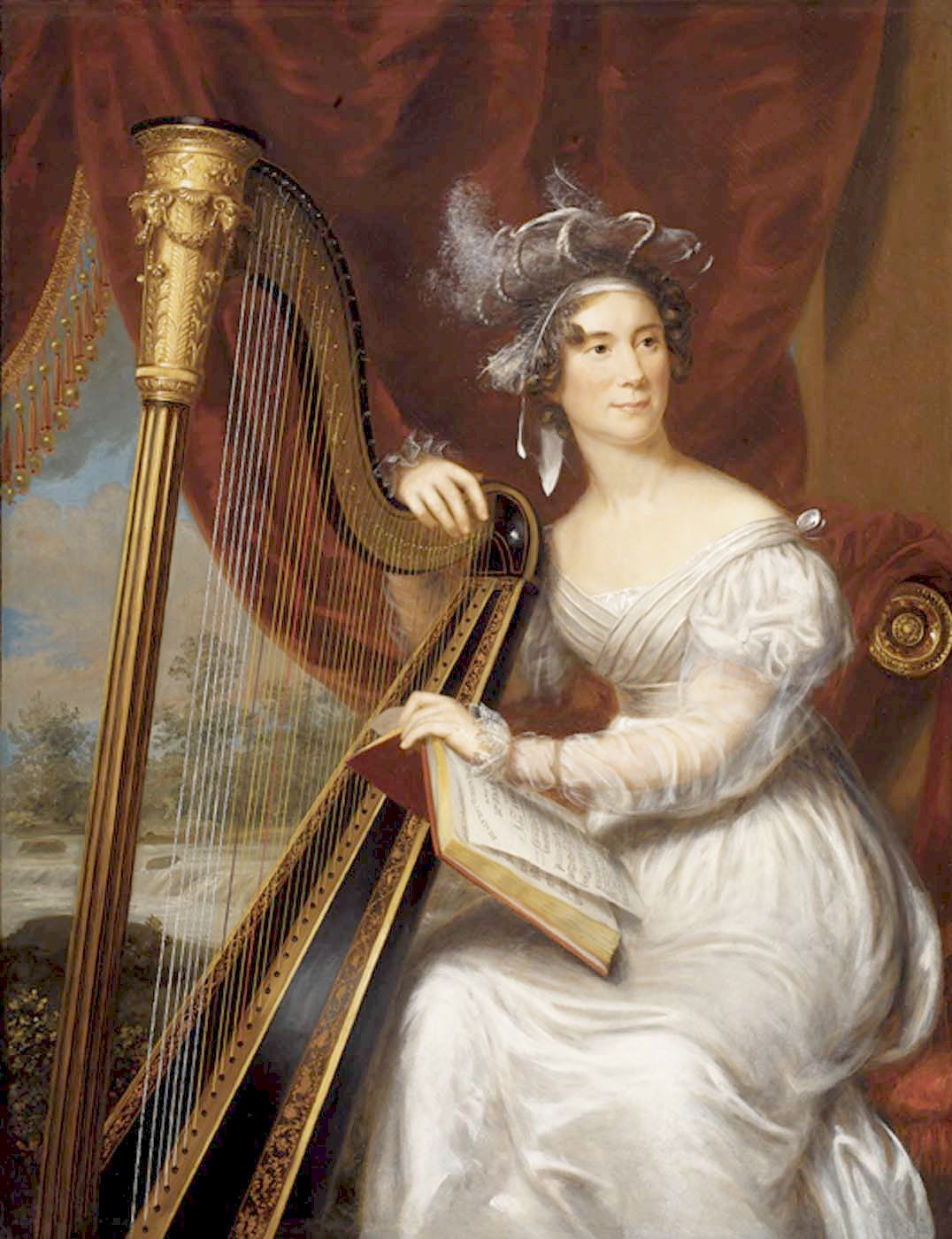
1826,
by Charles Bird King
Still,
she was talented. She read and spoke fluent French, an invaluable asset
for a diplomat husband. She was an accomplished harpist and had her
first lady portrait painted with harp, and a book of music open to
“Hail to the Chief” which her husband first used as President and has
been used by every president since. She wrote a poem on her
Father-in-law’s death that was published anonymously, and a perceptive
play about the political world of her husband’s presidency. She wrote a
great deal for herself and her children (of four, only Charles Francis
Adams would survive her), including unpublished biographical notices of
herself which she began in her forties on her return permanently to the
United States as the wife of the Secretary of State in the James Monroe
administration. The first sketch she began in the White House in the
heat of a particularly depressing July day in 1825 and entitled it
simply “Record of a Life.” The style is simple, self deprecating, and
frequently caustic in content.
I
have no pretensions to be a writer and no desire to appear any thing
more than a mere commonplace personage with a good memory and just
observation enough to discover the difference between a man of sense
and a Fool, and to know that the latter do the least mischief of the
two.
She
only got as far as John Quincy’s assignment at the Prussian court
(1797-1801) which ends with him telling her of his first true love,
Mary Frazier. She makes no mention of the birth of her son George in
April 1801, just prior to her first journey to America, nor of the four
prior miscarriages.
There
are diaries, primarily covering the years October 1812-to 1815, and
again 1819 to 1849, and a considerable body of correspondence, some of
which did not surface until recently when it was first used by Paul C.
Nagel and then given to the Massachusetts Historical Society.
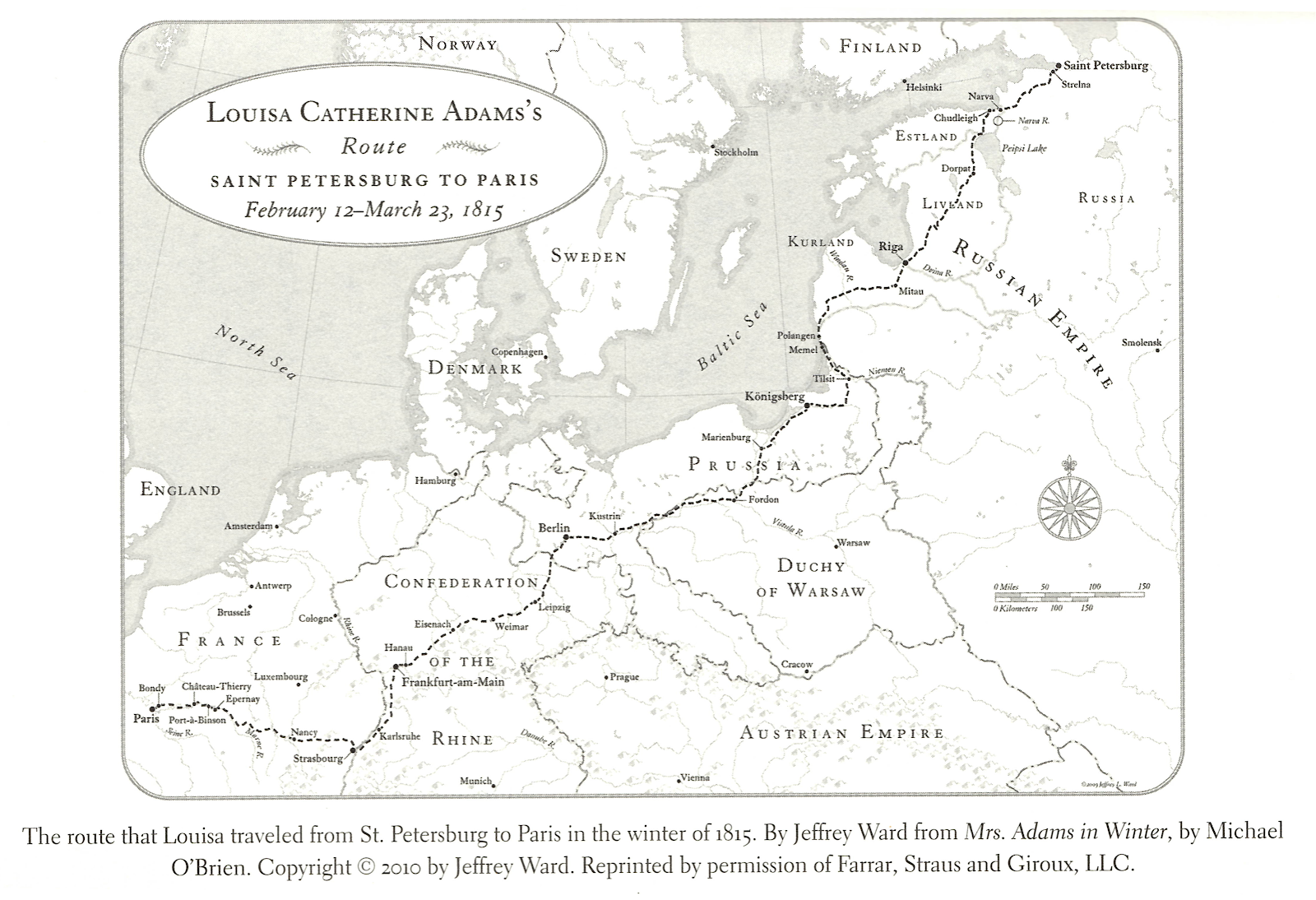
The
diaries fail to detail her one great adventure, the journey she and her
seven year old son Charles took on their own in February and March
1815, from St. Petersburg, Russia, to Paris, some 2,000 miles,
accompanied by servants whose reliability was questionable, and several
necessary passports to enable her to cross borders. She would write her
memories down in 1836 in a harrowing account of her adventure.
It
has often been a matter of regret to me that I kept no journal of my
travels from St. Petersburg, to paris --and having little to occupy my
mind or attention, I will even at this late period endeavour to sketch
some of its incidents; merely by way of amusement, to fill up an hour
which might be less profitably employed--It may perhaps at some future
day serve to recall the memory of one, who was -and show that many
undertakings which appear very difficult and arduous to my Sex, are by
no means so trying as imagination forever depicts them--And that energy
and discretion, follow the necessity of their exertion, to protect the
fancied weakness of feminine imbecility...
In
2010, Michael O’brien published a study of Louisa’s journey that
corrected her memories and supplemented it with her letters placing it
all in the context of the times. As Catherine Allgor observed on the
dust jacket of Michael O’brien’s book, Mrs. Adams in Winter, a Journey
in the Last Days of Napoleon.:
Louisa
Catherine Adams, a woman who spent her life in voyages both literal and
metaphorical, above all longed to leave her mark on the landscape of
the life she passed through. The noted historian Michael O’Brien gives
Louisa her voice, assuring her place in history as a woman ‘who was,’
as she put it. Take these twin journeys, rendered with precision and
grace by a master --across the dramatic frozen landscape of Napoleon’s
Europe,
and deep within the mind and heart of one of the most compelling
characters in American History.
Louisa
picks up her autobiographical pen again in 1840, after her husband’s
return to Congress. She copies the “Record” and begins anew in journal
and letter form what she calls “Adventures of a Nobody.” This time she
got as far as her life in St. Petersburg where her only daughter was
born and died at the age of 13 months. The “Adventures” end with a
diary like entry which concludes with “my child has gone to heaven”
dated September 12 [15], 1812.
The
correspondence of the St. Petersburg sojourn clearly shows that she was
in many ways the eyes, ears, and social grace of the Adams’s,
befriending the Czar and the ladies of the nobility, sending perceptive
reports to husband when he left to negotiate peace between Great
Britain and the United States. In her paper concerning a treason trial
that followed the burning of Washington in 1814, a University of
Maryland Law school student, Jennifer Smith, discovered Louisa
reporting and assessing the state of affairs on the banks of the
Potomac from her perch in St. Petersburg.
The
fear that the government was not doing enough to ensure treasonous
“opposition . . . [was] hushed” [Jennifer Smith writes] reached across
the Atlantic Ocean to Louisa Catherine Johnson Adams in St. Petersburg
Russia, who wrote to John Quincy Adams in November 1814:
“The
defects of our Constitution are certainly now completely brought to
light and a Government which is too feeble to check the treason which
is formed in the very heart of the people it affects to rule must sink
the very conviction that the Laws cannot reach them gives a boldness,
energy and strength to factions which must render them successful . . .
“
In
this she echoed her father-in-law during his administration, and
expressed her fear that factions such as witnessed in the New England
press that opposed the war to the point of disunion, would prevail.
The
Massachusetts Historical Society and the Adams Papers have published
all of Louisa’s autobiographical writings and her diaries in two well
indexed, excellent volumes that clearly demonstrate her ability to
express herself well, often in an entertaining style, but within a dark
shadow of frequent depression, illness, and self-recrimination.
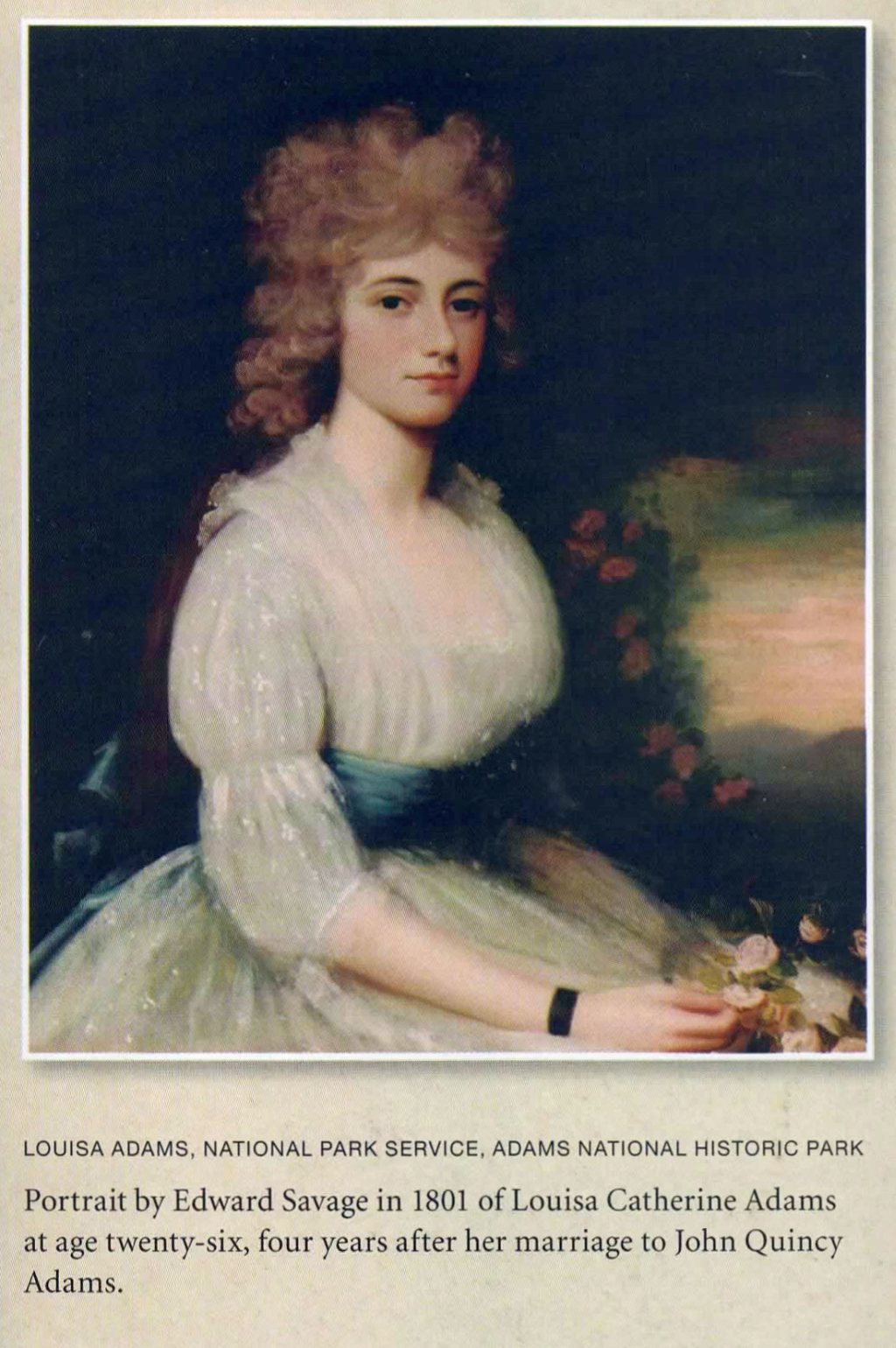
So
who was Louisa Catherine Adams at the age of 26, seen in this 1801
portrait by Edward Savage? What can we know about her in her own right
and the influence she had on others including her husband, her family,
and on the role of First Lady of the nation.
I
first learned of Louisa Catherine when I wrote about the business
career of her father who was born in Calvert County Maryland and who
participated in the aggressive and entrepreneurial efforts by the
Annapolis merchant firm of which he was a member, to break the hold of
the London and Scottish merchants on the importing of finished goods
and the exporting of Maryland tobacco. So successful did they prove to
be before the Revolution that the wealthiest of the Maryland planters
consigned their tobacco to Wallace, Davidson, and Johnson, including
Charles Carroll of Carrollton, who even consigned two of his young
children to her father’s care on route to their boarding schools in
Liege, in what is now Belgium. Because her father left the firm under a
financial cloud, and spent the remainder of his life (he died in 1802)
fighting in the courts with his former partners, my focus remained with
the fate of the Annapolis partners. My study did not include what
happened to his family beyond the fact that his daughter Louisa
Catherine married a future President in 1797, just before the rest of
the family’s precipitous departure from London, fleeing from Joshua’s
creditors.
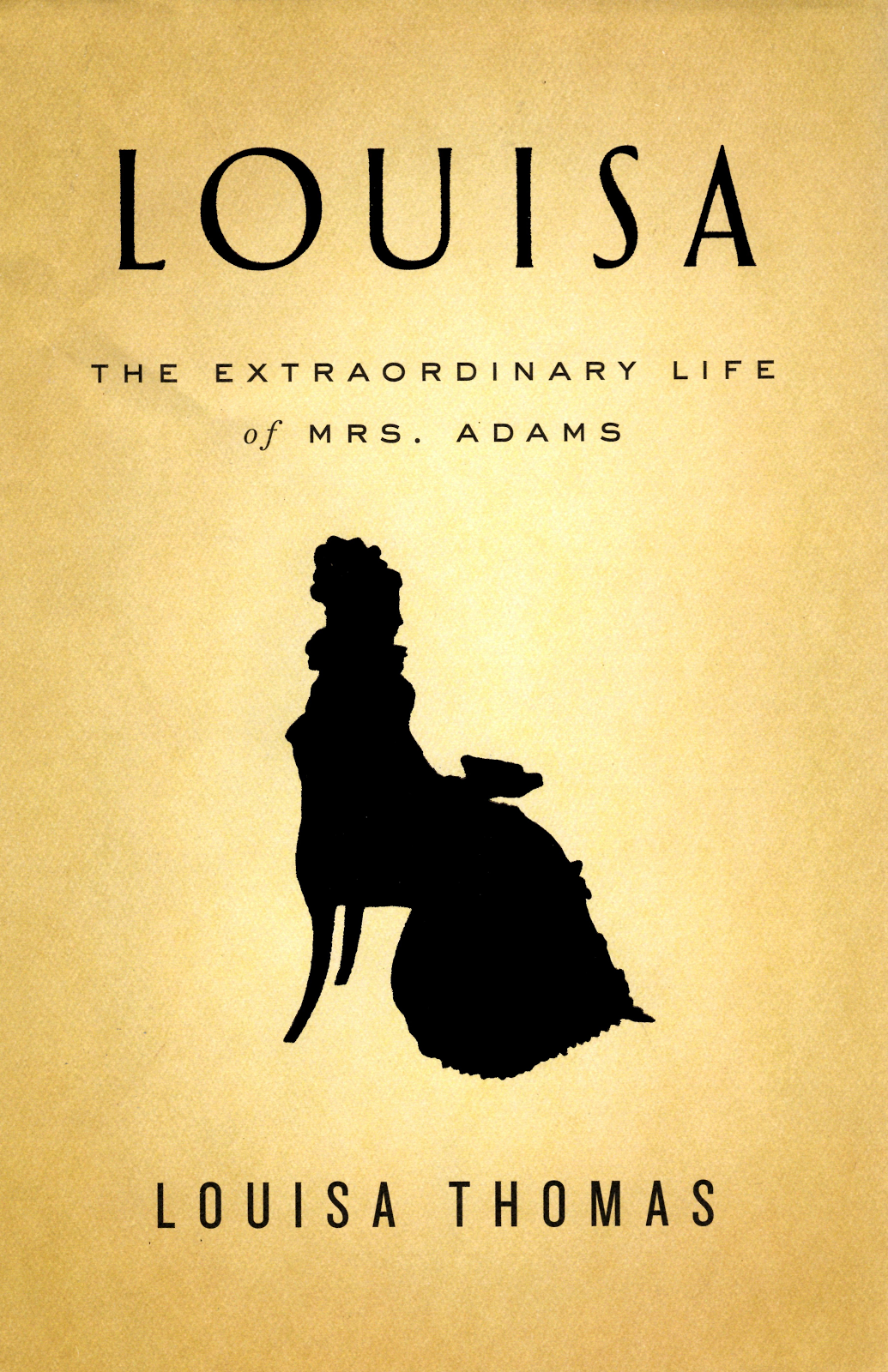
By
far the best modern biography of Louisa is by Louisa Thomas,
granddaughter of the perennial socialist candidate for President,
Norman Thomas. It is sensitive, extensive and thought provoking. She
successfully enters the shadowland of Louisa’s mind utilizing all the
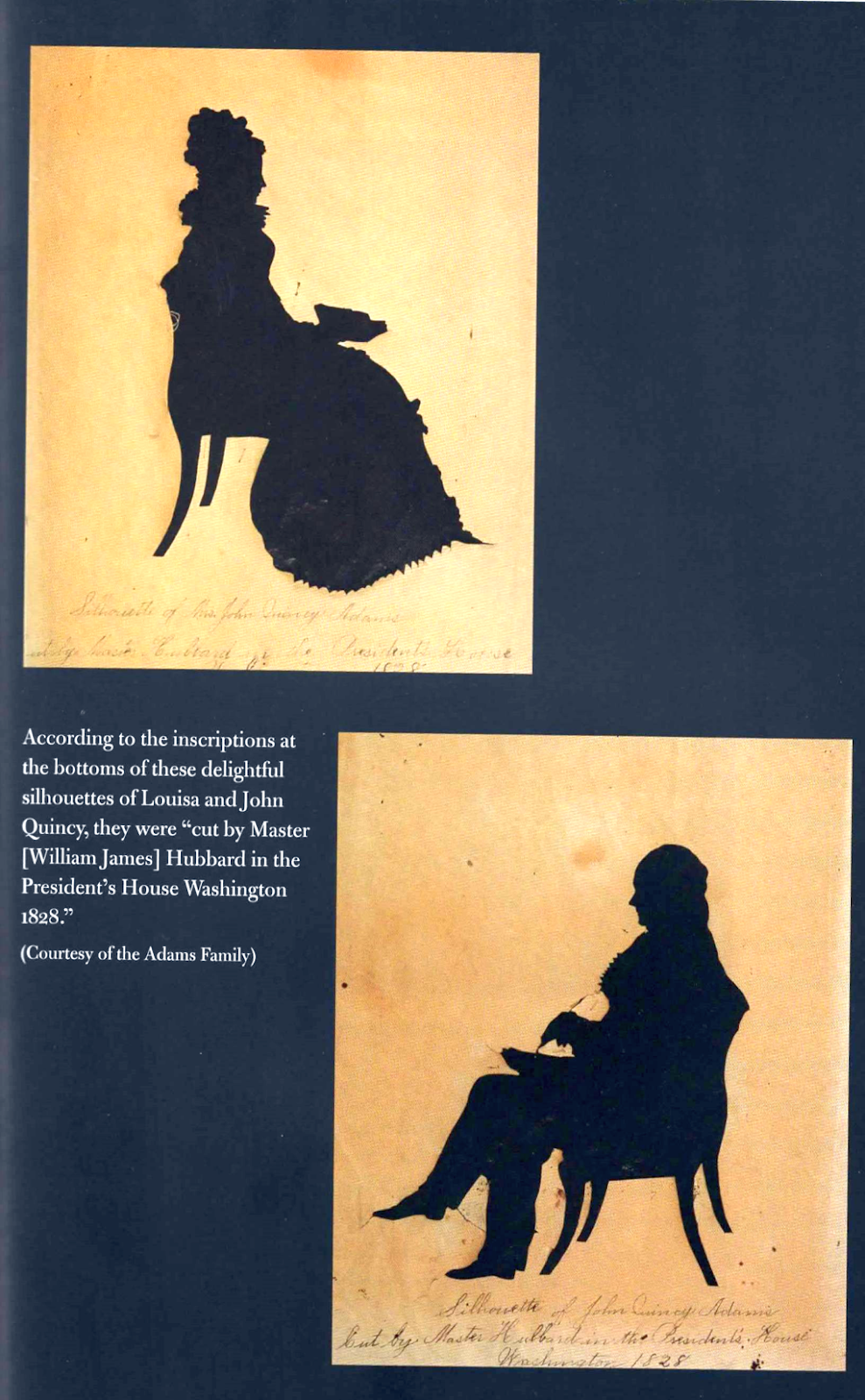
available evidence with great narrative skill. Louisa Thomas chose to
include only one image in her book, a silhouette that was cut in 1828
when she was first lady, symbolic of the need to see past the surviving
images of Louisa Catherine to the soul of her subject.
Joan
Challinor and Louisa Thomas were the first to clearly demonstrate that
Louisa Catherine was, in the eyes of the Anglican Church, and perhaps
her own, illegitimate. Her parents did not marry in the Anglican Church
until ten years after she was born. Under Maryland law, which governed
her father, he and Catherine Newth were eventually ‘married’ by common
law by 1780 (seven years), but not before Louisa Catherine, their third
child, was born in 1775. Yet, she and all of her sisters and her
brother were baptised in the Anglican church. How that was accomplished
without their parents being married in the church is still a mystery,
although the rules were probably administered loosely in light of her
father’s prominence in the American merchant community. Nevertheless it
was likely one of the dark secrets or at least troubling questions that
plagued Louisa throughout her life, along with the belief that her
father pawned her off just before his total financial collapse, to John
Quincy Adams in 1797, without every paying the promised £5,000 pound
sterling dowry.
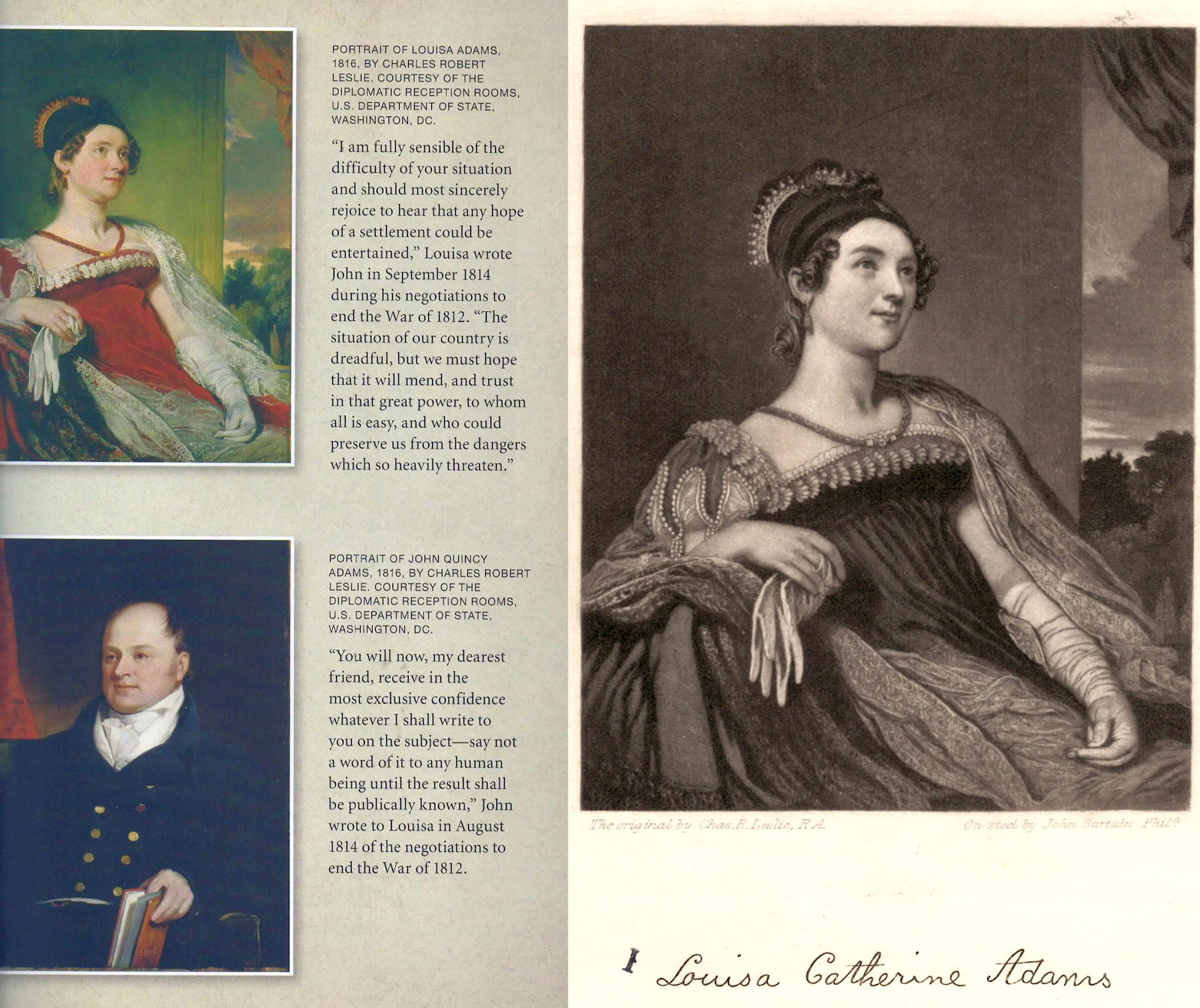
We
are best and most favorably remembered, I suspect, by our grandchildren
who are, perhaps, more forgiving of our foibles and shortcomings.
Louisa’s only surviving son, Charles Francis Adams, did write glowingly
of her diplomatic and entertaining abilities in an 1839 article
accompanying a softened and more youthful engraved rendition of the
portrait painted in 1816 when she was the wife of the American Minister
to Great Britain. Undoubtedly Louisa Catherine approved of both the
sentiment and the choice of portraits.
But
it was her grandson, the eminent historian Henry Adams, who wrote the
more realistic yet sympathetic biographical sketch of his grandmother,
someone he clearly felt suffered from the same educational shortcomings
he did, a point made well by Joan Challinor in her essay entitled “The
Mis-Education of Louisa Catherine Adams” published in 1986. His
memories were of “the Madam” an elderly woman, about whom he knew only
a little of her earlier life: In it Henry also assessed the educational
shortcomings that the first ten years of his father’s life spent abroad
had on his adjustment to American life, although he was able, unlike
Louisa Catherine and Henry to overcome them.
The Madam was a little more remote than the President, [Henry Adams
wrote in the Education of Henry Adams], but [the madam was] more
decorative.
She stayed much in her own room with the Dutch tiles,
looking
out on her garden with the box walks, and seemed a
fragile
creature to a boy who sometimes brought her a note or a
message,
and took distinct pleasure in looking at her delicate
face
under what seemed to him very becoming caps. He liked her
refined
figure ; her gentle voice and manner; her vague effect of
not
belonging there, but to Washington or to Europe, like her
furniture,
and writing-desk with little glass doors above and
little
eighteenth-century volumes in old binding, labelled
"Peregrine
Pickle" or "Tom Jones" or "Hannah More." Try as she
might,
the Madam could never be Bostonian, and it was her cross
in
life, but to the boy it was her charm. Even at that age, he
felt
drawn to it. The Madam's life had been in truth far from
Boston.
She was born in London in 1775, daughter of Joshua
Johnson,
an American merchant, brother of Governor Thomas Johnson
of
Maryland; and Catherine Nuth, of an English family in London.
Driven
from England by the Revolutionary War, Joshua Johnson took
his
family to Nantes, where they remained till the peace. The
girl
Louisa Catherine was nearly ten years old when brought back
to
London, and her sense of nationality must have been confused;
but
the influence of the Johnsons and the services of Joshua
obtained
for him from President Washington the appointment of
Consul
in London on the organization of the Government in 1790.
In
1794 President Washington appointed John Quincy Adams Minister
to
The Hague. He was twenty-seven years old when he returned to
London,
and found the Consul's house a very agreeable haunt.
Louisa
was then twenty.
At that time, and long afterwards, the Consul's house, far more
than
the Minister's, was the centre of contact for travelling
Americans,
either official or other. The Legation was a shifting
point,
between 1785 and 1815; but the Consulate, far down in the
City,
near the Tower, was convenient and inviting; so inviting
that
it proved fatal to young Adams. Louisa was charming, like a
Romney
portrait, but among her many charms that of being a New
England
woman was not one. The defect was serious. Her future
mother-in-law,
Abigail, a famous New England woman whose
authority
over her turbulent husband, the second President, was
hardly
so great as that which she exercised over her son, the
sixth
to be, was troubled by the fear that Louisa might not be
made
of stuff stern enough, or brought up in conditions severe
enough,
to suit a New England climate, or to make an efficient
wife
for her paragon son, and Abigail was right on that point, as
on
most others where sound judgment was involved; but sound
judgment
is sometimes a source of weakness rather than of force,
and
John Quincy already had reason to think that his mother held
sound
judgments on the subject of daughters-in-law which human
nature,
since the fall of Eve, made Adams helpless to realize.
Being
three thousand miles away from his mother, and equally far
in
love, he married Louisa in London, July 26, 1797, and took her
to
Berlin to be the head of the United States Legation. During
three
or four exciting years, the young bride lived in Berlin;
whether
she was happy or not, whether she was content or not,
whether
she was socially successful or not, her descendants did
not
surely know; but in any case she could by no chance have
become
educated there for a life in Quincy or Boston. In 1801 the
overthrow
of the Federalist Party drove her and her husband to
America,
and she became at last a member of the Quincy household,
but
by that time her children needed all her attention, and she
remained
there with occasional winters in Boston and Washington,
till
1809. Her husband was made Senator in 1803, and in 1809 was
appointed
Minister to Russia. She went with him to St.
Petersburg,
taking her baby, Charles Francis, born in 1807; but
broken-hearted
at having to leave her two older boys behind. The
life
at St. Petersburg was hardly gay for her; they were far too
poor
to shine in that extravagant society; but she survived it,
though
her little girl baby did not, and in the winter of
1814-15,
alone with the boy of seven years old, crossed Europe
from
St. Petersburg to Paris, in her travelling-carriage, passing
through
the armies, and reaching Paris in the Cent Jours after
Napoleon's
return from Elba. Her husband next went to England as
Minister,
and she was for two years at the Court of the Regent.
In
1817 her husband came home to be Secretary of State, and she
lived
for eight years in F Street, doing her work of entertainer
for
President Monroe's administration. Next she lived four
miserable
years in the White House. When that chapter was closed
in
1829, she had earned the right to be tired and delicate, but
she
still had fifteen years to serve as wife of a Member of the
House,
after her husband went back to Congress in 1833. Then it
was
that the little Henry, her grandson, first remembered her,
from
1843 to 1848, sitting in her panelled room, at breakfast,
with
her heavy silver teapot and sugar-bowl and cream-jug, which
still
exist somewhere as an heirloom of the modern safety-vault.
By
that time she was seventy years old or more, and thoroughly
weary
of being beaten about a stormy world. To the boy she seemed
singularly
peaceful, a vision of silver gray, presiding over her
old
President and her Queen Anne mahogany; an exotic, like her
Sevres
china; an object of deference to every one, and of great
affection
to her son Charles; but hardly more Bostonian than she
had
been fifty years before, on her wedding-day, in the shadow of
the
Tower of London.
Such a figure was even less fitted than that of her old
husband,
the President, to impress on a boy's mind, the standards
of
the coming century. She was Louis Seize, like the furniture.
The
boy knew nothing of her interior life, which had been, as the
venerable
Abigail, long since at peace, foresaw, one of severe
stress
and little pure satisfaction. He never dreamed that from
her
might come some of those doubts and self-questionings, those
hesitations,
those rebellions against law and discipline, which
marked
more than one of her descendants; but he might even then
have
felt some vague instinctive suspicion that he was to inherit
from
her the seeds of the primal sin, the fall from grace, the
curse
of Abel, that he was not of pure New England stock, but
half
exotic. As a child of Quincy he was not a true Bostonian,
but
even as a child of Quincy he inherited a quarter taint of
Maryland
blood. Charles Francis, half Marylander by birth, had
hardly
seen Boston till he was ten years old, when his parents
left
him there at school in 1817, and he never forgot the
experience.
He was to be nearly as old as his mother had been in
1845,
before he quite accepted Boston, or Boston quite accepted
him.
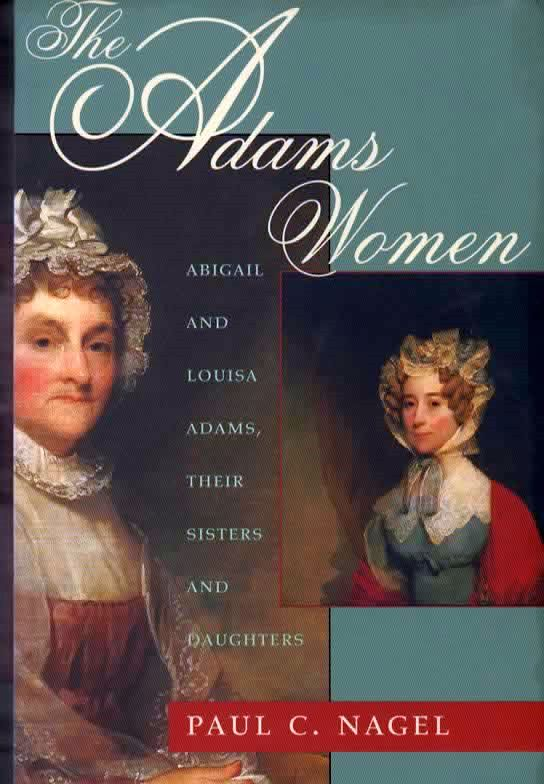
Prior
to Louisa Thomas’s biography, the most sensitive assessment of Louisa
Catherine life was a chapter in The
Adams Women
by Paul C. Nagel.
He
introduces Louisa Catherine at the end of Abigail Adam’s life in 1818.
Abigail had not approved of Louisa’s marriage to John Quincy,
considering his having married beneath himself to a woman who was too
European. Her relationship with Louisa was strained to say the least
until the last years of her life when Louisa not only won over her
mother-in-law, but also endeared herself to the aging John Adams. It
was Abigail that kept her from taking her two eldest sons with her on
the mission to Russia, not to see them for most of their formative
years. Neither sons, George Washington, or John Adams II, would do very
well with their lives. Both were alcoholics, a disease that their
brother, Charles Francis attributed to the Smith side of the family,
Abigail’s family. Such an assessment was quite possibly correct,
considering the recent research on the genetics of alcoholism, but
Louisa always blamed herself in part on not being there to nurture her
children. It was also quite likely that John Quincy’s distance from his
two oldest sons and his instance on a rigorous academic course of study
always presented in a critical framework, had something to do with
their personal failures. He did take his son John Adams as his private
secretary when President and inflicted him with the management of a
failing grist mill in Rock Creek park afterwards. By then he was too
far along in the disease that killed him. He did leave behind a wife
and one daughter who would care for Louisa, but the suicide of the
eldest, George Washington Adams in 1829 and the death of John Adams II
in 1834, left an indelible depression on Louisa and shadowed her for
the remainder of her life.
In
1818, those debilitating events of Louisa Catherine’s life lay ahead of
her. As to her relationship her mother-in-law, it had blossomed into
true friendship. As Paul Nagel writes:
No
one captured the nature of Abigail Adams better than Louisa. First she
said that her mother-in-law was “the guiding planet around which all
revolved, performing their separate duties only by the impulse of her
magnetic power.” Then, in a poem of farewell, Louisa enlarged the
tribute in charming lines which especially touched old John Adams:
“Depart thou Sainted Spirit, wing thy happy flight/To the bright realms
of everlasting light./ Yet fondly hover oer’ thy lonely friend,/In
nightly visions resignation send,/Cheer his great mind, Attune his soul
to Peace,/Till in this world his hopeless grief may cease,/ And when
his spirit quits this mortal clay/Lead him to heavenly bliss and guide
him on his way.
Louisa,
from her days in the convent school, leaned towards being a high
Anglican and often was disparaging of the “Unitarian” beliefs of her
father-in-law and husband, seeking solace in the book of common prayer,
and according to her wishes, buried by it.
The
most politically influential period in Louisa Catherine’s life came in
the twelve years that John Quincy Adams served first as Secretary of
State in the Monroe Cabinet and then on his own as President of the
United States. The first scholar to write about her role in those years
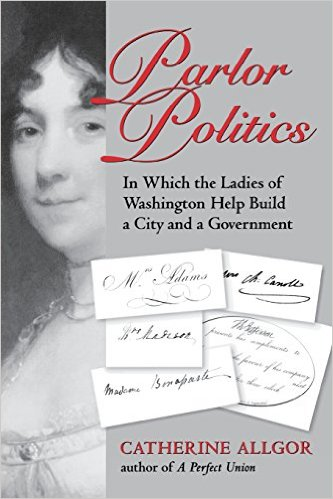
is Catherine Allgor in her Parlor
Politics: In Which the Ladies of Washington Help Build a City and a
Government
( Charlottesville: University Press of Virginia, 2000). There she
stands on her own, if in the shadow of Dolley Madison who appears on
the cover, but not Louisa.
To
quote one reviewer:
When
Thomas Jefferson moved his victorious Republican administration into
the new capital city in 1801, one of his first acts was to abolish any
formal receptions, except on New Year's Day and the Fourth of July. His
successful campaign for the presidency had been partially founded on
the idea that his Federalist enemies had assumed dangerously
aristocratic trappings―a sword for George Washington and a raised dais
for Martha when she received people at social occasions―in the first
capital cities of New York and Philadelphia. When the ladies of
Washington City, determined to have their own salon, arrived en masse
at the president's house, Jefferson met them in riding clothes,
expressing surprise at their presence. His deep suspicion of any
occasion that resembled a European court caused a major problem,
however: without the face-to-face relationships and networks of
interest created in society, the American experiment in government
could not function.
Into
this conundrum, writes Catherine Allgor, stepped women like Dolley
Madison and Louisa Catherine Adams, women of political families who
used the unofficial, social sphere to cement the relationships that
politics needed to work. Not only did they create a space in which
politics was effectively conducted; their efforts legitimated the new
republic and the new capital in the eyes of European nations, whose
representatives scoffed at the city's few amenities and desolate
setting. Covered by the prescriptions of their gender, Washington women
engaged in the dirty business of politics, which allowed their husbands
to retain their republican purity.
Constrained
by the cultural taboos on "petticoat politicking," women rarely wrote
forthrightly about their ambitions and plans, preferring to cast their
political work as an extension of virtuous family roles. But by
analyzing their correspondence, gossip events, "etiquette wars," and
the material culture that surrounded them, Allgor finds that these
women acted with conscious political intent. In the days before
organized political parties, the social machine built by these early
federal women helped to ease the transition from a failed republican
experiment to a burgeoning democracy.
Louisa
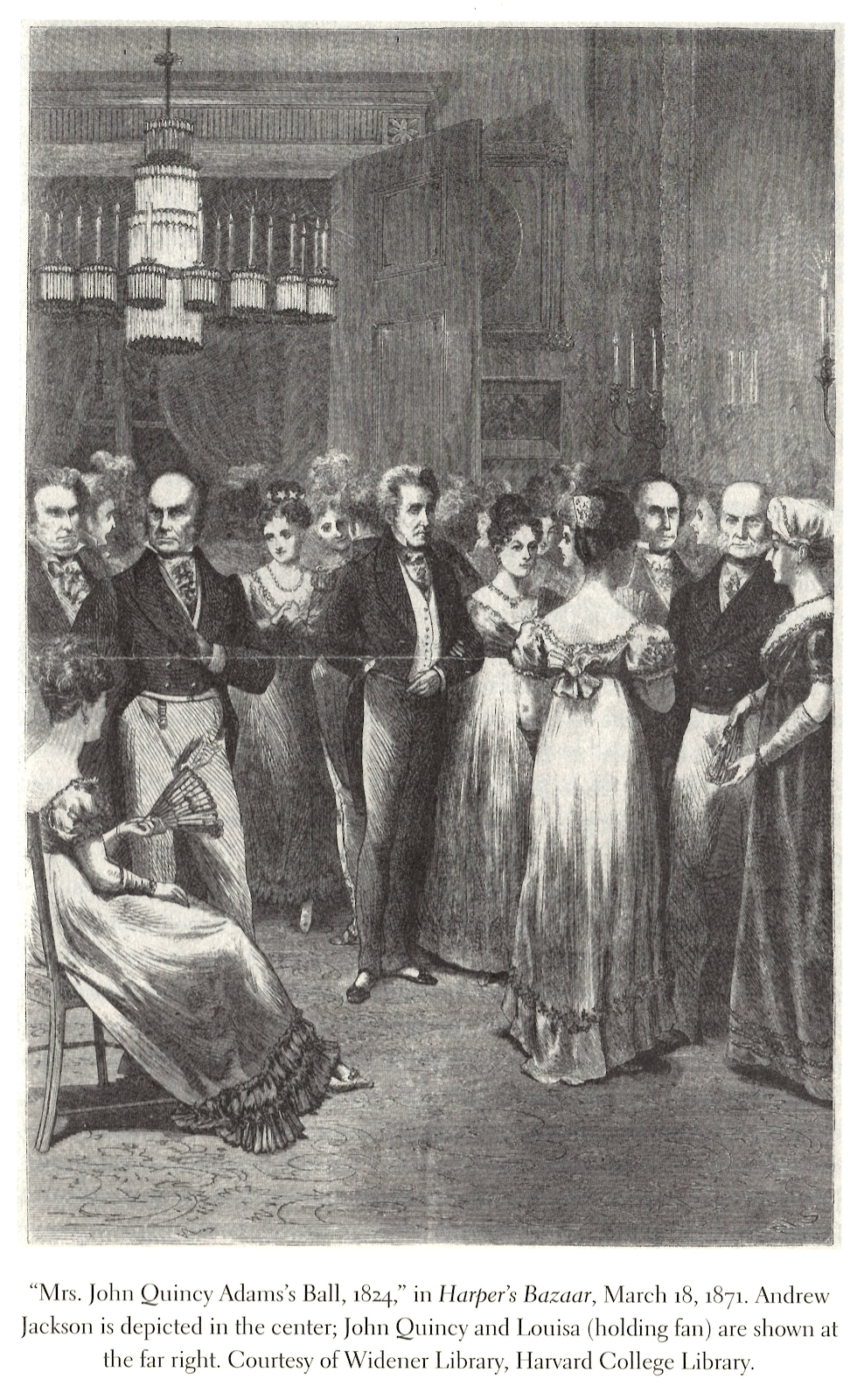
is perhaps best known for the party she threw for Andrew Jackson in
1824. In a chapter entitled A
Beautiful plan,
Mary F. Heffron in her posthumous biography of Louisa (2014) begins
with a quote from the poet and newspaper editor John Agg: “Belles and
matrons, maids and madams, All All are gone to Mrs. Adams.” Based on
her correspondence, Mary Heffron paints a word picture of Louisa
Catherine trying
All
kinds of cajolery to get her Macbeth-”If chance will make me king, why
chance may crown me” --to mend his political ways. Bemoaning “the
illiberal attacks of any idiot that can hold a pen,” Louisa worked hard
to bolster his confidence: “My conviction from my long acquaintance
with your conduct as a publick man is so strong that the deeper they
dive, the higher they must elevate your character.” These were words
that the personally insecure and politically clumsy John Quincy needed
to hear, but they could not move him from his pedestal.
Despite
of her husband’s aloofness, Louisa entertained and promoted her
husband’s interests. She held Tuesday sociables at her home and on
December 20, 1823 she “decided to hold a ball honoring Andrew Jackson
on January 8, 1824, the anniversary of the general’s victory in the
Battle of New Orleans”. Jackson was Adam’s most serious rival for the
presidency. The Ball was a success.
“Louisa
led the guest of honor through the crowd, making introductions as they
went. Anticipating that she would be the center of attention, she had
chosen a ball gown of light-catching steel lame with “ornaments for
head, throat, and arms” of cut-steel,” all producing a”dazzling
effect.” the Statesman’s correspondent was suitably impressed: “Mrs
Adams was elegantly but not gorgeously dressed. In her manner she
unites dignity with an unusual share of ease and elegance and I never
saw her to greater advantage than when promenading through the rooms,
winding her way through the multitude by the side of the gallant
General. At the approach of such a couple, the crowd unvoluntarily gave
way as far as practicable and saluted them as they passed.”
It
would prove to be the highlight of her success at promoting her
husband. He would win the 1824 election by one vote in the House of
Representatives and appoint another contender, Henry Clay, who
convinced his supporters to back John Quincy, to the post of Secretary
of State. It was called the “corrupt bargain” by the press that favored
Jackson. Instead of eight years as Secretary of State and then with
Adam’s support, the presidency, Henry Clay would serve only four and
Jackson would win the 1828 election by a wide margin, consigning John
Quincy Adams, like his father before him, to one term. Those four years
were also miserable ones for Louisa Catherine. While she continued to
entertain at the White House, playing the Harp and popularizing “Hail
to the Chief,” her son John’s accounting mistake when a Billiard table
was acquired for the White House was met by cries of the misuse of
public funds and a near duel between John and a reporter. The
Jacksonian press was relentless, attacking her for her European ways
and Adam’s elitism, while he in turn promoted better weights and
measures, observing the stars, and the Federal Funding of what would
become known as Henry Clay’s American system. The country was not ready
for such programs nor was Louisa ready for the steady stream of
criticism.
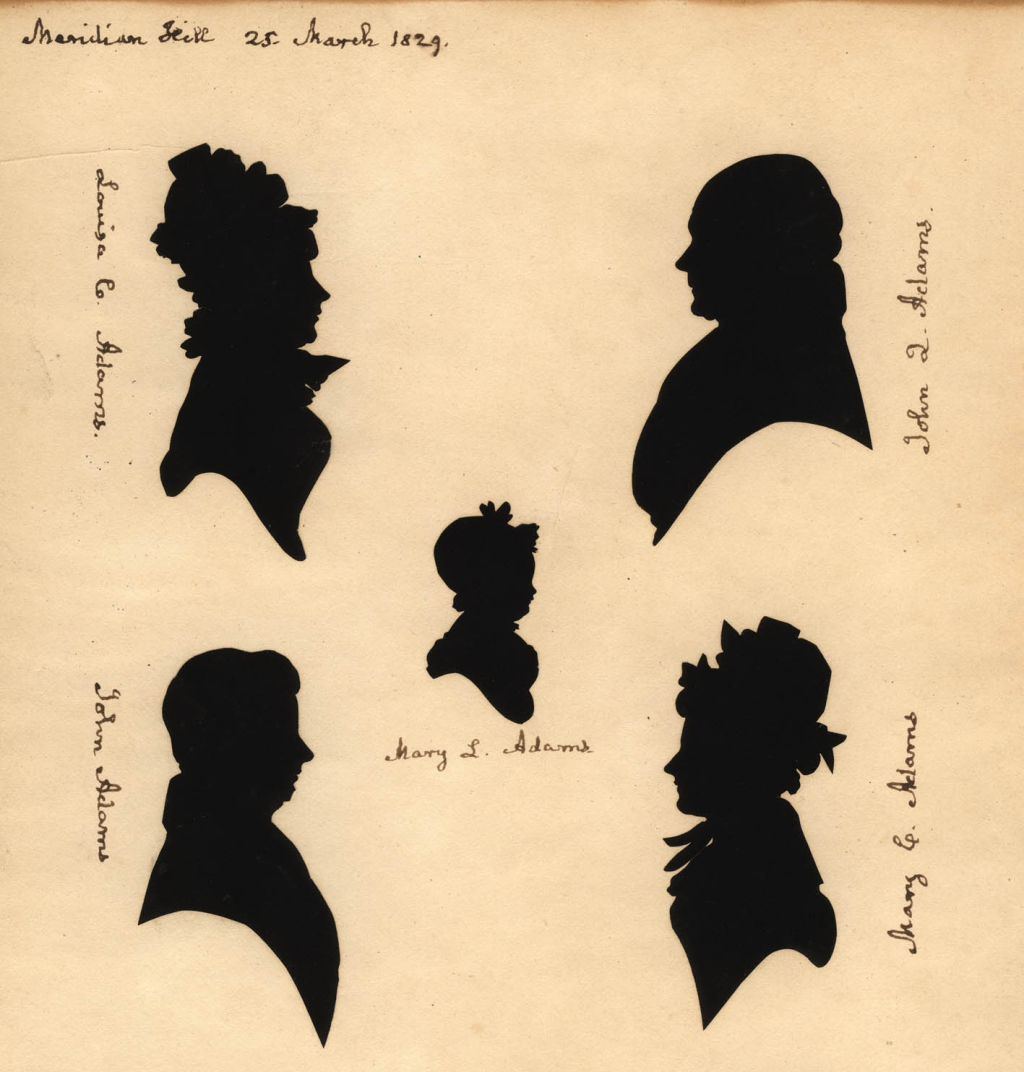
With
great relief, when the election was over, she moved the family directly
north of the White House to Meridian Hill where she briefly found the
rural quiet contentment that she craved. The approach to Meridian Hill
was lined with yellow wood trees which she so fancied that two were
planted in Quincy for her enjoyment, according to family tradition. Of
politicians, it was said, only Martin Van Buren came to call. The happy
repose at Meridian Hill was short lived. While she had her new
granddaughter (shown in the silhouettes she and John Quincy had cut
there) to adore and entertain her, a relationship that would continue
for a number of years, her son John was not able to cope well with his
responsibilities, his alcoholism at times all consuming, and her
eldest, George Washington Adams committed suicide.
Late that summer of 1829, Meridian Hill was sold and Louisa had to
move once again, back to Quincy, expecting never to return to
Washington. She was mistaken. John Quincy relished the notion that his
local constituents wanted him to represent them in the Capitol. When he
was elected popularly for the first time as a Representative, he and
Louisa headed back to Washington. No more parties of note, nor
campaigning for her husband. He didn’t need it. His position on the
right to petition Congress and his successful Supreme Court defense of
the Amistad slaves brought death threats and great unease to Louisa
Catherine who frequently escaped to her bed. It was in those years that
she began her memoir “Adventures of a Nobody,” and her grandson Henry
first came to remember her, both at Quincy, her summer residence, and
in Washington.
Appropriately,
John Quincy Adams died at work in the capitol in 1848, rising to oppose
the honors being granted the military leaders of the Mexican War. He
died much revered and honored, even by his enemies in the South who
chose to speak no evil of the dead. Louisa mourned and spent the
remainder of her life largely in Washington.
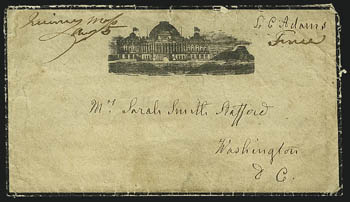
There
was no fund for the support of First Ladies, although Congress granted
free mail, known as franking privileges, to her that she used for the
remainder of her life. She did have a financially astute son, Charles
Francis, who provided well for his family and Louisa’s eccentric
brother, Thomas Baker Johnson, managing investments and pursuing a
distinguished legal and diplomatic career, eventually after his
mother’s death, following in his grandfather and father’s footsteps as
Minister to the Court of St. James in London during the American Civil
War. It would be Charles who would build the first presidential library
at Quincy to house the family’s 14,000 volume collection. Charles
Francis had been the only one of Louisa’s children to have been in her
care throughout most of his childhood, bearing the strenuous journey
from St. Petersburg to Paris alone with his mother and living largely
with his parents until his days at Harvard. The lack of the alcohol
gene may have helped, but Louisa was the present and nurturing buffer
between Charles Francis and his father, possibly helping to set him on
the path to fame and fortune, if not the White House.
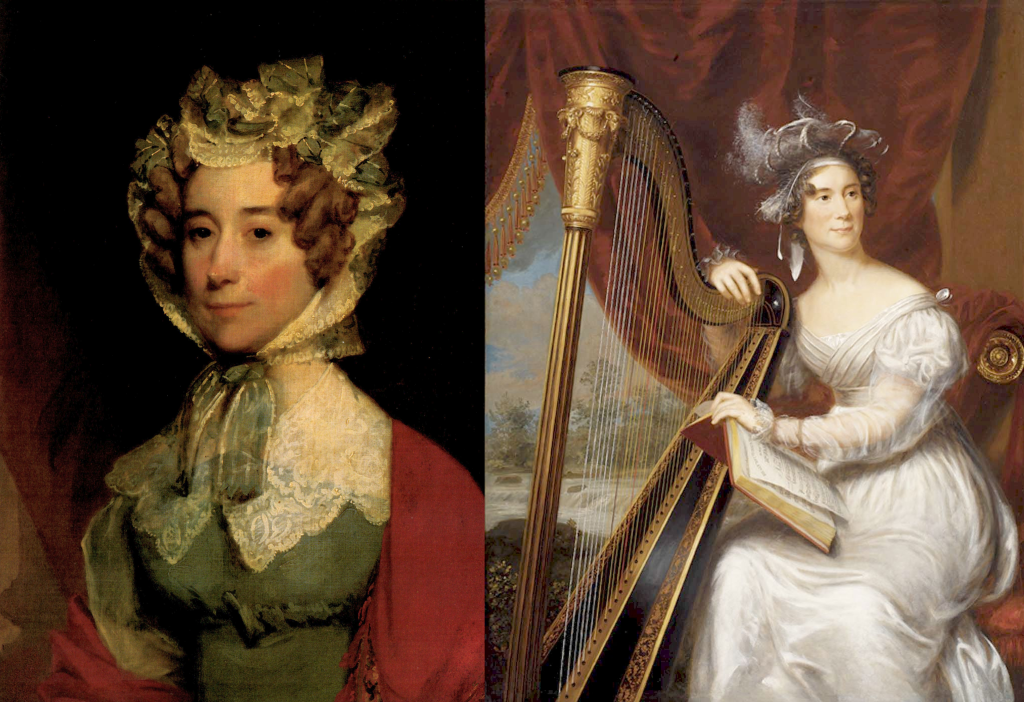
My
favorite painting of Louisa is one that she did not find flattering.
Completed by Gilbert Stuart in 1826 during the difficult Presidential
years, Louisa Thomas captures it in prose, a Louisa Catherine who is
small
and thin. Her ornate bonnet, high lace collar, and scarlet shawl almost
envelop her; there are deep shadows. The colors of her face are washed
out, the lines softe. Her expression is tired and sad. Louisa first saw
the finished version at an exhibition at the Boston Athenaeum and
thought it an accurate representation. It looked,, she wrote, like a
woman who has just felt “the first chill of death.” she was half
joking; there’s something gentle, appealing, and intimate about the
painting. But it is the portrait of an older woman, and it suggests
some secret sorrows. Its tone is essentially private.
Louisa
Catherine sat for another portrait at about the same time by Charles
Bird King, one that Louisa Thomas rightfully describes as political:
Both
portraits, [Louisa Thomas writes] --on political, one domestic; one
lively, one exhausted; one powerful, one withdrawn---captured something
essential about her. She was both women, however contradictory the
images seemed. “One visitor to Washington in the winter of 1824
remembered her as “very talkative and lively” and her parties “always
pleasant and gay,’ but at home she was often unwell, and her family
followed her mood. Despite her torrid activity, her health was
terrible. “Nothing but opium affords relief at night,” she wrote to her
son John during the summer of 1823.
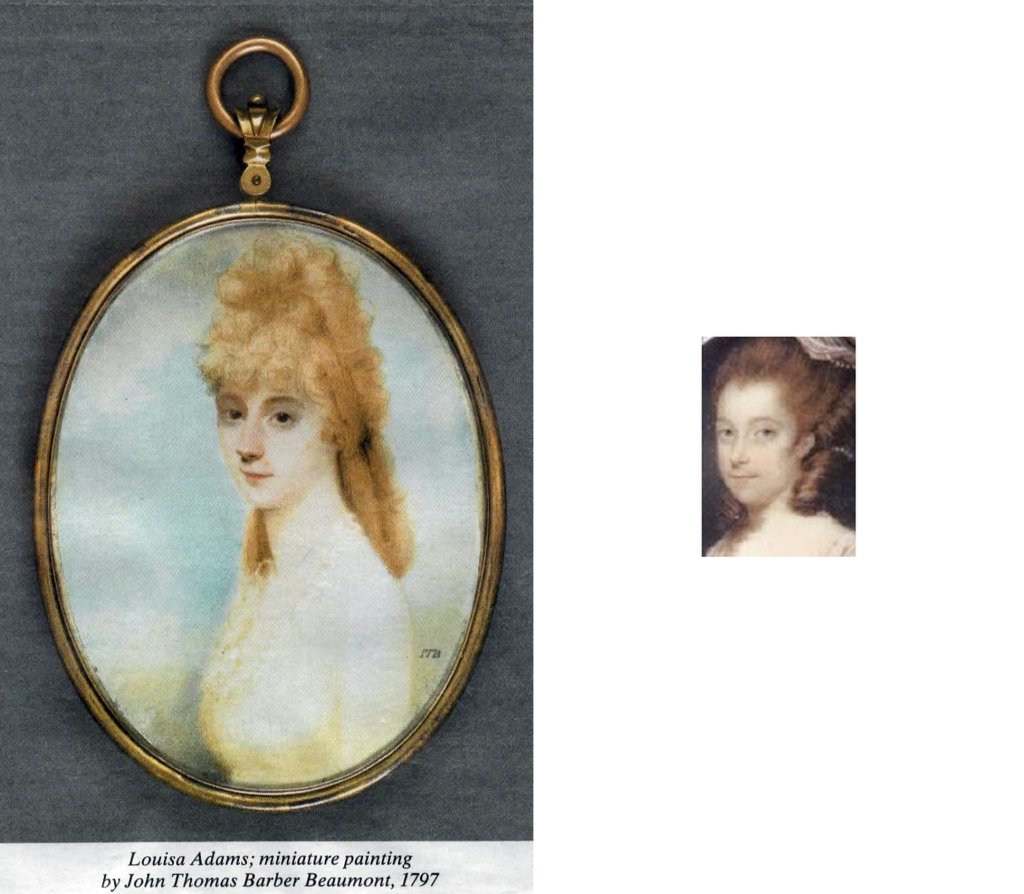
Gone
was the gay, perhaps at times giddy young 20 year old girl of 1797,
full of the stories of love drawn from the novels of the day. While the
serious side of her nature peers at us from the earliest known
miniature attributed to her days in Nantes in the care of the nuns, it
would be her education in the shadow of her husband, a world in which
she tried valiantly to find her own voice, never really succeeding,
only soaring for a few years in the capacity of useful ally like an American
Phoenix, the
title of another biography in which the author argues that even before
his unsuccessful presidency, John Quincy Adams and Louisa Catherine
Adams transformed their European sojourn into America’s salvation
through the ties they forged in Russia, once a strong ally in defense
of America’s independence.
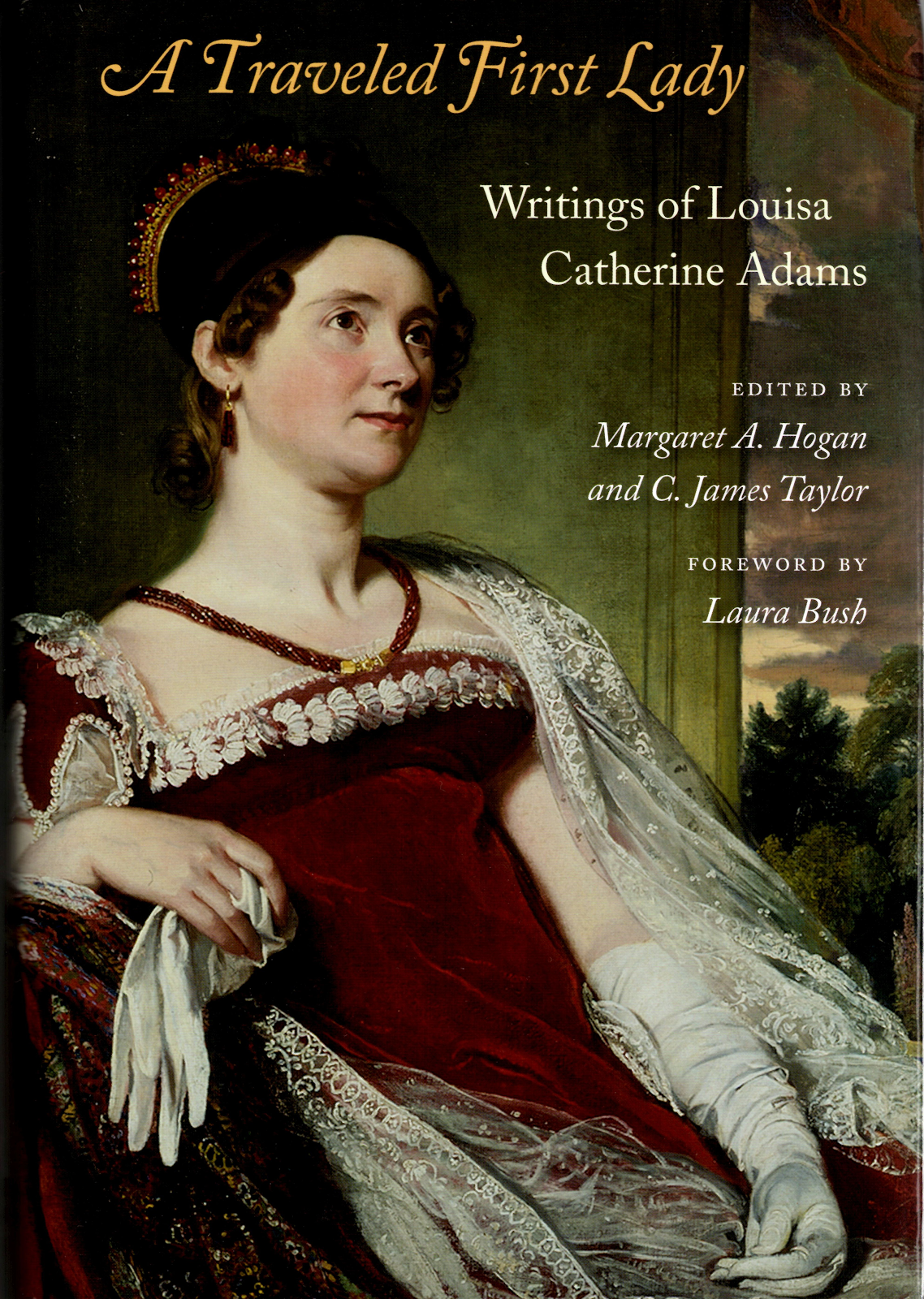
In
1816 Louisa Catherine’s portrait was painted in London on the eve of
her returning to America to become the dutiful wife of the Secretary of
State. Apart from the loss of her daughter in St. Petersburg, she had
yet to suffer from the loss of two of her sons and the slings and
arrows of the political world. She was indeed a traveled first lady
which provided her with the knowledge and diplomatic skills to fill the
unofficial office of First Lady, but even then in 1816, she looks
pensive, perhaps even annoyed, with the roles which awaited her at the
side of a brilliant and stuffy man who perhaps loved himself above all
others. She fulfilled the outward reaching roles demanded of her with
grace and effectiveness, but suffered for it. While born a Maryland
citizen, she remained attached to her European upbringing and her
European tastes, never fully able to comprehend or appreciate the
unrefined, rough and tumble Democracy that men like Andrew Jackson
represented. For her generation and for us she remains a woman in the
shadows, a silhouette, to be observed, reflected upon, but perhaps
never fully understood.