
Virtual Reality, Critical Thinking, and Access to A Permanent, Truthful Record of the Past
©Dr. Edward C. Papenfuse,
Archivist of the State of Maryland, retired
First presented September 10, 2003, revised April 5, 2018
At a University of Maryland Law School luncheon several years ago, Barbara S. Gontrum, introduced the faculty to “New Library Initiatives.” In a softspoken, persuasively engaging presentation, she outlined a wide range of services, electronic, paper, and human, that the library provides for the study of the law. She reminded the faculty of the great cost of maintaining those services, especially electronic, and the enormous task of preserving those resources in this new age when even the most advanced students, possibly even some law professors, believe that a google/lexis/westlaw search is all that is needed to answer any legal question of merit.
The problems before all of us in this age of fake news, unreliable news feeds, and the mis-use of personal data in an effort to shape our thinking and affect our vote are staggering if not overwhelming. We seem to no longer teach and require critical and evaluative thinking on the part of those in our Democracy who need it the most. We fail to preserve and make accessible the very documents, paper and electronic that make critical and evaluative thinking possible. In other words we seem to no longer be able to discipline ourselves to seek the truth wherever it may lead us, and to unearth and respect the lessons of the past, especially as they relate to why it is important both to abide by, and to shape the law to current needs. Based on personal experience walking 10,000 steps a day, I would estimate that 90% of American drivers do not obey the laws governing stopping for pedestrians in a crosswalk. I was almost hit twice today as I tried to cross a thoroughfare in crosswalks with signs that read clearly "stop for pedestrians in the crosswalk." This is not about simply obeying the law. It is also about knowing why the laws exist, how they got there, and, if need be, how we should go about effecting change when necessary. Not that I want the laws governing crosswalks changed. I would prefer to change the minds of those who would disobey those laws through persuasion and requiring both a conscience and critical thinking on the driver’s part. Perhaps their even getting off their cell phones.
For several years I taught courses with three professors at the University of Maryland School of Law in which my role was to take the students beyond Lexis/Nexis into documenting the history of the law.
What was clear to me then and remains clear to me today is that it is vital to
- teach students, faculty, librarians, and archivists, that there is much more to the record than a Google/Lexis/Westlaw case analysis and that as much of the contributory materials in any case ought to be both preserved and reviewed as possible, preferably as images and/or searchable electronic text,
- find adequate resources to permanently preserve these records in whatever form they can best survive as long as it is both readily accessible and verifiable (i. e. legally trustworthy),
- counter effectively the nattering nabobs of negativism who claim that the electronic record cannot be considered a permanent record on its own and who deflect attention to their perceived need of an expensive and outmoded technology as the failsafe security blanket for the printed and manuscript word[1]
For good reason, Archivists and Librarians are by nature conservative, especially when it comes to issues of conservation and preservation. We have experienced the destruction by fire of too many courthouses. We have labored long, hard, and successfully for archival standards for the permanent care and preservation of paper historical records. We have pioneered in the advocacy and implementation of acid free papers for books and permanent records. We have forced the development of high standards for the capturing of images on film, although we missed the red spotting nightmare of poor film processing of the 1950s and 60s which still threatens a whole generation of microfilm holdings with self destruction.
Today, as we face the questions of what we should be preserving permanently and how we should be making it accessible, our concentration should be on placing as much of the legal record as we can, as quickly as we can, into an electronic archives environment. I use the words “electronic archives environment” deliberately and to mean a system of generic, non-proprietary, on line electronic backup and redundancy made as safe and secure as paper or microfilm can be. Such a system is possible now and can be safeguarded in the future if we do so wisely and with care.
Archivists and Librarians have addressed these three issues before, and, I suspect, will do so again, although I believe the urgency is greater today than it was in March of 1989 when a number of us met at the Library of Congress to discuss the development of Statewide Preservation Programs. Since then the web revolution has intervened and we have all had to face up to a mammoth new preservation problem: how to cope with the fact that most of what we know and how we know it is today a potentially fleeting electronic record. As Archivists and Judges, I know we would prefer it to be otherwise.
Indeed to my mind it is a sad commentary on the ownership of the intellectual property of the law that we must rely heavily on private purveyors of electronic information for our knowledge of the law. Who is to ensure that that information will be preserved permanently and be available to all who should have access to it in the future? I would argue that Libraries and Archives should be the prime keepers and the prime beneficiaries of the 'sale' of legal information in electronic form (I would even argue the heresy that Westlaw/Lexis/Nexis should be wholly owned nonprofit public corporations whose profits are plowed back into the total care and preservation of archival and library materials). But that is another, more delicate issue, to be reserved for another day, although I will point out that the only reason we have been able to even accomplish the little that we have with the Archives of Maryland On Line is because of the income produced by and for the archives as a result of our making oversized materials such as maps and plats, and land records available for a fee on line.[2]
The primary role of archivists and librarians should be one of ensuring that analysis and conclusions regarding legal actions can be made independently of privately held information banks from the actual records themselves. Use the databanks and added value information services for entry access. Use them for short cuts. Use them for inspiration. But preserve the essential information that relates to the legal process in a freely and readily accessible electronic environment which any user should be trained to mine. That means investing money and energy in holding on permanently to what I call the building blocks of the law: the constitutional, the legislative, and the judicial process as documented in the surviving court record and supplementary materials such as newspapers and relevant manuscript collections. It is important to stress process because we are too often convinced that the summary of what transpired is all that we need to know, yet in the dissenting opinions and losing briefs, as well as the over-turned lower court opinions, and the arguments of the minority in debates over legislation are to be found the seeds of future change. We all know Justice Harlan’s dissent in Plessy v Ferguson.[3] Some of us know well William Paca’s 22 proposed amendments to the Constitution of the United States most of which James Madison would be forced to incorporate into the Bill of Rights.[4] But how many students of the law (other than perhaps Judge Dumbauld and a handful of scholars) have looked carefully at the evolution of the individual State Declaration of Rights, and the passion with which we once wrote our State Constitutions. What of the record still exists? How accessible is it? Why should we care?
The answer lies in how well archivists, librarians, judges and historians, highlight their significance and excite interest in the high value of the surviving evidence.
For example, at what point and why are laws subject to judicial review? During the anniversary year of Marbury v. Madison, how many people remembered and studied Whittington v. Polk, probing beneath the surface to understand who made what decision and why?
To what degree have the briefs in Supreme Court cases been preserved and made accessible?[5] How much is known about the process by which the cases such as Barron v. Baltimore were brought to the court and what those cases reveal that is meaningful, not only about the law, but about the underlying social, economic, and political issues that the cases represent.
I believe such cases prove one essential point: We need to work together to preserve the vast array of documentation that has survived from our legislative and legal system in order that we as a nation can continue to learn and grow with a civic conscience that exceeds our current level of apathy. As I said in 1989 and repeat again today, if we do not learn to better share the resources and stress the access side of preservation, we are doomed to retreat further into ignorance. Bullies will become presidents and National Security advisers will launch us into a nuclear war.
As I said then, and repeat now: the battles for turf and a clear inability of institutions to see beyond their own collecting imperatives too often get in the way of treating collections as cultural resources to be preserved for the use of the people generally. n our state, we were unable to enlist the assistance of the Library of Congress when they had grant funds to give out apparently because they had an internal project of less useful dimensions that they preferred to support, and now our State Library system has chosen to go its own way with a digital preservation initiative that will drain resources from our pioneering Archives of Maryland on Line initiative. At the State Level, following in the footsteps of the University of Michigan and Cornell, but extending the model beyond the printed book to core state documents, we at the Maryland State Archives have shown that with a few well spent dollars, a great deal can be accomplished IF a sharp focus is maintained, and resources are found to sustain the product in an accessible electronic format (see "A Revolution in Archives, www.archivesofmaryland.net" in Uncommon Sense, Winter/spring 2001, No. 112, pp. 5-14. ). It would be helpful if our colleagues in the library world would recognize that fact and lend their support in ours and their time of need.
But rather than make the technical arguments for what we, nearly alone among states, have been doing to preserve and make accessible the legal and legislative record, or rather than even make the more obvious case for a better pooling of resources to help our pioneering efforts succeed at a greater, more effective pace, permit me to return to by far the most important hurdle that all of us face in this era of rapidly constricting resources: convincing archivists, librarians, and the public at large that there are critical records that they are missing which deserve to be preserved, and to outline what must be done to make them permanently accessible.
II
There is a little known and studiously avoided provision in the Maryland State Constitution that “it shall be the duty of the General Assembly to provide by Law for taking, at the general election to be held in the year nineteen hundred and seventy, and every twenty years thereafter, the sense of the People in regard to calling a Convention for altering this Constitution; and if a majority of voters at such election or elections shall vote for a Convention, the General Assembly, at its next session, shall provide by Law for the assembling of such convention, and for the election of Delegates thereto.” The last time Maryland held a Constitutional Convention was in 1967, the carefully honed product of which was soundly defeated at the polls the following year. I remember that year well. It was our first full year in Baltimore. The weekend after Martin Luther King’s assassination we watched from the rooftop of our row house apartment as Baltimore burned.
Americans care little about writing and revising constitutions today. Much of the passion, the art, of writing down in a comprehensive, meticulous fashion what good government means, and how it should function, has long been lost to issues out of context ranging from the right to bear arms to the right to life. In 1776, people saw things differently. Our leaders then held passionately to the proposition that our highest priority was a well-functioning, effective government, especially at the level of the thirteen rebellious states. Some states were slower to respond than others. Maryland was one, but finally the eighth Maryland convention was persuaded. On June 28, 1776 Marylander Samuel Chase wrote our future President John Adams "I shall offer no other apology for concluding than that I am this moment from our House to procure an express … with a Unan[imous] vote of our Convention for Independence. ... our people have fire if not smothered. ... Now for a government."[6]
All the aspiring states rose to the challenge. Maryland wrote its first state constitution between August and November 1776, hammering out a 42 article Declaration of Rights and a Form of Government with sixty provisions.Today only a single copy exists of the first drafts of each, both buried in the papers of John Dickinson at the Historical Society of Pennsylvania. If we know about them at all, it is because they were identified by William Sumner Jenkins for the Library of Congress in the 1950s as being important (yet curiously not microfilmed), but until their images were linked and made accessible through our prototype for the Archives of Maryland on Line, Documents for the Classroom, (http://www.mdarchives.state.
The drafts were sent to Dickinson by Samuel Chase for his comments and suggestions. Laying them side by side with the journals of the Convention and the surviving fragments of the proceedings of the committees of the whole as each article was debated, sometimes modified, and, in one rare instance, rejected, it is possible to reconstruct the passion and the process by which the final product was forged and even lend some credence to arguments of legislative intent, possible that is, if the access to the documents is swift, accurate, and complete.
When final touches were added and the two documents promulgated, there was only a limited provision for amending and none for a new convention. The language was clear. “That this form of government, and the declaration of rights, and no part thereof, shall be altered, changed, or abolished, unless a bill so to alter , change, or abolish the same, shall pass the general Assembly, and be published at least three months before a new election, and shall be confirmed by the general assembly, after a new election of delegates, in the first session after such new election.” This was followed by language decidedly peculiar unless you have spent some time in our State. The peninsula between Delaware and Chesapeake Bays which Maryland shares with the States of Delaware and Virginia, known as the ‘Eastern Shore’ has always had an independent streak. Their representatives found enough votes in the 1776 Constitutional Convention to add that “nothing in this form of government, which relates to the eastern shore particularly, shall at any time hereafter be altered, unless for the alteration and confirmation thereof, at least two thirds of all the members of each branch of the general assembly shall concur.”
How then did there come to be a provision that the electorate must be consulted every twenty years? By 1850 there was sufficient unhappiness over the lack of representation from Baltimore City in the Maryland State House, that the General Assembly was at last persuaded to call a Constitutional Convention. Once convened, after prolonged debate, a provision was adopted that:
It shall be the duty of the Legislature, at its first session immediately succeeding the returns of every census of the United States, hereafter taken, to pass a law for ascertaining, at the next general election of Delegates, the sense of the people of Maryland in regard to the calling a Convention for altering the Constitution; and in case the majority of votes cast at said election shall be in favor of calling a Convention, the Legislature shall provide for assembling such Convention
The next Constitutional convention would not be called until late in the Civil War when Maryland finally got around to abolishing slavery. Adopted in 1864, the new Constitution not only provided that any proposed amendments be published in German (there had been a large influx of German speaking immigrants in the intervening years since the last Constitution was adopted), but that every twenty years beginning in 1882, the electorate should be polled on whether or not they wanted another chance to review the state’s fundamental laws.
Instead it would be only three years before another convention was called in 1867, a convention that perfunctorily renewed the 20 year rule, after which there was no serious call for review and reform for another 100 years. In the meantime, a Science Fiction writer from Massachusetts, Roger Sherman Hoar, in 1917, and a Professor at the University of Pittsburgh, Francis Newton Thorpe, in 1909, studiously compiled reference works on the process of State Constitution making that were designed to make the task of revision more comparative and, possibly, easier.
Roger Sherman Hoar, a lawyer who preferred writing pulp fiction about his hero ‘Radio Man,’ found that seven states, Oklahoma, Maryland, New Hampshire, Iowa, Michigan, New York, and Ohio, required the people be consulted regularly on whether or not a constitutional convention should be called. He did so in answer to the self-imposed question:
[§2. Must legislature get popular approval for convention?]
Most of the constitutions which contain provisions for the calling of conventions now provide that they be called after the legislature has submitted the question of a convention to the people and has obtained their approval, such a popular vote to be taken whenever the legislatures themselves may think proper. The first provisions of this character were those contained in the Delaware constitution of 1792, the Tennessee constitution of 1796, the Kentucky constitution of 1799, and the Ohio constitution of 1802. The Kentucky provision of 1799, which was substantially repeated in the constitution of 1850, threw great obstacles in the way of calling a convention, by requiring two successive popular votes; but this plan was not followed by other States except in the one case of the Louisiana constitution of 1812. The Kentucky constitution of 1891 discarded the requirement, but does require the vote of two successive general assemblies to propose the question to the people. The plan of permitting the legislature at its discretion to submit to the people the question of calling a constitutional convention, has for many years been the most popular one, and is now in force by the constitutions of twenty-five States.
Some States do not even leave it to the discretion of the legislature as to when the people shall vote on the question of calling a convention, but specifically provide by their constitutions that popular votes shall be taken at definite intervals. There are now six States which require the periodical submission of this question. The constitutions of four of these permit the legislature to submit the question to the people at other than the regular periodical times.
{60} The Oklahoma constitution requires the legislature to submit the question at least once in every twenty years, leaving the particular time to the legislature's discretion.
Thus the practice of obtaining the popular approval for the calling of a convention may be said to have become almost the settled rule. Thirty-two State constitutions require such a popular expression of approval, and even where it has not been expressly required, such a popular vote has been taken in a majority of cases in recent years.
Maine and Georgia are the only States whose constitutions now provide for the holding of a constitutional convention, without also containing a provision for first obtaining the approval of the people.
In the case of these States it may be argued that the convention derives its authority from the legislature alone; although in the case of Maine it may well be argued that the convention derives its authority from popular acquiescence, as manifested in the failure of the people to circulate a referendum petition; and in both cases it might possibly be argued (on the analogy of the Pennsylvania decision to be discussed a little later in this chapter) that the people ratify the legislative statute by participating in the election of delegates under it.
In the case of the thirty-two State constitutions which require a popular vote in advance of calling the convention, it may be contended that the people call the convention under a permission graciously conferred on them by the constitution, but the Delaware, Indiana, Pennsylvania, Georgia, and Florida cases discussed in the last chapter, in which cases valid conventions were held in open disregard of constitutional provisions relative to the manner of holding conventions, lend weight to the theory that a convention authorized by the constitution stands upon no different footing with respect to the source of its authority, than a convention which is not so authorized, or than one which is even prohibited …If conventions are beyond the jurisdiction of the constitution, it matters not whether the constitution attempts to {61} prohibit or to authorize them, or is silent on the subject; all such conventions are supraconstitutional.
In 1994, Hoar’s analysis was updated by Katherine M. Mauk, in an essay that was as even more uninspiring than Hoar’s deadly prose, but their conclusions remain the same: there is no prohibition against periodic review of the rules and institutions of government by the people, it is only a matter of finding a way to inspire them to undertake the challenge. On the part of Maryland and New Hampshire (which copied its language from Maryland) it can’t be said that it was for want of inspiring language incorporated into their Declaration of Rights from the outset:
That all persons invested with the legislative or executive powers of government are the trustees of the public, and as such, accountable for their conduct; wherefore whenever the ends of government are perverted, and the public liberty manifestly endangered, and all other means of redress are ineffectual, the people may, and of right ought to do, reform the old, or establish a new government. The doctrine of non-resistance against arbitrary power and oppression is absurd, slavish, and destructive of the good and happiness of mankind.
At the expense of the U.S. Congress, Professor Francis Newton Thorpe did the best he could to inform the electorate by compiling and publishing the changes that took place in state constitutions prior to 1909. But given the then poor state of the nation’s archives, and the incomplete manner of recording state laws and constitutional modifications it was inevitably as flawed as it was tedious.
Thorpe began compiling information on State Constitutions as early as 1888. The New York Constitution (which probably was the actual source of the text of Maryland’s 20 year rule in 1864) was among the first to garner his attention. In the margin of his transcription of the forty two page journal of the 1801 New York Constitutional convention Thorpe wrote: “copied in 7 = hrs. continuous. July 26, 1888. F.N.T.”
Even as careful as he may have tried to be with the sources at his command, Thorpe made countless errors of omission and, at times, transcription. Between 1776 and 1851 there were sixty-seven amendments to the Maryland Constitution. Thorpe records only twelve.
Perhaps even as important as the amendments that were passed on by the voters, are the ones that failed. Take for example the proposed Constitution of 1792 of which there are only three known copies. It attempted to make elections biennial, placed considerably more power in the hands of the indirectly elected senate (including having the governor elected by the electors of the Senate rather than by a joint ballot of the House and Senate), made the governor’s council elected by the Senate Electors, permitted Senators to hold civil office, made the judiciary serve at the pleasure of the General Assembly, easily removable, and, perhaps most importantly of all, added a new clause,
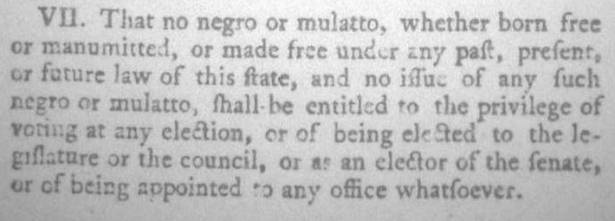
which implied that free blacks had been voting (contrary to Justice Taney’s assertion in the Dred Scott case), and could be elected or appointed to office, something the framers wished to avoid. We are still researching the debate and the vote over these proposed changes, but in their failure, they illuminate not only the constitutional thinking of the day, but help explain how attitudes towards government and how it ought to function changed in the decades following that first creative burst of constitution writing in 1776.
While the reasons for adopting a mandatory consideration of the sense of the people on calling a constitutional convention prove to be mundane, it is probably not a coincidence that the notion of revisiting the written constitution every generation was a passionately debated topic when Thomas Jefferson first broached it with James Madison. Indeed it speaks to the heart of Jeffersonian concepts of democracy.
Most scholars are aware of Jefferson’s later pronouncements on the need for periodic constitutional revision. He writes at length about them in his July 12, 1816 letter to Samuel Kercheval:[7]


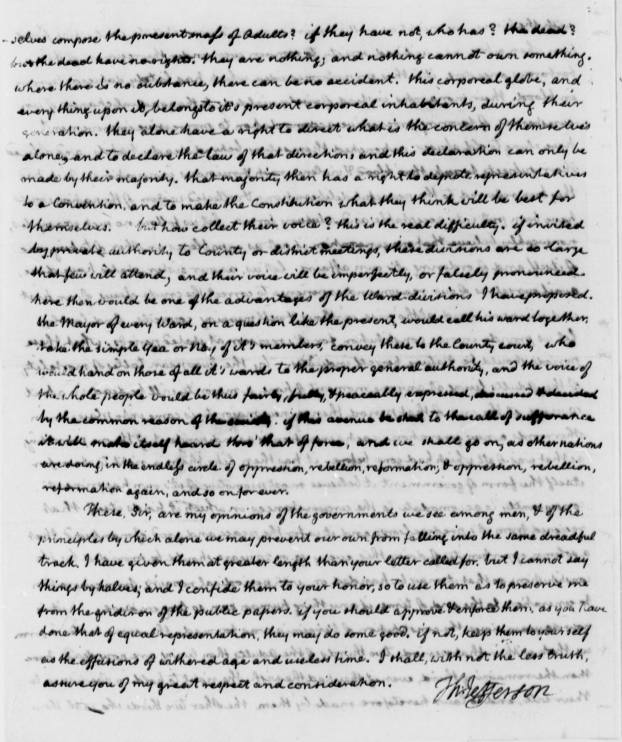
Fortunately in Jefferson’s case, this long letter has been transcribed and the transcription will be found in note 8 above, , but we are facing another crisis in education in that reading and writing handwriting is disappearing as a necessary component of of our learning which if not reversed will severely affect our ability to make the best use of the vast collections of court records that are filled with cursive writing.
Still, what is generally overlooked by most people, is that Jefferson first broached the idea of the importance of rewriting constitutions with James Madison in 1789. Writing from Paris in the midst of another Revolution not yet consumed by terror, Jefferson was less verbose and more precise in his argument that “the earth always belongs to the living generation.” I suspect his primary concern was that he was spending far beyond his means as an American in Paris, because he dwells at length on how the debts of the previous generation should not encumber the next, but his philosophical argument based upon Buffon’s life tables was that on average a generation was approximately 20 years, and that every twenty years the constitution should be rewritten.
… no society can make a perpetual constitution, or even a perpetual law. The earth belongs always to the living generation. They may manage it then, and what proceeds from it, as they please during their usufruct [the concept in Roman Civil Law of the right of using and enjoying all the advantages and profits of the property of another without altering or damaging the substance]. They are masters too of their own persons, and consequently may govern them as they please. But persons and property make the sum of the objects of government. The constitutions and the laws of their predecessors extinguished them, in their natural course, with those whose will gave them being. This could preserve that being till it ceased to be itself, and no longer. Every constitution then, and every law, naturally expires at the end of 19 years. If it be enforced longer, it’s an act of force and not of right.
James Madison’s response is equally compelling if not as compassionate. Madison had just survived an election fight with James Monroe in which he was forced to promise his constituency that if elected he would offer amendments to the newly adopted Federal Constitution designed to protect individual and states’ rights. Madison replied from New York where the First Congress convened:
Your favor of the 9th. of Jany. inclosing one of Sepr. last did not get to hand till a few days ago. The idea which the latter evolves is a great one, and suggests many interesting reflections to legislators; particularly when contracting and providing for public debts. Whether it can be received in the extent your reasonings give it, is a question which I ought to turn more in my thoughts than I have yet been able to do, before I should be justified in making up a full opinion on it. My first thoughts though coinciding with many of yours, lead me to view the doctrine as not in all respects compatible with the course of human affairs. I will endeavor to sketch the grounds of my skepticism. …
If the observations I have hazarded be not misapplied, it follows that a limitation of the validity of national acts to the computed life of a nation, is in some instances not required by Theory, and in others cannot be accomodated to practice. The observations are not meant however to impeach either the utility of the principle in some particular cases; or the general importance of it in the eye of the philosophical Legislator. On the contrary it would give me singular pleasure to see it first announced in the proceedings of the U. States, and always kept in their view, as a salutary curb on the living generation from imposing unjust or unnecessary burdens on their successors. But this is a pleasure which I have little hope of enjoying. The spirit of philosophical legislation has never reached some parts of the Union, and is by no means the fashion here, either within or without Congress. The evils suffered & feared from weakness in Government, and licentiousness in the people, have turned the attention more towards the means of strengthening the former, than of narrowing its extent in the minds of the latter. Besides this, it is so much easier to espy the little difficulties immediately incident to every great plan, than to comprehend its general and remote benefits, that our hemisphere must be still more enlightened before many of the sublime truths which are seen thro' the medium of Philosophy, become visible to the naked eye of the ordinary Politician.
The art of constitution making lies not only in the crafting of documents designed to withstand at least a generation of abuse, but also in the passion with which the constitutional issues are debated and resolved peaceably, on paper.
Jefferson and Madison, along with the seventy-eight men who served in the 1776 Constitutional Convention of Maryland, and the hundreds of others who participated in similar conventions in other states, cared passionately about the process and the consequences of writing constitutions. Their enthusiasm was contagious. With care and diligence we can recapture most, if not all of that passion, by carefully reconstructing what the framers thought, how they argued, and, most importantly of all, recording precisely what they produced and how their successors amended. The web provides us with the unparalleled opportunity to accomplish what Francis Newton Thorpe could not, fast, authoritative, well indexed access to the ideas, words, and arguments of those who wrote out constitutions. The result may well be a revival of the art, a renewal of the passion, for the written explanation of what government is and what government ought to be. Our charge is to marry the technology with the evidence in as cost effective and expeditious a manner as possible.
Perhaps even more important than the revival of the passion for making constitutions work they way they were intended, is the possibility that new and important interpretations of our law and our history in general will emerge from a careful preservation, ease of access to, and careful perusal of the documentation underlying such basic constitution issues of Legislative Intent, Judicial Review, and Federal/State Relationships.
Two examples are Whittington v. Polk and Barron v. Baltimore.
In Whittington v. Polk (WHITTINGTON vs. POLK [NO NUMBER IN ORIGINAL] COURT OF APPEALS OF MARYLAND, GENERAL COURT, EASTERN SHORE 1 H. & J. 236; 1802 Md. LEXIS 1 ) the Maryland courts struggled with the right of judicial review before it ever got to the Supreme Court and did so on what some might argue are firmer constitutional grounds than the Supreme Court did in Marbury v. Madison[9] Rather than argue the merits of the case, which Jed Shugerman, a graduate student at Yale has done admirably in a recent essay (5 U. PA. J. CONST. L. 58 (2002))in which he used all the available records he could find, attention should be focused here on not just the importance of preserving the original record linked to the printed report, but also to the significance of the participants, particularly the judges, particularly the political opposites on the court, Jeremiah Townley Chase, the chief judge, and judge Gabriel Duvall. Chase served as an elector for John Adams in 1800, Duvall for Jefferson, but both had also served in the 9th Convention in the summer of 1776 (Duvall as Clerk), wrote the first State Constitution for Maryland. Both knew first hand what the intent of the framers was with regard to Judicial review of legislation. While they would disagree on how the case should ultimately be decided (Duvall would write a brief dissent, illustrated below in which he argued Whittington was not entitled to the office), it was no wonder that both came out so strongly for the right of the court to determine the constitutionality of a law (a right it did not have to exercise until the Dashiell case in 1824[10]). Indeed the Maryland General Assembly paid such heed to the Whittington decision that it did what it had to the right way the next time it addressed the reorganization of the judiciary. It followed constitutional guidelines (and thus also the court’s in Whittington) by amending the constitution, rather than simply passing a statute. This is advice that had not been strictly adhered to and in all likelihood is a fundamental reason why the Mount Vernon Compact of 1785, the meaning of which was so much a bone of contention between Virginia and Maryland over the use of the waters of the Potomac, has always been constitutionally invalid.[11]
the original of Gabriel Duvall’s dissent in Whittington v. Polk.[12] T
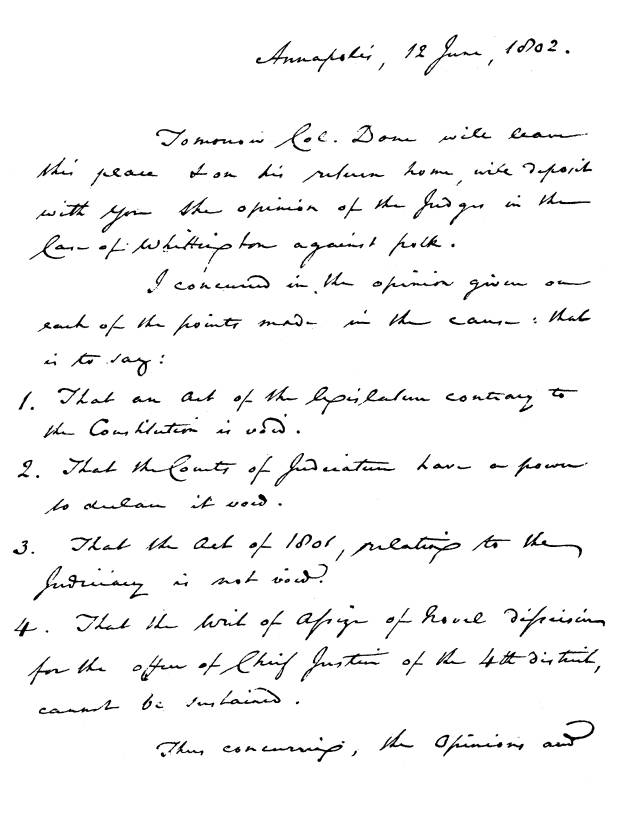
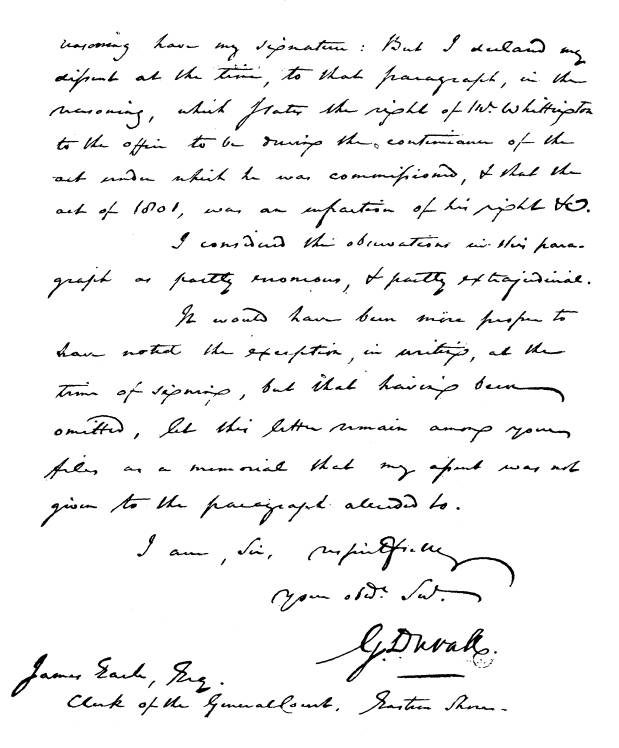
Note that in making every effort to preserve all the relevant records in a case, particular care should be taken to capture any surviving docket information.

There in synopsis form will be found the format and chronology of the case.In Barron v. Baltimore all research should begin with the dockets, particularly at the trial court level. Here will be found the jury list and an indication that the papers should be rich in exhibit materials such as maps and plats.
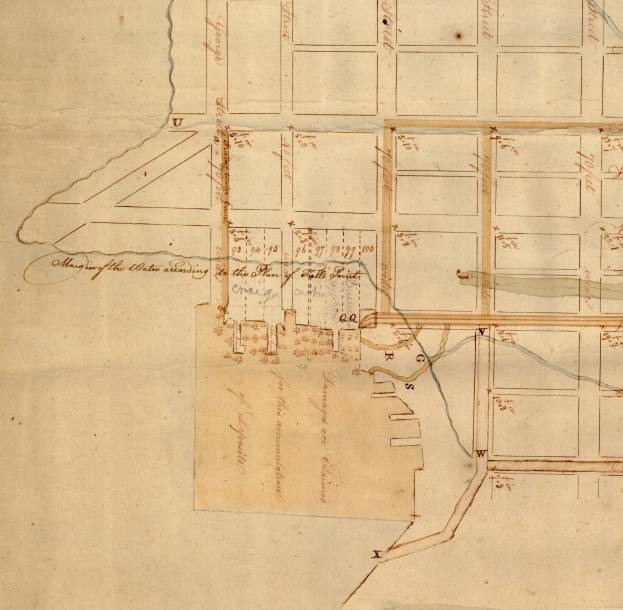
The basic issue in Barron v. Baltimore is that the City graded the streets above the Harbor and the runoff from the streets caused by a violent rainstorm silted up commercial wharves owned by Craig and Barron. Who should pay to have the silt removed? Could property be ‘taken,’ i.e. the business of the wharves, without compensation? The jury decided for the owners. The Maryland Court of Appeals reversed the decision and ruled that the City was to be held harmless because it acted in the general public interest. The whole matter was shifted to the Federal Courts on the grounds that the Fifth Amendment was relevant (nor shall private property be taken for public use, without just compensation).[13] Chief Justice Marshall, in his last decision on the court, refused to hear his successor, Roger B. Taney argue the case for Baltimore. From Marshall’s perspective insufficient reasons had been presented documenting why the squabble was a Federal matter, and he dismissed Barron’s petition with the argument that the issue was one governed by the State Constitution, and that the founding fathers did not intend for it to be interfered with by any provision of the Federal Constitution including the 5th Amendment.
For whatever cause, none of the arguments in Barron v. Baltimore made in the Maryland Courts emerged in print, yet copious manuscript court reporter’s notes exist as well as exhibits among Maryland’s judicial records. They provide a richness to how a case was argued and helps the reader access how a case was argued and with what supporting documentation.
first page of unreported reporter’s notes in Barron v. Baltimore

For the most part Barron v. Baltimore is remembered for what appeared to be a reversal of John Marshall’s strong nationalist interpretation of the Constitution, when in fact a review of all the arguments and documents in the case suggest it is rather a strong endorsement of the rights of property owners as they are defined by the separate state constitutions. Indeed it might even be argued that property owners in Maryland are not constitutionally entitled to just compensation when their property is taken for public purposes or for the public good.
A third example is a case for which a treasure trove of original papers have survived independently of the National Archives and which are supplemented by rich biographical and other public record materials at the Maryland State Archives. It involves the enforcement of habeas corpus and the successful reprimand of a President by a Chief Justice for not acting constitutionally. You can read about the case, Ex Parte Merryman (17 F. Cas. 144, *; 1861 U.S. App. LEXIS 380, **; 9 Am. Law Reg. 524; 1 Taney 246) from the official record in the materials distributed, but to realize how much is missed by not understanding the context or grasping the full extent of the historical I would recommend exploring the Federal Center for the Courts and the American Bar Association’s forthcoming web site on this and other important cases for use in high school and college classrooms. Even the account in the Oliver Wendell Holmes Devise volumes on the Taney Court did not reveal the complete richness or significance of the still extant record.
III
It is a clearly demonstrable fact that so much of the substance of the history and meaning of the law is lost when recourse is only made to the reported decisions and, occasionally, the printed briefs.
If we are to put passion back into our sense of civic duty and effectively remind ourselves that we should be willing and eager to rewrite our constitutions thoughtfully every generation, if not every twenty years (today our generations, as well as our life spans are getting longer) we must find the resources to preserve the fragments of evidence that will make such an exercise productive and worthwhile.
What then should we do?
Given such limited resources, priorities should be set as to what records are preserved first and made most accessible within the context of a well designed, generically formatted and managed, electronic archives.
1) Cease fretting about whether or not the electronic record can be a permanent record. The fact is that it must be and we must take steps with existing technology to assure ourselves that it is. Maintaining an electronic record permanently with existing technology is possible now. We simply must be prepared to bear the cost of redundancy and vigilance, price that can be far less than paper conservation, book storage, and security microfilm.
2) Begin with the constitutional and legal framework of our states and the nation, then move to whatever else we have resources to convert to electronic form.
3) Unless endowments specific to a collection can be raised for the purpose without affecting the larger funding issues, don’t waste resources on imaging projects of marginal value or of little substantive legal or constitutional related content.
4) Support financially and morally the efforts of such states as Maryland to further the goal of preserving the total surviving legal record of the state, as is evidenced in the Archives of Maryland on Line, not only in creating mirror or parallel sites for the storage of our data in selected Law School computers around the country (on the JSTOR model), but also by a willingness to pay by supporting subscription for the privilege of mirroring the site, a subscription sufficient to advance the amount of material scanned, transcribed, and interpreted
5) Help small struggling institutions like ours to be recognized as major players in need when it comes to the handing out of federal and foundation grants. Nothing has been more frustrating to me over the years than to have the Maryland State Archives treated as inconsequential to the preservation of essential information, while sister library and historical society institutions, private and public, have had little difficulty in getting funds to digitize collections of less integral value to our legal history and the history of our society generally, than those which are entrusted to our care.
With massive budget cuts looming that will entail the mass destruction of the very fabric of what we can know about the creation and interpretation of our constitutions and our laws, it is time for us to allocate what resources we have wisely. We must take seriously The Critical Importance of Preserving the Historical Context of the Law in an Authoriative, Permanent, and Readily Accessible Electronic Environment. Jefferson offers sound advice. Every generation must passionately engage in the revitalization of the very fabric of our laws and of our government, but it must do so, as Madison reminded him, with the benefit of the knowledge and the wisdom of those who have gone before.
In a former steel shelving warehouse in a major city there is a significant collection of public papers relating to the legal business of the city reaching back to the first decade of the 20th century. While they are stored under less than ideal circumstances and are cared for by a very small overburdened staff, the greatest threat to their preservation is that few know what they contain, or care about what might be learned from their contents.
While working with a volunteer who is cataloging the papers of the Baltimore City Law Department, I selected a case at random. It happened to be a challenge to the practice of the City Jail to send prisoners who the jailer deemed mad directly to the City Insane Asylum, bypassing all the laws on the subject, and the constitutional rights of the person who had served his or her time. [14] Most of the prisoners treated that way, from the records in the file that covered a period of six years, were African American. The Assistant City Solicitor (who happened to be a future, long term Governor of the State) wrote an eloquent, stinging indictment of the practice. “I am of opinion,” he wrote, “that this practice is not legal. No man can be deprived of his life liberty or property without due process of law. This means that no man can be deprived of his liberty and confined in an insane asylum without judicial proceedings of some kind being first had.”
There are vast treasures of untapped past wisdom (and folly) among the legal records of this nation. Let us find the resources to preserve them and to make them known and available to future generations in a readily accessible environment. That means bringing the huge body of court records of the Federal Courts and the State Courts now virtually inaccessible in remote storage locations on line in in a permanently available, usage fee free service supported by public funds for the educational benefit of us all. There is much to learn, if we only turn our attention to learning it in a civic minded, critical thinking way. If we do so, perhaps we will save ourselves from the treacherous path of tweeting ignorance and insult transformed into a hopeless, fruitless, even racist, course of public policy that dooms us all.

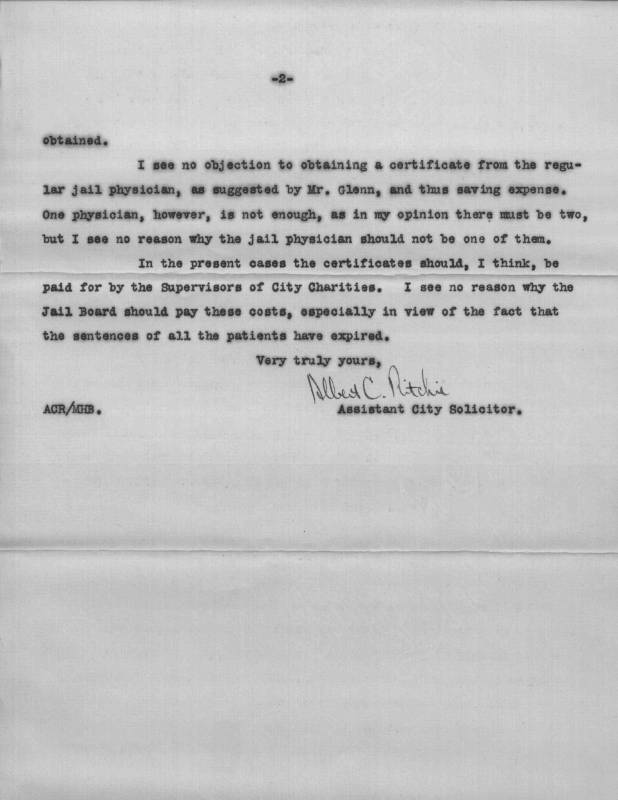
from Baltimore City Archives, RG 13, Series 2, file 4616.
End notes
[1] The phrase is historical and was used by a nationally known politician from Maryland whose veracity was at times suspect. Jerry Dupont of the Law Library Microform Consortium in his letter of February 20 to participants in this conference, raises legitimate concerns about the reliability of the electronic record when poorly managed, but the rejection of the digital only approach is both shortsighted and misdirected. It would be ideal if we could afford the resources necessary to move all electronic records into a more stable, analog, environment that improves upon COM, computer output microform,(a technology that has been around for a long time, but which did not adequately provide for shades of gray, nor color). The fact is that we can’t afford it (leaving aside the questions of what it would cost to store and access such media), and our resources would be better spent on ensuring a stable, redundant, generic electronic archives, something that is possible and economically viable even within the confines of the infant state of current technology.
[2] See for example www.plats.net, user name plato, password plato#
[3] For the dissent and all known briefs see: http://curiae.law.yale.edu/
[4] Paca’s and the Maryland Minority’s proposed amendments circulated widely. See, for example, The Pennsylvania Gazette, May 7, 1788.
[5] See the pioneering work of http://curiae.law.yale.edu/
http://curiae.law.yale.edu/
[6] htttp://www.mdarchives.state.
[7] Letter from Thomas Jefferson to Samuel Kercheval, July 12, 1816. Transcription source: http://lachlan.bluehaze.com.
Letter To Samuel Kercheval - Monticello, July 12, 1816
To Samuel Kercheval_
Monticello, July 12, 1816_
SIR, -- I duly received your favor of June the 13th, with the copy of the letters on the calling a convention, on which you are pleased to ask my opinion. I have not been in the habit of mysterious reserve on any subject, nor of buttoning up my opinions within my own doublet. On the contrary, while in public service especially, I thought the public entitled to frankness, and intimately to know whom they employed. But I am now retired: I resign myself, as a passenger, with confidence to those at present at the helm, and ask but for rest, peace and good will. The question you propose, on equal representation, has become a party one, in which I wish to take no public share. Yet, if it be asked for your own satisfaction only, and not to be quoted before the public, I have no motive to withhold it, and the less from you, as it coincides with your own. At the birth of our republic, I committed that opinion to the world, in the draught of a constitution annexed to the "Notes on Virginia," in which a provision was inserted for a representation permanently equal. The infancy of the subject at that moment, and our inexperience of self-government, occasioned gross departures in that draught from genuine republican canons. In truth, the abuses of monarchy had so much filled all the space of political contemplation, that we imagined everything republican which was not monarchy. We had not yet penetrated to the mother principle, that "governments are republican only in proportion as they embody the will of their people, and execute it." Hence, our first constitutions had really no leading principles in them. But experience and reflection have but more and more confirmed me in the particular importance of the equal representation then proposed. On that point, then, I am entirely in sentiment with your letters; and only lament that a copy-right of your pamphlet prevents their appearance in the newspapers, where alone they would be generally read, and produce general effect. The present vacancy too, of other matter, would give them place in every paper, and bring the question home to every man's conscience.
But inequality of representation in both Houses of our legislature, is not the only republican heresy in this first essay of our revolutionary patriots at forming a constitution. For let it be agreed that a government is republican in proportion as every member composing it has his equal voice in the direction of its concerns (not indeed in person, which would be impracticable beyond the limits of a city, or small township, but) by representatives chosen by himself, and responsible to him at short periods, and let us bring to the test of this canon every branch of our constitution.
In the legislature, the House of Representatives is chosen by less than half the people, and not at all in proportion to those who do choose. The Senate are still more disproportionate, and for long terms of irresponsibility. In the Executive, the Governor is entirely independent of the choice of the people, and of their control; his Council equally so, and at best but a fifth wheel to a wagon. In the Judiciary, the judges of the highest courts are dependent on none but themselves. In England, where judges were named and removable at the will of an hereditary executive, from which branch most misrule was feared, and has flowed, it was a great point gained, by fixing them for life, to make them independent of that executive. But in a government founded on the public will, this principle operates in an opposite direction, and against that will. There, too, they were still removable on a concurrence of the executive and legislative branches. But we have made them independent of the nation itself. They are irremovable, but by their own body, for any depravities of conduct, and even by their own body for the imbecilities of dotage. The justices of the inferior courts are self-chosen, are for life, and perpetuate their own body in succession forever, so that a faction once possessing themselves of the bench of a county, can never be broken up, but hold their county in chains, forever indissoluble. Yet these justices are the real executive as well as judiciary, in all our minor and most ordinary concerns. They tax us at will; fill the office of sheriff, the most important of all the executive officers of the county; name nearly all our military leaders, which leaders, once named, are removable but by themselves. The juries, our judges of all fact, and of law when they choose it, are not selected by the people, nor amenable to them. They are chosen by an officer named by the court and executive. Chosen, did I say? Picked up by the sheriff from the loungings of the court yard, after everything respectable has retired from it. Where then is our republicanism to be found? Not in our constitution certainly, but merely in the spirit of our people. That would oblige even a despot to govern us republicanly. Owing to this spirit, and to nothing in the form of our constitution, all things have gone well. But this fact, so triumphantly misquoted by the enemies of reformation, is not the fruit of our constitution, but has prevailed in spite of it. Our functionaries have done well, because generally honest men. If any were not so, they feared to show it.
But it will be said, it is easier to find faults than to amend them. I do not think their amendment so difficult as is pretended. Only lay down true principles, and adhere to them inflexibly. Do not be frightened into their surrender by the alarms of the timid, or the croakings of wealth against the ascendency of the people. If experience be called for, appeal to that of our fifteen or twenty governments for forty years, and show me where the people have done half the mischief in these forty years, that a single despot would have done in a single year; or show half the riots and rebellions, the crimes and the punishments, which have taken place in any single nation, under kingly government, during the same period. The true foundation of republican government is the equal right of every citizen, in his person and property, and in their management. Try by this, as a tally, every provision of our constitution, and see if it hangs directly on the will of the people. Reduce your legislature to a convenient number for full, but orderly discussion. Let every man who fights or pays, exercise his just and equal right in their election. Submit them to approbation or rejection at short intervals. Let the executive be chosen in the same way, and for the same term, by those whose agent he is to be; and leave no screen of a council behind which to skulk from responsibility. It has been thought that the people are not competent electors of judges learned in the law. . But I do not know that this is true, and, if doubtful, we should follow principle. In this, as in many other elections, they would be guided by reputation, which would not err oftener, perhaps, than the present mode of appointment. In one State of the Union, at least, it has long been tried, and with the most satisfactory success. The judges of Connecticut have been chosen by the people every six months, for nearly two centuries, and I believe there has hardly ever been an instance of change; so powerful is the curb of incessant responsibility. If prejudice, however, derived from a monarchical institution, is still to prevail against the vital elective principle of our own, and if the existing example among ourselves of periodical election of judges by the people be still mistrusted, let us at least not adopt the evil, and reject the good, of the English precedent; let us retain a movability on the concurrence of the executive and legislative branches, and nomination by the executive alone. Nomination to office is an executive function. To give it to the legislature, as we do, is a violation of the principle of the separation of powers.It swerves the members from correctness, by temptations to intrigue for office themselves, and to a corrupt barter of votes; and destroys responsibility by dividing it among a multitude. By leaving nomination in its proper place, among executive functions, the principle of the distribution of power is preserved, and responsibility weighs with its heaviest force on a single head.
The organization of our county administrations may be thought more difficult. But follow principle, and the knot unties itself. Divide the counties into wards of such size as that every citizen can attend, when called on, and act in person. Ascribe to them the government of their wards in all things relating to themselves exclusively. A justice, chosen by themselves, in each, a constable, a military company, a patrol, a school, the care of their own poor, their own portion of the public roads, the choice of one or more jurors to serve in some court, and the delivery, within their own wards, of their own votes for all elective officers of higher sphere, will relieve the county administration of nearly all its business, will have it better done, and by making every citizen an acting member of the government, and in the offices nearest and most interesting to him, will attach him by his strongest feelings to the independence of his country, and its republican constitution. The justices thus chosen by every ward, would constitute the county court, would do its judiciary business, direct roads and bridges, levy county and poor rates, and administer all the matters of common interest to the whole country. These wards, called townships in New England, are the vital principle of their governments, and have proved themselves the wisest invention ever devised by the wit of man for the perfect exercise of self-government, and for its preservation. We should thus marshal our government into,
1, the general federal republic, for all concerns foreign and federal;
2, that of the State, for what relates to our own citizens exclusively;
3, the county republics, for the duties and concerns of the county;
and
4, the ward republics, for the small, and yet numerous and interesting concerns of the neighborhood; and in government, as well as in every other business of life, it is by division and subdivision of duties alone, that all matters, great and small, can be managed to perfection. And the whole is cemented by giving to every citizen, personally, a part in the administration of the public affairs.
The sum of these amendments is,
1. General Suffrage.
2. Equal representation in the legislature.
3. An executive chosen by the people.
4. Judges elective or removable.
5. Justices, jurors, and sheriffs elective.
6. Ward divisions. And
7. Periodical amendments of the constitution.
I have thrown out these as loose heads of amendment, for consideration and correction; and their object is to secure self-government by the republicanism of our constitution, as well as by the spirit of the people; and to nourish and perpetuate that spirit. I am not among those who fear the people. They, and not the rich, are our dependence for continued freedom. And to preserve their independence, we must not let our rulers load us with perpetual debt. We must make our election between economy and liberty, or profusion and servitude. If we run into such debts, as that we must be taxed in our meat and in our drink, in our necessaries and our comforts, in our labors and our amusements, for our callings and our creeds, as the people of England are, our people, like them, must come to labor sixteen hours in the twenty-four, give the earnings of fifteen of these to the government for their debts and daily expenses; and the sixteenth being insufficient to afford us bread, we must live, as they now do, on oatmeal and potatoes; have no time to think, no means of calling the mismanagers to account; but be glad to obtain subsistence by hiring ourselves to rivet their chains on the necks of our fellow-sufferers. Our landholders, too, like theirs, retaining indeed the title and stewardship of estates called theirs, but held really in trust for the treasury, must wander, like theirs, in foreign countries, and be contented with penury, obscurity, exile, and the glory of the nation. This example reads to us the salutary lesson, that private fortunes are destroyed by public as well as by private extravagance. And this is the tendency of all human governments. A departure from principle in one instance becomes a precedent for a second; that second for a third; and so on, till the bulk of the society is reduced to be mere automatons of misery, and to have no sensibilities left but for sinning and suffering. Then begins, indeed, the bellum omnium in omnia, which some philosophers observing to be so general in this world, have mistaken it for the natural, instead of the abusive state of man. And the fore horse of this frightful team is public debt. Taxation follows that, and in its train wretchedness and oppression.
Some men look at constitutions with sanctimonious reverence, and deem them like the arc of the covenant, too sacred to be touched. They ascribe to the men of the preceding age a wisdom more than human, and suppose what they did to be beyond amendment. I knew that age well; I belonged to it, and labored with it. It deserved well of its country. It was very like the present, but without the experience of the present; and forty years of experience in government is worth a century of book-reading; and this they would say themselves, were they to rise from the dead. I am certainly not an advocate for frequent and untried changes in laws and constitutions. I think moderate imperfections had better be borne with; because, when once known, we accommodate ourselves to them, and find practical means of correcting their ill effects. But I know also, that laws and institutions must go hand in hand with the progress of the human mind. As that becomes more developed, more enlightened, as new discoveries are made, new truths disclosed, and manners and opinions change with the change of circumstances, institutions must advance also, and keep pace with the times. We might as well require a man to wear still the coat which fitted him when a boy, as civilized society to remain ever under the regimen of their barbarous ancestors. It is this preposterous idea which has lately deluged Europe in blood. Their monarchs, instead of wisely yielding to the gradual change of circumstances, of favoring progressive accommodation to progressive improvement, have clung to old abuses, entrenched themselves behind steady habits, and obliged their subjects to seek through blood and violence rash and ruinous innovations, which, had they been referred to the peaceful deliberations and collected wisdom of the nation, would have been put into acceptable and salutary forms. Let us follow no such examples, nor weakly believe that one generation is not as capable as another of taking care of itself, and of ordering its own affairs. Let us, as our sister States have done, avail ourselves of our reason and experience, to correct the crude essays of our first and unexperienced, although wise, virtuous, and well-meaning councils. And lastly, let us provide in our constitution for its revision at stated periods. What these periods should be, nature herself indicates. By the European tables of mortality, of the adults living at any one moment of time, a majority will be dead in about nineteen years. At the end of that period, then, a new majority is come into place; or, in other words, a new generation. Each generation is as independent as the one preceding, as that was of all which had gone before. It has then, like them, a right to choose for itself the form of government it believes most promotive of its own happiness; consequently, to accommodate to the circumstances in which it finds itself, that received from its predecessors; and it is for the peace and good of mankind, that a solemn opportunity of doing this every nineteen or twenty years, should be provided by the constitution; so that it may be handed on, with periodical repairs, from generation to generation, to the end of time, if anything human can so long endure. It is now forty years since the constitution of Virginia was formed. The same tables inform us, that, within that period, two-thirds of the adults then living are now dead. Have then the remaining third, even if they had the wish, the right to hold in obedience to their will, and to laws heretofore made by them, the other two-thirds, who, with themselves, compose the present mass of adults? If they have not, who has? The dead? But the dead have no rights. They are nothing; and nothing cannot own something. Where there is no substance, there can be no accident. This corporeal globe, and everything upon it, belong to its present corporeal inhabitants, during their generation. They alone have a right to direct what is the concern of themselves alone, and to declare the law of that direction; and this declaration can only be made by their majority. That majority, then, has a right to depute representatives to a convention, and to make the constitution what they think will be the best for themselves. But how collect their voice? This is the real difficulty. If invited by private authority, or county or district meetings, these divisions are so large that few will attend; and their voice will be imperfectly, or falsely pronounced. Here, then, would be one of the advantages of the ward divisions I have proposed. The mayor of every ward, on a question like the present, would call his ward together, take the simple yea or nay of its members, convey these to the county court, who would hand on those of all its wards to the proper general authority; and the voice of the whole people would be thus fairly, fully, and peaceably expressed, discussed, and decided by the common reason of the society. If this avenue be shut to the call of sufferance, it will make itself heard through that of force, and we shall go on, as other nations are doing, in the endless circle of oppression, rebellion, reformation; and oppression, rebellion, reformation, again; and so on forever.
These, Sir, are my opinions of the governments we see among men, and of the principles by which alone we may prevent our own from falling into the same dreadful track. I have given them at greater length than your letter called for. But I cannot say things by halves; and I confide them to your honor, so to use them as to preserve me from the gridiron of the public papers. If you shall approve and enforce them, as you have done that of equal representation, they may do some good. If not, keep them to yourself as the effusions of withered age and useless time. I shall, with not the less truth, assure you of my great respect and consideration.
Also available at: http://odur.let.rug.nl/~usa/P/
[8] Images taken from the Jefferson Papers, Library of Congress,
http://memory.loc.gov/cgi-bin/
[9] See: http://curiae.law.yale.edu/
[10] 6 H. & J. 288; 1824 Md. Lexis 20
[11] see Douglas Jehl, "A New Frontier In Water Wars Emerges as Worry Over Resources Grows in East." The New York Times, 3 March 2003. None of the lawyers in the case have examined the constitutionality of the Compact of 1785 (and it’s partial re-enactment of 1958) from the perspective of both the Virginia and Maryland State Constitutions. I suspect this happened because lawyers are not generally trained in the fundamental importance to the law of State Constitutions, the text and evolution of which is generally poorly documented. Professor Horst Dippel’s on line project at the University of Kassel is designed to correct the many flaws in the standard sources for State Constitutions. The bottom line is that all the arguments about the Maryland Virginia boundary that are related to the Compact of 1785 are probably in error because the Compact itself was never constitutionally valid. Closer attention to the constitutional issue as intended by the framers might have saved considerable expense on both sides and led to full management of the River’s resources by Maryland, the sole owner of the whole of the river as defined indisputably in Maryland’s 1632 charter.
[12] found in GENERAL COURT OF THE EASTERN SHORE (Judgments) MSA S471-90, April 1802, R-Y, 1/21/1/20. See also GENERAL COURT OF THE EASTERN SHORE (Docket) MSA S479-46, April 1802, 1/20/4/8.
[13] Barron v Baltimore 32 U.S. 243 See: http://mdhistory.msa.maryland.
[14] Baltimore City Archives, Record Group 13, Series 2, File 4616. The assistant City Solicitor was Albert C. Ritchie, latter Attorney General and Governor of Maryland. Ritchie’s boss was W. Cabell Bruce, a Pulitizer Prize winning biographer of Benjamin Franklin.

