Emancipation?
Maryland The 'Free' State: November 1, 1864,
Why Then?, and Why is it Worth Remembering?
Reflections on a Celebratory Evening
at the Maryland Historical Society
by
Ed Papenfuse, Maryland State Archivist, retired
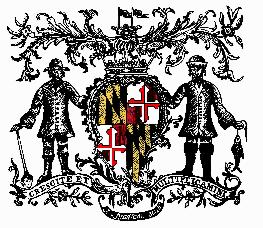
Sparrow Seal. This seal first appeared in 1765 on the title page of the Reverend Thomas Bacon's compilation of the Laws of Maryland, and until 1793 it ornamented printed editions of the session laws of the Assembly. Carved on a wood block by Thomas Sparrow, ward and employee of the Annapolis printer, Jonas Green, the Sparrow seal bears the Latin motto "Crescite et Multiplicamini," which means "Increase and Multiply." To the general assembly and the advocates of a written constitution for Maryland, that meant articulating in Declaration of Rights and Constitutional provision form what that government should be and what individual freedoms that government ought to be protecting.
On November 4, 2014, Maryland experienced a gubernatorial race that some election result divines thought was too close to call. Instead it proved a victory against incumbency at a time when a majority of voters were apparently alienated from government at the state level and by political gridlock in Congress. Another election night 150 years ago last October 12, was too close to call. On that day voters went to the polls to vote on a proposed constitution which provided for the emancipation of the slaves in Maryland. It would take from October 12, when the polls opened, until the Governor completed his review of the soldier vote on October 29th, that the new Constitution was proclaimed in effect as of November 1, 1864.
Two important anniversaries occurred in 2014 that deserve close attention as written reminders to each successive generation of Americans that even in the most contentious times, if we focus on the fundamentals of what we expect of our government there is the promise of progress. The first anniversary marks the adoption of the Maryland Constitution of 1864 that became effective on November 1 that year. The second honors the publication in 1964 of a seminal study of the political fight that led to emancipation.entitled The Mighty Revolution, Negro Emancipation in Maryland, 1862-1864, by Charles Wagandt (Baltimore: Johns Hopkins University Press, 1964).
As a border state that remained in the Union, Maryland’s constitution prior to November 1, 1864, and the black code that enforced it, condoned slavery. Slaves were considered nothing more than a permanent labor force, the property of the slave owner to do with much as he or she pleased. They were included in the inventory of personal property at the slave holder’s death, along with cows, sheep, horses, and household furniture. Maryland did permit property owners to free their slaves within the context of increasingly restrictive laws. As a result the ‘free’ population of former slaves and their offspring was nearly equal to the enslaved in Maryland on the eve of the civil war, but without a semblance of citizenship.
There were a considerable number of citizens of Maryland who were opposed to slavery. There will always be the academic argument how many and whether or not they were a majority of Marylanders, but the history of the struggle to abolish slavery in Maryland legally through a revision to the Constitution is an excellent way to probe the attitudes and mindsets of all Marylanders in 1864 as they confronted the bloody consequences of a civil war that seemed far from ending.
Anyone wanting to understand the politics of emancipation in Maryland must begin by reading Charles L. Wagandt’s The Mighty Revolution. He mined the sources available to him with great effect, assessing the political process and the results with great skill, but his book is not the end of the story, but merely an excellent beginning with which to reflect and move forward in the quest to better understand what happened, and what that means in terms of reinforcing the legal framework of American Democracy.
Maryland, after much debate, and a very close vote of adoption (263 votes out of over 60,000 votes cast) and rebuilt its fundamental written law to exclude slavery. Slaves were emancipated, but what that meant was far from decided and would require innumerable battles at the polls and in the courts, even, sadly the streets, extending to 1964, the year of Wagandt’s seminal work, and beyond.
Election Returns, Maryland Constitution of 1864, Vol.667, pg.97
William Starr Meyers. Johns Hopkins University Studies in Historical and
Political Science MARYLAND STATE ARCHIVES (Archives of Maryland Online)

This return includes the tally of Union soldiers whose 2,633 votes for the Constitution was the deciding factor in abolishing slavery in Maryland. Governor Bradford reviewed all of the soldiers votes (the Maryland State Archives still has many of the ballots) and threw out some, leaving a majority of 263 for the constitution of 1864.

Series Information: GOVERNOR (Election Returns) 1838-1895 MSA S108
Images from tallies of ballots cast. Items in the series include total votes for each candidate. Records grouped by office (e.g., sheriff, U.S. Representative, and Presidential Electors). Also contains Constitutional Convention referendum results (1851, 1864, and 1867) as well as ballots cast by soldiers while on duty during the Civil War. Arranged chronologically and by county and office. These are samples of the paper ballots cast in the ratification of the proposed constitution (October 12) and the general election for President in November, 1864.
That the soldiers on the battlefields were key to the Constitution’s adoption as well as the Presidential election that followed, is without question. Without those votes, the citizens at home would have defeated the Constitution, leaving it to the Federal government to compel the emancipation of the slaves which it would do for the conquered slave states and the other border states the following year.
Maryland would be one of the earliest states to ratify the 13th Amendment to the Constitution. In fact it was deliberating on ratification on that day in early February 1865 when Lincoln passed through Annapolis, unannounced and barely heralded on his way to meet with the Confederate Commissioners.

What is significant about the political struggle for a constitutional emancipation in Maryland is that it occurred at all at the state level. The process was a tumultuous one chronicled by Charles Wagandt, in which military interference, political chicanery, and the usual dirt of American politics all played a part. In 1864 whether or not slavery should continue or be abolished was seen by both sides as a matter to be resolved constitutionally locally and not by military, presidential, or Federal legislative decree. In terms of the evolving concept of what constituted American Democracy, Maryland did it right, following those states to the north and northwest that had already done so. Maryland followed Thomas Jefferson’s dictum that every generation should examine its legal foundations to see if they were indeed sound or need of repair or rebuilding.[1]
For the most part, the opponents to emancipation fought their battle in the convention, the election, and in the courts, always believing that even if they lost, at least they would be compensated for the property they surrendered to freedom. When President Lincoln heard the news of Maryland’s constitutional emancipation, he told a crowd at the White House that he congratulated Maryland, but regretted the failure to adopt emancipation two years earlier, for then it “would have saved to the nation more money than would have met all the private loss incident to the measure.” [2] In defeat the opposition, as did Lincoln, expected compensation to be paid for property lost, and with the loss of Lincoln that April as an ally, sought to re-enslave the healthy former slaves through a prolonged ‘apprenticeship,’ that was to be administered by the Maryland Orphan’s Court. That too was resolved constitutionally, but required appeals to the Supreme Court and an opinion by Chief Justice Salmon P. Chase, successor to Maryland’s Roger Brooke Taney who, coincidentally, died on the day that Marylanders went to the polls to vote on the new Constitution (October 12, 1864).[3]
Slaveholders in Maryland had looked with some envy as well as apprehension when, by act of Congress, slavery was abolished in the District of Columbia in 1862.
To quote the National Archives web site:
:
According to the census of 1860, there were 3,185 slaves resident in the District of Columbia. Clearly no slaveholder there ‘lost’ any of his property without the ‘just compensation’ owed him or her under the 5th Amendment to the U. S. Constitution.[4]
The ambivalence of Marylanders to the consequences of emancipation if extended to Maryland, is clearly evident in a Frederick County newspaper editorial “The Negro Problem” which was published on the eve of emancipation in the District of Columbia. Emancipation is a noble goal, but the unforeseen consequences of abolition were a cautionary tale for Marylanders, slave and non-slaveholders alike.

from the Republican Citizen, a Frederick County newspaper, April 11, 1862,
Maryland State Archives, scm 10418-03
It has long been assumed that the nickname for Maryland as the “Free State” was first given tongue in cheek by the Baltimore Sun[5] when Maryland failed to enforce prohibition in the 1930s. That was not the case. The first time Maryland was called the “Free State” was by a Boston newspaper announcing the adoption of the 1864 Constitution and emancipation of the slaves:
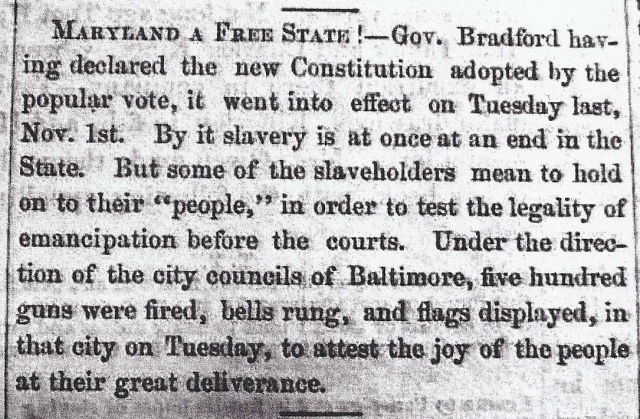
Boston (AN2.M4B62817) Commonwealth published weekly
Sep 6, 1862-Dec 28, 1895, November 5, 1864 issue
An Eastern Shore newspaper echoed the praise of the Philadelphia Inquirer :
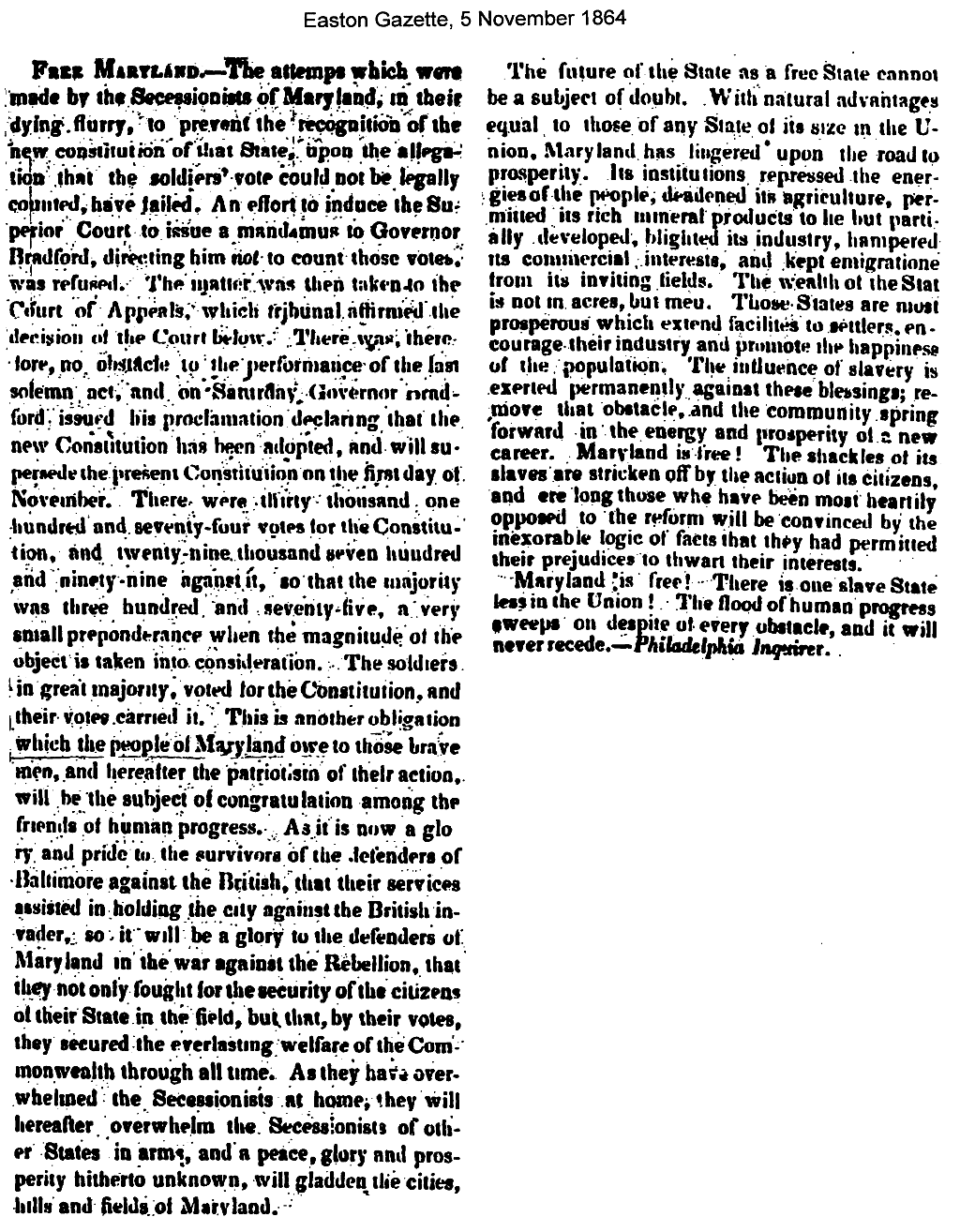
Special Collections (Easton Gazette) "Free Mayland", November 5, 1864, p.3
The Easton Gazette, a Talbot County newspaper, printed this article from the Philadelphia Inquirer. The article is a congratulatory message to the citizens of Maryland as it joined the ranks of free states in the Union. It points out that the constitution was passed in spite of a secessionist push to have the Superior Court of Baltimore City demand Governor Bradford disallow the soldier's votes that proved the difference in the ratification of the proposed constitution
The reaction in Baltimore City to the adoption of the proposed Constitution was jubilation. Robert Schoeberlein pointed this out in his blog entry:
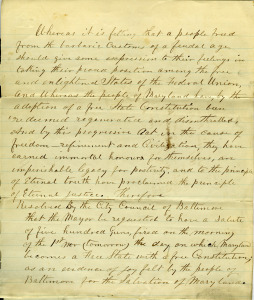
Resolutions in honor… New Constitution, BCA BRG16-1-134-16-24
On November 1, 1864, Maryland abolished slavery when a new state constitution forbidding the practice went into effect. The simple words of Article 24 of [the Declaration of Rights] of that document stated:
“[T]hat hereafter, in this State, there shall be neither slavery nor involuntary servitude, except in punishment of crime, whereof the party shall have been duly convicted; and all persons held to service or labor as slaves, are hereby declared free.”
How did the Baltimore City government react to the news of emancipation? The all-male, all-white City Council passed a remarkable resolution that starts:
Whereas it is fitting that a people freed from a barbaric custom of a feudal age should… tak[e] their proud position among the free… Whereas the people of Maryland have by the adoption of a free State Constitution have been redeemed regenerated and disenthralled, And by this progressive act in the cause of freedom… have earned immortal honors for themselves….
A committee of the City Council, at the urging of Mayor Chapman, arranged for a 500 gun salute “as an evidence of [the] joy felt by the people of Baltimore for the Salvation of Maryland.”
Chapman further requested that church bells ring at sunrise to greet the dawning of this new era.
How did Baltimore’s African American population greet the news of emancipation? According to the Baltimore Clipper newspaper:
The colored portion of our community converted [the first of November] into a day of holiday, thanksgiving, and prayer… they donned their best attire, and social reunions were indulged in… [t]he various churches were thronged during the entire day, and at the church on Saratoga Street [Bethel A.M.E.]… the place was crowded, and at times it was impossible for a vehicle to pass… so dense was the mass of persons.

Emancipation Day activities in Baltimore, Baltimore Clipper, November 2, 1864,
msa_sc3895_2_23_1864_11-
Harper’s Weekly in its October 29, 1864 issue headlined “All Hail Maryland!”
ALL HAIL, MARYLAND !
THE Maryland soldiers have achieved one of the grandest victories of the war. They have lifted " the despot's heel" from the shore of their Maryland. Their vote has redeemed their State from the curse of Slavery, and anchored it first and forever to the Union, whose cause, as the old Continental Congress declared, " is the cause of human nature." Their victory shows that they, too, understand the meaning of this war. They perceive that it is the armed insurrection of the privileged few against the laboring many. They know that the great slaveholder is the direct rival of the free laborer who lives by his daily wages. They know that while the system lasts permanent peace is impossible, and having learned in the battle-field and the Southern prison that the tender mercies of slavery are cruel, they have, with one master blow, demolished the root of the war in the soil of Maryland. It is indeed "a glorious victory." God bless the Maryland citizens at the front and the Maryland citizens at home
and on December 4, thanked “God for Maryland Freeing Her Slaves” in one of the many woodcuts the magazine published during the war.

The opponents of the Constitution took their cause to the state courts, instituting a lawsuit challenging the inclusion of the soldiers vote.
The case was argued unsuccessfully in the lower court by a highly regarded slave owner lawyer by the name of William Schley and lost on appeal to the Maryland Court of Appeals in a final decision rendered on October 29, 1864 that permitted Governor Bradford to proclaim Emancipation effective November 1..

Image source: Maryland State Archives SPECIAL COLLECTIONS (Judge James F. Schneider Collection relating to the History of the Courts and the Legal Profession in Maryland) William Schley 1863 autographed Cartes de Visite, courtesy of the Library Company of the Baltimore Bar, MSA SC 5598-4-129
Schley (1799-1872) was an early supporter of Lincoln and the Union Party in Maryland. Lincoln came in a distant third in Maryland in the presidential election of 1860 and was threatened with assassination if he made a public appearance in Baltimore on his way to his inauguration. As Charles W. Mitchell records in his Maryland Voices of the Civil War, Schley defended Lincoln’s avoiding Baltimore. On February 23, 1861, Schley wrote:
A vast crowd was present at the Depot to see you arrive this morning, but at “Ten” you may judge the disappointment at the “announcement” of your “passage” through unseen, unnoticed and unknown--it fell like a thunderclap upon the Community --was denied as a “hoax” --&c until the truth was made [known] beyond a doubt --A large “police force” was present to preserve the peace, besides your many friends to resist attack--which I now declare was meditated and determined. By your course you have saved bloodshed and a mob.[6]
Schley was from a prominent Frederick County family where he pursued his runaway slaves and practiced law.

"For the apprehension and delivery of my negro man Leonard." Frederick Town Herald, 7 July 1828,
In the 1830s he sought his fortune as a lawyer in Baltimore City, after marrying the daughter of a prominent Washington County slaveholder whose entangled estate he would continue to defend until his death in 1872 of smallpox.[7] By 1864 he was disillusioned with Lincoln and Seward, with whom had argued that the arrest of Marylanders without benefit of Habeas Corpus was unjust and unwarranted.[8] In 1864, disillusioned with President Lincoln, he cast his lot with the Democrats becoming an elector for the Democratic Candidate, George McClellan. He articulated his reasons why in a speech published on Wednesday, November 2, 1864, the week before Marylanders went to the polls.

"Address of William Schley, Esq." The Sun, 2 November 1864
Emancipation came to Maryland through an underlying belief apparently held by most voters that it had to be done within the framework of the state constitution and the law, if it was to be done at all. When it finally came on November 1, 1864, the Emancipation provision was not contained within the operational body of the new constitution, but rather in the declaration of rights, Article 24, and it did not address the question of citizenship. The slaves were free, but their rights as free men and women were circumscribed by the lack of voting rights, the lack of the right to participate on a jury, and the failure to provide free and equal access to education. That would be a long and tortuous path, filled with legal obstacles. Fortunately, however, because Maryland provided a constitutional basis for freedom from slavery, coupled with an acceptance of the negro’s right to vote (even though Maryland refused to ratify the 15th Amendment until 1973), former slaves would have their own advocates, trained in the law, to lead the way to further legal and constitutional change, with one of their own ultimately being elevated to the Supreme Court of the United States.
To better understand what happened, how it happened, and why it happened, it is essential for at least every generation to be able to return to the surviving record, insisting that it is retained as quickly and efficiently in a permanently available, publicly accessible, virtual repository. It is a critical component of sustaining our democracy that we are able simply and easily to access the surviving records of the past to learn from from them and to improve upon what is learned.
For example, one of the best ways to attempt to comprehend, if not understand, the prevalent racism of 1864, is to actually read the newspapers of the day and the detailed record of the debates in the Constitutional Convention. Where are the on-line, indexed issues of the Baltimore Clipper, the Easton Gazette, and the Frederick Republican Citizen? Putting them online with a modicum of optical character recognition is neither difficult nor expensive, but it must be done in the context of a full understanding of not only what has survived, but what has not. Sadly much of the newspaper print world of the 19th and 20th century has not survived (or will not without optical character recognized imaging done very soon). Given the advent of the ‘Cloud’ and volunteers with sufficient desktop power to create the e-pub, the cost to the archives of production of the e-publication would be nominal, leaving the real cost, apart from imaging, to be the pennies per e-pub page charge for perpetuating them in a web-based server environment.
The cost of the initial imaging cannot, of course be overlooked, but with the low cost of flatbed scanners and economies of scale, the cost of scanning original pages can be reduced significantly, especially if willing and able volunteers are enlisted to do the work.
Caution, of course, needs to be exercised in evaluating what is found in the newspapers, just as reliance on the surviving correspondence and legal briefs of identified actors, must be carefully evaluated. The repositories of the archival material must help evaluate and explain the evidence they make available, as well as looking beyond their own holdings to source material elsewhere.
For example, if the Maryland State Archives does, as I hope it will, and places optical character recognized copies of all of the surviving issues of the Baltimore Clipper on line from its collection of originals, as well as of the Frederick Republican from its microfilm collection, it also needs to explain that missing issues may be held elsewhere while at the same time incorporating the scholarly cautions of historians like Charles Wagandt into its guide to Maryland newspapers. As Charles Wagandt points out:
Newspapers too slipped into the ring of patronage seeking [during the Civil War]. The Baltimore Clipper offered to sell Montgomery Blair a two year control of its political sentiment. Five thousand dollars plus government advertising and printing for Maryland was the requested fee along with the salary of the editor and any assistant.[9]
Other forms of evidence than the written word need to be brought into the re-examination of the historical narrative from oral histories, to photographs to artifacts of every kind. Perhaps nothing is more important than a good genealogy of family and associations. The recent study of just one family divided by the war yet united on so many different levels makes that abundantly clear in an enjoyable narrative form,[10] while understanding William Schley’s family obligations brought by his marriage into the slaveholding Ringgolds helps inform the assessment of his role in the anti-constitution camp.
In the end, to be truly emancipated in understanding the past with regard to prevailing attitudes and prejudices, and to formulate strategies to influence the minds and hearts of the present on all manner of public policy, public support of the custodianship of the surviving record and its translation into a permanent , readily accessible, affordable, virtual world is of the highest priority. Without that attention to the preservation of and access to the surviving record whether paper or virtual, by those who are meant to be the guardians the goal of in an informed and inclusive democracy is doomed. Without persistent identification and explanation of the historical record in tweetable terms that entice the tweeters to go beyond acronyms of communication, to perhaps go and read a good book (tactile or kindle) and to delve into a re-evaluation of the historical record, archives have no sustainable future. Tweet and blog to reach the broadest possible audience, but provide that audience with the teasers, the means and the incentive, to emancipate themselves from fragmented conversations and to allocating some of their online time to exploring the stories of the past in greater depth, as well as opening up their pocketbooks to assist in the survival on line of the records that make that exciting and self-edifying exploration possible. Archives and Special Collections desperately need the support and vision to implement a permanent, virtual archive of their holdings, placed in the topical and biographical context of where else those holdings lead. Following the archive.org model, each institution holding any records of value must move a virtual representation of them on to servers and storage devices they own, along with all the born digital exhibits and substantive blog entries that they currently farm out to fleeting and expensive service providers. That such a virtual place could be a shared resource among big and little institutions, is probably best, but getting the big institutions to assist the small ones at minimal charge may prove to be too great a challenge.
In facing the challenges of the virtual world, archivists and special collection curators must own their own virtual world and not leave it to the Fold3’s or the Gales of this world to be the proprietary and expensive purveyors of knowledge. Excellent on line exhibits, fully documented, like that of the Maryland Historical Society’s Key Items Tell Maryland Emancipation Story must be permanently and freely accessible to the public on society owned and operated servers with open source software and cloud associated local storage.[11] Institutions cannot depend upon hardware and software, let alone storage that they do not control for their virtual presence. It must be open source and transmutable with little expense from one generation of virtual environment to the next. It is a serious mistake to allow the Apple’s of this world to defeat with the change of an operating system what was meant to be a permanent app for the enjoyment of Bach’s brilliant Goldberg Variations.

courtesy of http://opengoldbergvariations.
For a brief moment in time, on my IPAD, I could listen to a superb artist play all the Bach Goldberg variations while following every note of the music as it was played on the image of the score, much like the bouncing ball of music hall fame.. It was glorious and I expected it to always be there for me, but that was not to be. As Robert Douglass of http://opengoldbervariations.
this is the sad consequence of Apple changing the technologies and terms of iPad apps. It caught us by surprise as well. I need to remove the link from the website.
MuseScore is currently looking for an intern who would be able to work with them to upgrade the app to the new IOS version, in case you know of any aspiring young programmers who love music and open source software.
Let’s hope that as institutions venture out into the virtual world they do not fall into the trap of having to say at some time in the future, figuratively, Goodbye to Bach with their virtual world lost for ever. It isn’t just our heritage that is at stake, it is civilization as we are able to remember it.
.
[1] Maryland’s Constitution of 1851 required the General Assembly to conduct a referendum after each census to see whether voters desired a new constitutional convention. The current constitution calls for a referendum every 20 years:
It shall be the duty of the General Assembly to provide by Law for taking, at the general election to be held in the year nineteen hundred and seventy, and every twenty years thereafter, the sense of the People in regard to calling a Convention for altering this Constitution; and if a majority of voters at such election or elections shall vote for a Convention, the General Assembly, at its next session, shall provide by Law for the assembling of such convention, and for the election of Delegates thereto. Each County, and Legislative District of the City of Baltimore, shall have in such Convention a number of Delegates equal to its representation in both Houses at the time at which the Convention is called. But any Constitution, or change, or amendment of the existing Constitution, which may be adopted by such Convention, shall be submitted to the voters of this State, and shall have no effect unless the same shall have been adopted by a majority of the voters voting thereon.[1]
[2] quoted from Charles Wagandt, The Mighty Revolution… (Baltimore: The Johns Hopkins University Press, 1964), p. 264.
[3] Richard Paul Fuke, Imperfect Equality (New York: Fordham University Press, 1999), ff., but especially the case of Ex Parte Elizabeth Turner from Talbot County, pp. 81-82.
[4] Preliminary Report on the Eighth Census 1860 (Washington: Government Printing Office, 1862) p. 131.
[6] Charles W. Mitchell, Maryland Voices of the Civil War (Baltimore: The Johns Hopkins University Press, 2007), p. 29.
[7] see the admirable beginnings of a biography of Schley on the Maryland State Archives web site: http://msa.maryland.gov/msa/
[8] see Charles W. Mitchell, Maryland Voices, p. 248.
[9] Wagandt, The Mighty Revolution, p. 188.
[10] Helen Drury Macsherry, Pastime: Life and Love on the homefront during the Civil War, 1861-1865 (ISBN-10: 0989140806
[11] When preparing on-line exhibits that feature documents and artifacts from an institution’s collections, the exhibit should intentionally reach out to other institutions holding documents and artifacts relating to the theme of the exhibit. For example in this online exhibit of the Maryland Historical Society, the reference to the papers quoted of one of the members of the Constitutional Convention who opposed emancipation should link to the indexed copies of the debates of the Convention on the Maryland State Archives web site. Exhibits and finding aids to the collections of a given institution should take the reader beyond the walls of the institution. The importance of integrating virtual exhibits into the fabric of the permanent virtual world is no more apparent than the virtual loss of one of the finest and most provocative exhibits ever produced at the Maryland Historical Society called “Mining the Museum.” It is also essential that citations be used in any blog writing that accurately bring the reader back to the virtual source. By doing so, not only is the narrative authenticated, but also the reader is aware of the institutional role in preserving and making accessible the underlying documentation.