Sunday, November 25, 2012

Annapolis, the Capital of the United States in Congress Assembled, 1783-1784: the Challenge, and the Last Word?


On Monday, November 26, 2012, it was my privilege to say a few opening remarks at an exhibit of documents and printed materials related to a formative period in American History, the extra-legal efforts of the thirteen British Colonies to separate themselves from British rule between 1774 and 1789, a cause not fully successful until the Treaty of Ghent in 1815, following the Second American War for Independence.


The occasion was the display of documents, printed material, and paintings largely owned by Stanley Klos, supplemented by loans from Seth Kaller, Michael Sullivan, and the organization, Forgotten Founders.

It is a fascinating exhibit, made even more remarkable by the extensive interpretive context provided by Stanley Klos and Mark Croatti, Director of the Annapolis Continental Congress Society, all of which can be found on the Society's web site: http://www.annapolisccs.org. The Society has been organized to promote the story of Annapolis as the capital of the United States from 1783-1784, and the whole history of the Continental Congresses, 1774-1789.

The exhibit is well worth studying carefully as it draws attention to a time when the British colonists south of British Canada took it upon themselves to re-define their relationship to the Crown and Parliament and ultimately to found a new nation out of whole cloth.  They did so by calling for an extra-legal convention of the thirteen colonies that emerged from spontaneous reactions all up and down the Eastern seaboard to the Coercive Acts of Parliament designed  to punish Boston for refusing to pay taxes on tea.  In Maryland, committees all over the colony, well documented by Charles Albro Barker in his Background of the Revolution in Maryland (New Haven: Yale University Press, 1940) and by Ronald Hoffman in A Spirit of Dissension (Baltimore: Johns Hopkins University Press, 1973), reacted strongly to the Boston Port Bill, one of the Coercive Acts, and called for a convention that met in Annapolis in July 1774.  This highly localized response across all the colonies is represented in this exhibit by a November 1774 printing of the Suffolk County Massachusetts resolves against the Coercive Acts, measures that the First Continental Congress would adopt in full by resolution on September 17, 1774:

Resolved unan[imously], That this assembly deeply feels the suffering of their countrymen in the Massachusetts-Bay, under the operation of the late unjust, cruel, and oppressive acts of the British Parliament--that they most thoroughly approve the wisdom and fortitude, with which opposition to these wicked ministerial measures has hitherto been conducted, and they earnestly recommend to their brethren, a perseverance in the same firm and temperate conduct as expressed in the resolutions determined upon, at a [late] meeting of the delegates for the county of Suffolk, on Tuesday, the 6th instant, trusting that the effect [s] of the united efforts of North America in their behalf, will carry such conviction to the British nation, of the unwise, unjust, and ruinous policy of the present administration, as quickly to introduce better men and wiser measures1


While I appreciate fully the importance of paying closer attention to the lessons of the Congresses held between 1774 and 1789, it would be remiss of me not to point out that the beginnings of concerted cooperative efforts among the colonies to formulate joint public policy and resist imperial rule from afar can be traced back to at least 1765, the Stamp Act Congress, and Daniel Dulany's pamphlet written and published in Annapolis:


When the First Annapolis Convention was in the making as a result of the Coercive Acts, Barker recounts (p.369) that "Daniel Dulany is said to have shaken his head, saying that he dreaded the consequences....,"
and consequences there were, ultimately leading to the subject of this exhibit entitled "America's Four Republics Exhibit."

There are many items presented here that will intrigue, educate, and enlighten those who view it, taking care to sort out the facts from interpretation.  There will continue to be those who see John Hanson as the First President of the United States in Congress Assembled and the role of George Washington in promoting our first trading expedition to China ought not, in my opinion, be a topic for debate.  There is no question that Congress authorized the departure of the Clipper Ship Empress of China on January 30, 1784, not George Washington, but our official trade representative, Samuel Shaw got his job with a resounding reference from Washington, and secured so much cargo, including some beautiful dishes intended for the retired Commander in Chief, that he had to charter a second vessel, the Pallas, captained by John O'Donnell of Baltimore where it arrived in 1785. O'Donnell  is better known today for his estate, Canton, which has lent its name to one of the more fashionable neighborhoods of Baltimore.

Apart from the Suffolk Resolves in this exhibit, I am particularly taken by a number of the items lent by Seth Kaller. The provenance of his Washington letter is the same as our holographic draft of Washington's resignation speech given on December 23, 1783, which soon will be on exhibit in the Maryland State House, thanks to the Friends of the Maryland State Archives. Washington threw down the gauntlet to Congress, charging them with caring for his army and stepping up to confront the many problems facing the new Republic.

This original is now on display at the Maryland State House in a specially constructed exhibit case that was dedicated on January 16, 2015


Seth Kaller's  copy of the official proclamation of the announcing the ratification of the Treaty of Paris by Congress on January 14, 1784, is also as intriguing as it is instructive.  When embossed with the Great Seal of Congress and signed, Congress was then meeting in the Old Senate Chamber of the Maryland State House, a short distance from where the document was exhibited.  I wonder if anyone has compared the typography of the broadside to the type of the Maryland Gazette of the same week. Perhaps it  was printed on the same printing press as Daniel Dulany's Considerations in the print shop off of Charles Street?  Maryland still has its own copy, one of thirteen signed, embossed and delivered, although ours is not in very good shape because it hung on the walls of the State House for many years before it was laminated and retired to our vaults. You can read about it on the Maryland State Archives web site accessed from the following image.


From my provincial perspective as State Archivist, I might quibble with the definition of Republic and argue that until the Articles of Confederation were ratified in 1781, it was all a matter of succeeding extra-legal conventions focused, after July 4, 1776,  on the prosecution of a war to end British rule led by George Washington, and that the Confederation itself, the first Republic,  found it powerless to stop the call for another convention in 1787 which in turn sought to form 'A More Perfect Union.'

In both the ratification of the Articles of Confederation and the amending of the U. S. Constitution, Maryland played leadership roles, possibly personified in Daniel Carroll, signer of both the Articles and the Constitution of the United States.


It was no accident that the Philadelphia Convention of 1787 chose September 17, 1787 as the day on which to ratify the Constitution.  John Adams, who was in England as our first minister to the Court of St. James, knew well the importance of September 17, as I suspect did most of the members of the Convention.  In his diary on the day that Congress adopted the Suffolk Resolves on September 17, 1774, Adams wrote:

"This was one of the happiest days of my life," noted John Adams in his Diary. "In Congress we had generous, noble sentiments, and manly eloquence. This day convinced me that America will support ... Massachusetts or perish with her." And to his wife he wrote: "These votes were passed in full Congress with perfect unanimity. The esteem, the affection, the admiration for the people of Boston and ... Massachusetts, which were expressed yesterday, and the fixed determination that they should be supported, were enough to melt a heart of stone. I saw the tears gush into the eyes of the old, grave, pacific Quakers of Pennsylvania." [quoted in the Journals of the Continental Congress, volume 1, 1904, p. 39, n. 1]

September 17, 1787 was also the last time that the Confederation Congress had any significant impact on the newly proposed government.  In his only speech to the Philadelphia Convention, Washington rose to suggest a change in the document to reflect an action already taken by Congress. Washington's remarks and Carroll's motion, led to the only erasure on the parchment ratified that day that changed the nature of representation in the House from one member of congress for every 40,000 people to one member for every 30,000.

As a strong proponent of a powerful, yet qualified, Federal government, Daniel Carroll of Maryland literally had the last word when it came to the Constitution and the views of the founding fathers as incorporated into the document as the first ten amendments.  When called upon to defend the Constitution as drafted in Philadelphia in 1787, he claimed not be a speaker of merit and chose rather to quote Benjamin Franklin on the necessity of improving upon the Articles of Confederation.  When elected to the First Federal Congress, however he took on the cause of amending the Constitution he helped write, sparring with Elbridge Gerry over the wording of the proposed 10th Amendment to the Constitution. It is to Carroll that belongs the honor of adding the words "or to the people" which to this day remains one of the least defined in law and in practice of all the amendments to the Constitution.  Carroll had the last word, but we have the obligation as this exhibit reminds us, of defining what those words mean.


Thursday, May 10, 2012

Fragments of the Star Spangled Banner and the Figures in the Window?


The other day, a neighbor and her brother kindly invited me to examine a family treasure.  It was a dark wood framed display of two photographs and two fragments, red and white,  snipped from the flag that flew over Ft. McHenry during the British bombardment of September 12-13, 1814.


The fragments were taken from a gigantic flag, 30 by 42 feet, made by Mary Pickersgill of Baltimore whose house is now a museum devoted to its history. Recently the Smithsonian spent millions of dollars conserving the remains of the flag, which originally cost $405.90.

from Lonn Taylor, et. al. The Star Spangled Banner, p. 66

After overcoming the sticker shock of recent auction prices of similar, but less well documented pieces of the flag ($35-65,000), we settled down to unraveling the history of the framed fragments before us and of the two photographs that accompanied them.

The fragments were cut from the flag while it was in the care of Captain George Henry Preble, the first serious historian of the flags and pennants of the United States,and sent to Henry May Keim of Reading, Pennsylvania.  Captain Preble had the first known photographs taken of the flag.  A copy of one of his photographs was framed with the two fragments by Keim along with another photograph of a holograph copy of the song by Francis Scott Key that we know today as "The Star Spangled Banner," our national anthem since 1931.   Henry May Keim inherited the autograph manuscript from his father, a friend of Francis Scott Key, and subsequently gave it to the Pennsylvania Historical Society. Before that either he or Preble made photographic copies which they both retained to frame with fragments of the flag.


When Preble framed three other fragments for himself, he used the same photographs of the flag and Key's song as had Henry May Keim.

from Lonn Taylor, et. al. The Star Spangled Banner, p.89


In all, before the flag finally came into public hands in ca.1912, more than 200 square feet of material had been cut away or lost.

The owner has left the family treasure on deposit at the Maryland State Archives for appraisal and possible sale to the Friends of the Maryland State Archives if they can raise the money to acquire it for exhibit as part of the War of 1812 bicentennial celebrations.

But who are the people in the photographs?  Keim's copy is one of two known early photographs of the flag.  The best known has been dated June 21, 1873 and has two figures in the window with the guard below turned slightly to the left.

from Lonn Taylor, et. al. The Star Spangled Banner, p.80
The Henry Keim's and Captain Preble's framed photographs have only one figure in the window and was probably taken within minutes of the other.  Perhaps the single figure in the Keim/Preble photograph is  the commander of Ft. McHenry, Major George Armistead's daughter,Georgiana Armistead Appleton, who lent the flag to Captain Preble, who in turn displayed it unfurled from the third floor of this Boston Navy Yard building?  Her 1860 photograph suggests that climbing to the third floor may have been too great a challenge.  Who is the marine? standing guard.  Might he be African American?  The flag remains embedded in our memories, as one of the great treasures of our Nation.  The figures in the window and on guard deserve to be remembered as well.

Note on Sources and Flag Conservation:

The best overall book on the history of the Fort McHenry flag is Lonn Taylor, Kathleen M. Kendrick, and Jeffrey L. Brodie, The Star-Spangled Banner. The Making of an American Icon, New York: Harper Collins, 2008. The best overall study of the song by Francis Scott Key inspired by the Fort McHenry Flag is P. W. Filby and Edward G. Howard, Star-Spangled Books, Baltimore: Maryland Historical Society, 1972.  See also George J. Svejda, History of the Star Spangled Banner from 1814 to the Present, Washington: National Park Service, 1969. Images other than those from Henry May Keim's framed fragments are excerpted from Lonn Taylor, et. al. The Star-Spangled Banner.  The Wikipedia article on the Star Spangled Banner Flag provides a good overview of the history and recent exhibits of the Ft. McHenry Flag including fragments.  It also provides an example of recent auction prices for fragments: http://en.wikipedia.org/wiki/Star_Spangled_Banner_Flag. The fragments continue to surface. When the American Antiquarian Society examined the contents of one of Captain Preble's pamphlet on the Ft. McHenry flag, they found fragments tucked inside. They were together in the shape of the Texas flag (sans star). Because they had been protected from the light these fragments are more vibrant than the Keim snippets, or those that were brought together in a 2008 Smithsonian exhibit. See: Robert M. Poole, Star Spangled Banner Back on Display, Smithsonian Magazine, November 2008 (http://www.smithsonianmag.com/history-archaeology/star-spangled-banner.html, accessed 2012/05/12)

How to preserve and conserve flags is an expensive proposition.  The Smithsonian spent $18 million dollars on conserving the Ft. McHenry flag, having to undo a well-intentioned (and patented) method that had been employed when the flag was given to it in 1912. As one web site notes: "When the Star Spangled Banner Flag was donated to the Smithsonian in 1912, it was already tattered and in very poor condition. The Institution began a restoration effort in 1914 by hiring Amelia Fowler, a well-known flag restorer and seamstress. She hired ten seamstresses who worked on the flag for eight weeks. First they removed a canvas backing that had been attached to the flag for the 1873 Boston Navy Yard photo. Then they attached a new linen backing with 1.7 million stitches to form a honeycomb mesh across the back of the flag. This mesh of stitches was intended to secure the fabric of the flag and prevent it from falling apart." 

(http://www.revolutionary-war-and-beyond.com/star-spangled-banner-flag.html, accessed 2012/05/12).  Amelia was quite an entrepreneur.  She was employed by the U. S. Naval Academy and the State of Maryland to 'conserve' their battle flag collections.  At the Maryland State Archives we have large collection of Maryland's Battle flags that are a product of her work, and insufficient funds to reverse the damage her method inflicted on them.


Wednesday, May 9, 2012

Private Property and the American Dream


The ownership of private property is at the heart of the American Dream. From the very beginnings of the United States the right to own and defend private property has been asserted, cultivated, and enthroned in the constitutional and statutory laws of the country. It is also at the heart of the Great American Tragedy, slavery, which was ultimately embedded in Federal Law through the 1850 Fugitive Slave Act that firmly asserted slaves as protected personal property, and was only uprooted Constitutionally in December 1865 with the adoption of the 13th Amendment, after the national trauma of a bloody Civil War, the consequences of which still haunt us as a nation.

Recently the Boy Scouts of America, Baltimore Area Council, identified 19.014 acres in Harford County, Maryland, that had long been used for camping and hiking trails, but for which they could not establish title.  They successfully argued that the land was 'vacant', meaning that it was never granted to a private party under conditions of ownership that reach back to the founding of Maryland.  In doing so, the Boy Scouts of America, Baltimore Area Council, have upheld a tradition central to the American Dream and established their rightful possession of a tract of land, that, because of the failure of the person who first identified it to follow through in legally acquiring it, had lain overlooked and unowned for over 200 years. Any one of the surrounding landowners of that ‘vacant’ land who happened to have their own property surveyed over those years, simply assumed that what proved to be ‘vacant’ was owned by the successors in title to the person who first thought about claiming it. The question was never raised until the Boy Scouts and those assisting them began probing  their legal right to possess and use the land.  In the end, with the help of a professional surveyor and  a thorough searching of the land records, they made their case before the Commissioner of Land Patents at a hearing held on March 28, 2012.

Without question, the Boy Scouts are to be commended for the care and thoroughness with which they documented and argued their case.  It is to be hoped that they will take it upon themselves to also help document the history and the lives of those who held the neighboring properties as a part of the effort to enrich the stories of both the bright and the dark side of the evolving American Dream.

For example, Harford County had its share of slaves and free blacks in a state that legalized slavery until November 1864. In the 1814 raid of the British on Bush River during America’s second war for independence, four of Aquila Nelson’s slaves fled to the British frigate Menelaus on the promise of freedom, led the British back to wreck havoc on the property of Bush River residents, and helped take the schooner Fox as a prize. The four men possibly went on to join the British Marines, accompanying those who fought with the British at the Battle of North Point and the Battle of New Orleans. By the time of the Civil War, the county’s slave population had declined to about 1,800, while the free black population was about 3,644. There were at least 168 black men who claimed to have been born in Harford County who joined the United States Colored Troops during the American Civil War, fighting to extricate the concept of human beings as private property from the laws of the land. One such veteran was William Watson from nearby Dublin who joined the famed 54th Massachusetts. Another was a Lewis Stump, perhaps associated with the Stumps who lost property in the 1814 raid by the British. One of the neighbors to the vacant land was slave owner Eliza Chase Coale, the daughter of one of Maryland’s signers of the Declaration of Independence, a slave owner himself. It is known where Eliza is buried on her estate, Westwood, in Harford County, but not her slaves, although the slave quarters have been documented. Nor do we yet know much about those former slaves and free blacks who were Harford County natives who fought with the Union for their freedom, possibly including the slaves and their descendants claimed by Aquila Nelson, Eliza Coale and their descendants.


In researching the surrounding ownership of the vacant land, the Boy Scouts have brought themselves close to the heart of the Great American Tragedy, and have an opportunity now to help tell the stories of the lives of those affected by it, both black and white, thereby contributing to the necessary healing process so essential to the definition of the modern American character. I encourage them to do so, working with the Maryland State Archives as it continues to document the lives of all Marylanders, slave and free (see The Legacy of Slavery, http://mdslavery.net). The map above is but one example of how the fragmentary sources related to the lives of free and slave can be brought together on the ancient maps of the county through such free dynamic mapping resources as Google Earth. In this case the inter-active map can be accessed from the biographies of all those shown on the map.

As to 19 acres of vacant land identified by the Boy Scouts, the State Archivist is directly involved in determining ownership for two reasons. Apart from his legal and constitutional obligation to preserve and provide access to the permanent records of the State that document property ownership, the Archivist of Maryland is also the Commissioner of Land Patents. The Commissioner of Land Patents derives his responsibilities by Charter and statute from the original land grant to Cecil Calvert, second Lord Baltimore, to all of what is today, Maryland. He established the land grant policies that the State of Maryland took over in 1776. Original grants of land to private individuals were, and still are, called land patents. They are the starting point for all land titles in Maryland, followed by deeds, mortgages, and other means of title transfer that we document in http://mdlandrec.net. If any piece of property cannot be traced back to an original land grant (Patent), there is a possibility that there never was a land grant and that it is available for the giving by the State (at a price, of course, related to the current value of the land). The Commissioner of Land Patents is charged with determining whether the claim for the land is valid, and if so, recommends its granting to the applicant by the State, the final step of which is approval by the Board of Public Works and a land grant signed by the Governor. Any proceeds from the transfer of the land from State ownership to the Boy Scouts will be used, as provided for in law, to further the research and writing goals of the Maryland State Archives, including the employment of interns on the Legacy of Slavery (http://mdslavery.net) project.

Note on sources:

One of the best introductions to the Fugitive Slave Act and its consequences is Don E. Fehrenbacher, The Dred Scott Case, Its Significance in American Law & Politics (New York: Oxford University Press, 1978). Chief Justice Taney in Ableman v. Booth, 1859, upheld the constitutionality of the Fugitive Slave Law. Ibid., p.453. For the ratification of the 13th Amendment see: http://en.wikipedia.org/wiki/Thirteenth_Amendment_to_the_United_States_Constitution. Maryland was the fourth to ratify in February 1865 during an unannounced and unheralded visit of President Lincoln. For the abolition of slavery in Maryland see: http://www.msa.md.gov/msa/speccol/sc2600/sc2685/html/conv1864.html. See also the biographies of Aquila Nelson MSA SC 5496-050755, Peter, George, Mark, and Primus, Eliza Chase Coale, http://www.msa.md.gov/msa/speccol/sc3500/sc3520/015800/015881/html/msa15881.html
Dr. Skipwith H. Coale, http://www.msa.md.gov/msa/speccol/sc3500/sc3520/015800/015882/html/msa15882.html

Thursday, February 2, 2012

"The devil is in the details"

Probably the greatest challenge facing any Archives is acquiring the resources necessary to properly store and make accessible its holdings whether on paper or electronic.  The Maryland State Archives is no exception.  Recently the Baltimore Sun featured our efforts to find space for the Baltimore City Archives to salvage a much neglected collection that reached back to the days of the founding of the city in the first decades of the 18th century, and included such much damaged treasures as all the details that went into the defense against the assault of the British in 1814.

One such detail was the moldy, water stained, and vermin eaten letter of the then Governor Winder, writing to Baltimore City Mayor Edward Johnson delegating his military authority to the General on the spot, Samuel Smith, as well as the assurance that he was doing everything within his power to supply the defenses of the town.  We saved the letter just in time before it disappeared altogether.

In our efforts to save Baltimore City's records, we were fortunate in getting a grant from the National Historical Publications and Records Commission to catalog on line what had survived and indeed images of this letter are also on line along with all the records we are finding that relate to the War of 1812 in which Baltimore played a key role in defining the future of America as we know it, as well as providing us with the inspiration for our National Anthem.

With the help of the city we also got some breathing room with regard to absorbing the annual demand for transferring permanent state records (about 6,000 cubic feet of records a year) and the pending state backlog (24,000 cubic feet).  The storage space is not ideal for archival records, nor are the other three warehouses where together we store over half of the archival heritage of the State.  As of this writing, we are out of space altogether and cannot take on anything more than a few more small transfers.  In terms of future efforts to understand the origins and development of public policy and the search for community and family roots, we are in crisis. A democracy cannot survive without a transparency in government that extends to the historical record and the ability to reflect on how to effectively build upon past successes while avoiding past mistakes.

At this point the question might arise as to why, instead of saving so much paper, we do not just scan and destroy to save space.  While we do scan and deliver images of our paper holdings as the research needs arise, the cost to scan wholesale and destroy the paper is vastly more expensive than properly storing them in an archival facility, not to mention that an image of a paper record cannot economically address all the issues of authenticity such as watermarks and the traces of intentional forgery.  It is true that one day we may be  a truly paperless government and our archives of the future all born digital records, but we seem to have a long way to go before that happens.

To date we have proposed two plans for the storage and access to our archival heritage  which I will call Plan A and Plan B.  Plan A, carefully researched and documented, called for the extension of our present facilities, largely underground, with public park above. I still think it the best approach and the best idea, but in these tough economic times it is simply unaffordable.   Plan B is to build or purchase and renovate a remote facility. It is an idea we broached several years ago with the Hall of Records Commission, modeled on the well-designed facility built by Johns Hopkins in Howard County as remote storage for their library system.


We returned to it with careful attention to what the private sector may have to offer, especially in a soft commercial real estate market for lease and/or purchase.  Our conclusions and detailed recommendations are now lodged with the Department of Budget and Planning.  Our hope is that they will be released very soon in response to the requirement of last year's Joint Chairman's report.  Our argument there is that for approximately $15,000,000 the State should purchase and renovate to archival standards a commercially built warehouse large enough to accommodate our projections of the accumulation of permanent archival records through the next 15 years, including consolidation from our current warehousing, and not renewing our expensive leases for non-archival commercial warehouse space as they expire.   In making this recommendation, we recognize that, given a robust records management program in all State and Local agencies, the private sector can more efficiently and cost effectively store and destroy temporary records.  Our recommendation for State owned and operated space extends only to the permanent historical records of the state so that, for example,  the proceedings of the legislature and the governor's correspondence of the future (both paper and electronic), do not suffer as Governor Winder's letter did.

We also need to do better by the employees who are  critical to the operations of the Archives.  At present approximately half are contractual, of whom a large number have worked hard and well for us for many years. We have proposed a plan of contractual conversion and have every hope that this year it will be adopted, especially because it is funded, not by general funds, but by special fund income derived from the archival services we provide at a reasonable cost to assist in the creation and maintenance of permanent records. For example, special fund income supported our creating one of the most successful cost effective electronic archives in the country, and is sufficient to fund contractual conversions.

While the basic infra structure of housing and caring for the Archival Heritage of Maryland is a cost most effectively and least expensively met by a State owned and operated facility, much of the value added work of the Archives can be and is supported through grants and the generous donations of private individuals.  Most recently our efforts to utilize the archival resources of the State to document the lives of slaves and those who claimed them as property have been supported by two significant grants from the U. S. Department of Education.  This has resulted not only in a remarkable research web site, but also a traveling exhibit that has excited public interest in, and additional support for, research and writing (http://www.mdslavery.net/exhibit/html/index.html).

Because of the down turn in the economy, however, there will be far less federal grant money, if any, available to help continue the work of  http://mdslavery.net. We are redoubling our efforts to find other sources of funding from the private and non-profit sector.

We do continue to receive gifts of manuscripts and funds for the restoration of a very small portion of our art and artifact collections.  Take for example the portrait of Governor Winder which is typical of the need for care and maintenance of all the artwork for which we are accountable.  With the assistance of the Senate the portrait was conserved and is now on display in the State House.


We are also grateful for the support for public exhibits such as the funding that came last year for restoration of the Old Senate Chamber and exhibits in the restored Old House of Delegates Chamber.  To compliment that funding, we have raised $200,000 in private funds for the building of an exhibit for the State House featuring Washington's draft of his resignation speech as commander in chief, and recently have been given a $20,000 manuscript letter that details the British reaction to all the effort that Governor Winder, General Samuel Smith, Mayor Edward Johnson, and the citizens of Baltimore put into defeating the superior naval and ground forces that attacked Baltimore in September of 1814. In part Sir Pulteney Malcolm, Vice Admiral, writes his wife Clementia from aboard the British Frigate Royal Oak, just after the battle and his good friend General Ross has been killed by sniper fire:


The Friends of the Maryland State Archives are actively working on behalf of the Archival program and are directly funding projects that get the word out about the importance and value of the State's Archival Heritage. Apart from raising the funds for the exhibit case for the Washington document and a member of the board giving the funds to acquire the British reaction to their Baltimore defeat, the Friends are funding a number of publications, one of which goes to the theme that if we want to learn anything new and possibly instructive about ourselves and our past, we need to pay close attention to the preservation and close examination of the details contained within our collections.

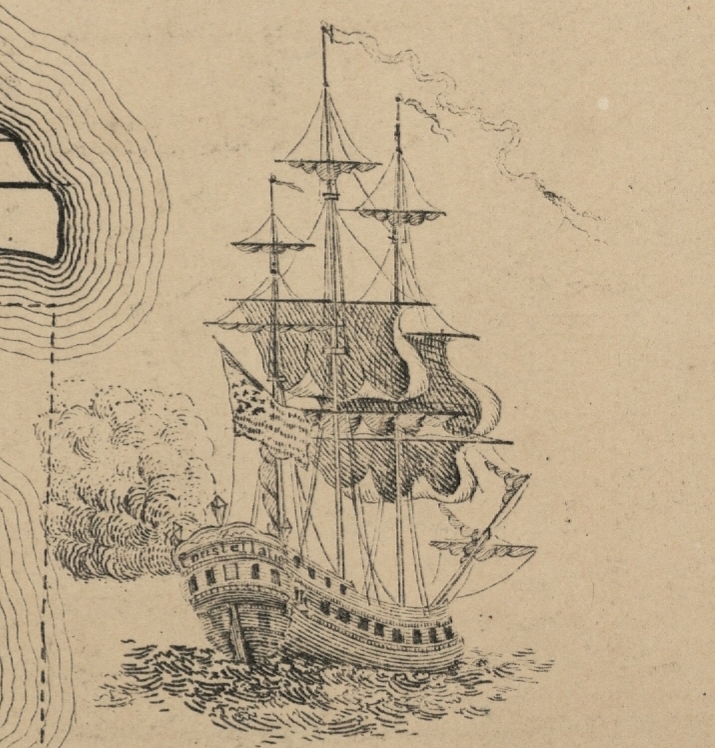
Indeed, as with all of the story of public policy and of history generally, the delight can be found in the archival details that are often overlooked and too often subject to neglect, such as once was the case with Governor Winder's 1814 letter.  For example, reams have been written about the U. S. Constellation and the controversy still rages in some quarters as to whether the current interpretation of that Baltimore City harbor attraction is correct.  In writing the narrative for a new Friends of the Maryland State Archives publication entitled "Views of Baltimore and Beyond" I found that one  of the maps from a private collection that was loaned to illustrate the book, had never been examined closely enough.  It was drawn ca. 1796 by a French expatriate engineer, and is the very first true topographical map of the city, a detail that currently is of great interest to those who are trying to recreate virtually what Baltimore was like during the War of 1812 to parallel their widely acclaimed reconstruction of Washington at the time the British burned the White House and the Capitol.  Imagine the surprise and delight to find that the engraver had added another detail over looked by the Constellation scholars: the very first known image of the U. S. Constellation, apparently firing a salute to the City just off Federal Hill.


Saving the details of the past in a reasonable program of appraisal and retention, providing a safe and secure housing for their care and retrieval, must be the primary publicly funded priority of any Archives.  Just how important those details can be was just recently the subject of another front page article in the Sun entitled "Laying Claim,"  that was published on February 1, 2012.


Because the Maryland State Archives has saved and cared for all of the surviving detailed records relating to the ownership of land in Maryland (the largest single component of our archival holdings), the Boy Scouts of Maryland may well be able to acquire and preserve a hitherto unowned tract of land in the midst of their Harford County campground, assuming they have mastered the details to win their argument before the Commissioner of Land Patents who happens to also be the State Archivist, an additional title that traces its origins back to the very first systematic keeper of the detailed public records of Maryland, the Second Lord Baltimore's chancellor for Maryland, Philip Calvert, his younger brother.

The old saying that "the devil is in the details" means that it is hard work and not without expense to extract answers from the historical record, but if we fail to even save the record, not only will we be without answers, we will lack the wisdom necessary to even ask the right questions.

Our archival heritage is at risk. We need your help both vocally and financially.
If you have found our on line and in person services at http://mdsa.net of use and important to you, you can make a donation in any amount on line to the Friends of the Maryland State Archives: https://shop1.mdsa.net/Donation/donate.cfm
You can also be vocal by writing directly to the governor, the comptroller and to the Maryland legislature,  including the Speaker of the House and the President of the Senate.  You will find their email addresses on our http://mdelect.net web site.

Thursday, January 26, 2012

Candlesticks, Mark Twain and the Public Memory

Our archival heritage is at risk. We need your help both vocally and financially.

If you have found our on line and in person services at http://mdarchives.net of use and important to you, you can make a donation in any amount on line to the Friends of the Maryland State Archives: https://shop1.mdsa.net/Donation/donate.cfm

You can also be vocal by writing directly to the governor, the comptroller and to the Maryland legislature,  including the Speaker of the House and the President of the Senate.  You will find their email addresses on our http://mdelect.net web site.  If you are a Maryland resident, you can also determine who represents you in the legislature by your address.

The principal responsibility and legally mandated mission of the Maryland State Archives is to be the safe, reliable, and accountable repository of the State's public memory, accessible to all at as little cost for access as possible. It should be at the Archives where you can reflect on and build upon the lessons learned about what ought to be government's role in protecting the lives and livelihoods of it citizens, and to sharpen our personal understanding of our origins and obligations, both as citizens and as family members in search of our roots. As President Lincoln wisely pointed out, we need to reach to those the mystic chords of memory that touch the better angels of our nature. Those who remain ignorant of their past, be it personal or public, will wander lost through life, susceptible to the mob rule of others as ignorant and self-destructive as they are to themselves. Yet if we do not now provide the professional care and archival storage for our public memory we will be left with only candlesticks and no candles to light our way.

We can and do find some resources to restore some artifacts, such as this restored Garrett County sponsored candlestick from the State's Artistic property inventory. It, which along with the rest of the silver that the citizens of Maryland including countless school children with their pennies, purchased, was given to the Cruiser Maryland in a gala ceremony at the Annapolis dock in 1906. Money can always be found to polish silver, but apparently not to hold on to the memories of those who lovingly bought it, and gave it for the use of the officers and crew of first the Cruiser and then the Battleship Maryland. My favorite photograph of the U. S. S. Maryland, is of her, injured, but steaming forth out of the chaos of Pearl Harbor on December 7, 1941 to do her duty.

Photo #: 80-G-19949 Pearl Harbor Attack, 7 December 1941
USS Maryland (BB-46) alongside the capsized USS Oklahoma (BB-37).
USS West Virginia (BB-48) is burning in the background.
Official U.S. Navy Photograph, National Archives collection

In many ways as State Archivist, in charge of keeping the public memory, I feel like a member of the crew on that valiant ship on that fateful day, not knowing how we will navigate our way out of the troubles we are in, but certain that we must and we can.

Records and Artifact Storage. While the Maryland State Archives has suitable storage capacity for paper records totaling 168,680 cubic feet, in its custody are 359,633 cubic feet of record material. Of these, some 190,963 cubic feet are stored in spaces ill-suited and even detrimental to their long-term preservation. Indeed, problems relating to records management in general and the Archives in particular have only gotten worse with time. The same is true for our extensive art collection which is ill housed and for which we have limited special fund resources for restoration of only a few of the treasures in our charge.

Since 2005, when the Archives first requested a capital allowance for records storage, the amount of space suitable to house permanent records has remained the same. The Archives’ main facility in Annapolis – the only suitable facility available – was filled to capacity (168,680 cubic feet) in the year 2000. Since that time, the Archives has taken on an additional 190,953 cubic feet of records. Thus, nearly 200,000 cubic feet of records - - well over half of the State’s total permanent holdings - - are housed in rented facilities that are totally unsuitable.

For the long-term preservation of record material and fine art, environmental control is vitally important. The impact of temperature, relative humidity, air quality/pollution, and light has been studied and recognized the world over. The lack of temperature and humidity controls at the adjunct warehouses of the Archives, without question, puts record material at risk. The consequence of inaction is the degradation and ultimate destruction of Maryland records and fine art.

Staffing and Succession Planning. Like many state agencies. The Archives has had difficulty over the years in retaining qualified staff. It has become quite routine for IT staff and junior archivists to get their training at the Archives and then move on to higher paying jobs. We know we will never be able to compete with the salaries of the federal government or that of the private sector, but our problem is seriously exacerbated by the fact that most of our junior professional staff do not have “PIN” positions with benefits. The real dilemma this portends for the future will be compounded by the fact that there are many of our senior staff who are now, or will be soon, eligible for retirement. Without trained, experienced junior staff to replace them, the Archives as an institution is in peril, not unlike the U.S.S. Maryland at Pearl Harbor.

At our last budget hearing, the budget analyst  asked that we address what we can do to rectify the critical storage problems we face right now. I have no easy answer. We have maxed out our ability to raise special funds. So much of what we have been able to earn through our entrepreneurial on line services has already been sucked away to pay for substandard warehouse rent. The short response is that in the short run we must have a direct appropriation for rent of a storage facility that meets minimal archival standards just to accommodate the permanent records that are sitting in expensive agency office space or are being thrust upon us because of the downsizing of government. Where will that come from? It is not allocated in this budget before you and I know of no private angel of mercy who will fund it for us, even though I have indeed tried to find one. The last time I tried unsuccessfully, Bernie Madoff had a great deal to do with why I was turned down. Perhaps by taking but a small amount from every other priority that is funded throughout the budget, a reallocation to us for temporary archival storage can be achieved while we await better times and a capital appropriation?

While we also realize that we must do more with less, we can't do anything if we do not have a core professional staff to manage our collections and to seek out new sources of special fund revenue, while maintaining the flow of what we already have which currently amounts to about 80% of what it cost to maintain our current inadequate level of storage and service.

This is not to say that we have not re-thought our staffing goals and reduced them significantly through the creative use of volunteers and utilization of what is called a 'cloud' approach to storing, indexing and accessing our records. What I mean by a 'cloud' is a techy term related to sharing resources privately and publicly owned. For example, our pioneering efforts to share electronic storage with a consortium of Libraries and State Archives, because of the leadership role we have played in creating a true electronic archives, should result in significant on-going support from the rest of partners for storing their collections in our electronic archives facilities.

Just recently the Library of Congress interviewed me as a digital pioneer, the pod cast of which was to be released on Valentine's Day. While I am flattered, what that means is that Maryland has been recognized by those in the business of preserving and making accessible electronic information as a leader in coming to grips with the storage and retrieval of permanent electronic records. Our on-line access to all the land records ever recorded in Maryland (at least those that survived court house fires) has no peer and is looked upon as a model electronic archival system. I fervently hope that what we have accomplished is not undermined by our inability also to properly care for the permanent paper records and artifacts poorly stored or awaiting transfer.
Despite the worrisome outlook for the proper care and management of our paper and artifact holdings, we do continue to deliver a very high level of service to the public and public agencies. Just a glance at the statistics of service accompanying our budget each year proves that point.

We also have an active Friends group that in small but meaningful ways assists us in salvaging records for public use that would otherwise be lost, and with helping us properly interpret the treasures in our collections. To date they have raised about half the funds necessary to exhibit Washington's draft of his speech that he gave in the Old Senate Chamber on December 23, 1783, establish firmly the principal of the primacy of the Civil Authority in our Republic. I was proud to be able to display that speech to Mrs. Obama and members of the Obama family last summer. Now all we need is to complete the work of the capital appropriation to restore the Chamber that the President of the Senate successfully sponsored last session.


A year ago the Friends of the Maryland State Archives came to the rescue of a fine private collection of records relating the history of Baltimore City, including this rare original Seaman's certificate which documents the beginning of the sailing career of a St. Mary's county mulatto by the name of Allen Thomas. Note the poignancy of what the document makes clear. He was 'free' but definitely not a citizen. That would take a civil war and for successive generations of his brethren, decades of struggle in and out of the courts for civil rights, a public record that we cannot afford to lose, yet is in danger if we don't store it well.


Mark Twain with Governor Warfield at Government House, May 1907

I suspect that by now you may be wondering where Mark Twain fits into all this discussion of preserving the public memory.

A year after the school children of Maryland labored to help pay for the Battleship Maryland Silver Service (which we will soon have on display again in the State House thanks to the generosity of the Senate and private donors) Mark Twain came to Annapolis, straight from his bed where he had been dictating his autobiography to his secretary Miss Lyon (Mrs. Twain was long dead but fondly remembered).
Twain's visit and the humor he dispensed on the occasion was widely reported in the newspapers of the day from Maine to Texas and beyond.

Twain came to raise money for the First Lady's favorite cause, her Presbyterian Church in Annapolis, which needed a new roof. The desire to hear from Twain was so great that his after dinner speech was moved from the Governor's Mansion to the recently dedicated, new House of Delegates Chamber, the one still in use today. He regaled the crowd with story after story. Peals of laughter filled the chamber as he told of the day he drowned, the watermelon he stole, and the tale of the drunken sailor who at the end of the story was heard through the darkness explaining to his wife “with a fervent, appropriate, and pious ejaculation. “God help the poor sailors out at sea.”.”

As was nearly always with Mark Twain, under the humor lay a serious message. It was a message of the importance of memory; remembering the good and evil that has befallen us, with humor yes, but as lessons not to be forgotten.

Take his memory of his life near Hannibal Missouri on the farm of his Uncle, John Quarles. And what he learned about slavery.

There was … one small incident of my boyhood days which touched this matter [of slavery] and it must have meant a good deal to me or it would not have stayed in my memory, clear and sharp, vivid and shadowless, all these slow-drifting years. We had a little slave boy whom we had haired from some one there in Hannibal. He was from the Eastern Shore of Maryland, and had been brought away from his family and his friends, half way across the American continent, and sold. He was a cheery spirit, innocent and gentle, and the noisiest creature that ever was, perhaps. All day long he was singing, whistling, yelling, whooping laughing –it was maddening, devastating, unendurable. At last one day, I lost my temper, and went raging to my mother, and said Sandy had been singing for an hour without a single break, and I couldn't stand it, and wouldn't she please shut him up. The tears came into her eyes, and her lip trembled, and she said something like this--
Poor thing, when he sings, it shows that he is not remembering, and that comforts me; but when he is still, I am afraid he is thinking, and I cannot bear it. He will never see his mother again; if he can sing, I must not hinder it, but be thankful for it. If you were older, you would understand me; then that friendless child's noise would make you glad.”
It was a simple speech, and made up of small words, but it went home, and Sandy's noise was not a trouble to me any more.

One bit of good news that I am pleased to share  is that because of our efforts to document the history of slavery in Maryland, The U. S. Department of Education has awarded us us a grant of $739,000 over three years to continue our research on the this history slavery on Maryland's Eastern Shore. That in essence means that we can continue to have a nationally recognized research program without any significant drain on the general fund. (See: The Capitol, for 2/3/2010, http://www.hometownannapolis.com/news/top/2011/02/03-26/State-archivists-uncover-stories-of-slavery.html).

Paul W. Gillespe — The Capital: Chris Haley, director of the Study of the Legacy of Slavery in Maryland at the Maryland State Archives, and research archivist Maya Davis look over 150-year-old copies of the Baltimore American and Commercial Advertiser, where the news item about Harriet Tubman was discovered.


As to Mark Twain, he left Annapolis earlier than planned for his bed at home in New York, and further dictation to Miss Lyon of his autobiography, the complete edition of which he insisted could only be published 100 years after his death, largely because of the truthful things he said about a lot of people. So far only the first volume has been published, making it in 735 pages to dictation in 1906. I can hardly wait to read what he had to say about his Annapolis sojourn and Mrs. Warfield's benefit in 1907, but at least the prospects of doing so are near at hand. He saw to the recording and preservation of his memories. We must do the same with our public memory. We must find the resources to preserve, protect, and to access those memories to maintain our sense of mission, accomplishment, and humor in public affairs. I can but give what I believe is good advice and advocate for what I believe ought to be done as the Custodian of the State's public memory. I and the staff can only be as successful if the literally hundreds of thousands of people who use our on-line resources take to the virtual streets through tweets, blogs, and email to convince our executive and legislative leaders that it is imperative that they help us find the resources to meet the archival challenge of preserving and making freely accessible the collective memory of  the past.

A generation which ignores history has no past and no future.
Robert Heinlein, The Notebooks of Lazurus Long
US science fiction author (1907 - 1988)

"The mystic chords of memory, stretching from every battlefield and patriot grave to every living heart and hearthstone all over this broad land, will yet swell the chorus of the Union, when again touched, as surely they will be, by the better angels of our nature." Abraham Lincoln, First Inaugural Address.